Starry-eyed, creative and heading back to Mars
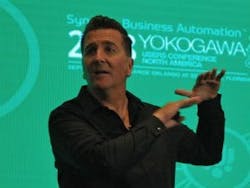
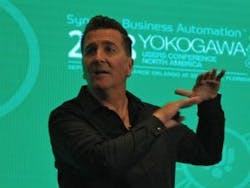
“Great works and great folly may be indistinguishable at the outset.” NASA Chief Engineer Adam Steltzner explained how an open, vulnerable mindset can promote creative breakthroughs in any field.
Dr. Adam Steltzner’s bio is a hoot—explorer of the solar system, it reads, student of human nature, engineer, writer, speaker and general loose cannon. With his cuffed jeans, black leather boots, sideburns and earrings, he certainly looks different than the other presenters at this Yokogawa Users Conference. More Stray Cats than straight-laced.
But once the NASA chief engineer began detailing how he led the team that landed the Curiosity rover on Mars back in 2012, it was clear this featured presentation was going to be, well, stellar.
And as lofty as Steltzner’s workplace may be, the lessons he has learned at NASA were applicable to everyone in the audience, no matter how grounded their focus.
There is a mantra the Bay Area native uses to guide his creative process: Great works and great folly may be indistinguishable at the outset. “This is simultaneously true and meaningless,” he admitted, before explaining how this mindset frees ideas, spurs creative problem-solving, and reduces the capability for negative judgment to stymie breakthroughs. It’s not a bad idea until it is proven to be.
There was plenty of realism amid the star-gazing here. Steltzner warned about over-reliance on models and simulation, as they are susceptible to the sin of omission—if you forget to include a rule of physics in the model, your simulation might work perfectly and be perfectly worthless.
He detailed the creation of a risk list to rank worrisome project elements in figuring out how to gingerly land the heavy, expensive rover. Few in the audience, I suspect, are immune to sleepless nights worrying about problems in their plants, just as Steltzner did in the months prior to landing day. “Some people count sheep,” he quipped. “I counted the ways to die on Mars.”
Solve problems collaboratively
But the eerily beautiful photos we have all seen are a testament to the success of this mission to Mars. And the lessons learned in that process, the keynoter stressed, are applicable to the varied fields of those in attendance:
-
“Hold on to the doubt” as long as you can, Steltzner asserted, as doubt enables curiosity-based (rather than fear-based) decision making.
-
Develop a workplace culture of collaboration—teams are necessary to fully realize individuals’ visions.
-
Shed the selfishness about reaching business outcomes. “It’s not about being right. It’s about finding right.”
-
While the exercise of planning has tremendous value, mindlessly clinging to “the plan” results in inflexibility and failure. The plan is merely an artifact of a fruitful planning process.
-
Failures are a normal part of success. There is great value in analyzing failures.
One of the trickiest parts of the Curiosity mission—a step most inclined to fail—was the final stage of slowing the craft to a speed (0 mph, ideally) at which the rover would not explode upon landing, which according to this hipster scientist would be “super uncool.”
The team working out of NASA’s Jet Propulsion Laboratory brainstormed many options before deciding upon one of the most unusual—a “Sky Crane” to lower the cumbersome craft onto the rocky surface. This solution was a product of the egalitarian, creative, vulnerability-encouraging workplace the team had established. “You cannot rank ideas based on which mouth they came out of,” advised Steltzner. “We had gray-haired generals in the room and people still wet behind the ears. If an idea is good, we will go with it. This allows you to evaluate ideas completely unfettered.”
The landing was a success, and since then the Curiosity rover has delivered a tremendous amount of information about the Red Planet. And, with that triumph behind him, Steltzner has moved onto NASA’s Mars 2020 Project, with the goal of delivering samples from Mars back to our planet. This mind-bogglingly complicated initiative entails many of the earthly endeavors managed by those in this conference room—data mining, predictive analytics, supply chain logistics, machine-maintenance, simulation, fuel-consumption, big data and more.
So it resonated when the guy with the sideburns and earrings and black leather boots—this explorer of the solar system/engineer/speaker/loose cannon—asked the rapt audience “Where will your curiosity take you?”
About the Author
Chris McNamara
Chris McNamara
 Leaders Logo
Leaders relevant to this article: