What next? The evolution continues



Under the day’s theme of “What Next: The Right Technology Today,” Kapur, together with Bruce Calder, vice president and chief technology officer, explained to the more than 1,200 HUG attendees from 31 countries in attendance how Honeywell is harnessing the latest waves of technology innovation on behalf of its customer base while continuing to preserve a path forward for users of even decades-old process automation equipment and systems.
Indeed, the continued migration of production assets from older process automation platforms placed high on the list of most pressing concerns highlighted in a video montage of user group leaders. Other top concerns include securing production assets from cyber threats, lowering the cost of ownership for automation, capturing and transferring the knowledge of an aging workforce to a new generation, and implementing advanced solutions such as data mining and analytics to deliver a “next level” of business value.
Evolution not revolution
Honeywell is working to address these new and old concerns alike through the application of IIoT communication and computing technologies to drive real value in in areas that matter most to users, Kapur said. “We’re making the business case for efficiency, reliability and safety gains. It’s an evolution not a revolution – yet will impact everything we do,” Kapur said.
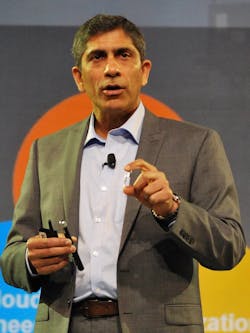
“For Honeywell, the IIoT is simply a means of unlocking value that could not be unleashed before.” Honeywell’s Vimal Kapur on the company’s measured leverage of new technology to deliver new business value to its customers.
Already, the company’s Lean Execution of Automation Projects (LEAP) methodology has been used in hundreds of projects, accelerating time to market and reducing project risk through cloud engineering, virtualization and Universal Process I/O. The company has moved aggressively in outcome-based services, signing on 25 new subscribers to its Assurance 360 programs in 2015. With these new services, where Honeywell takes on responsibility ranging from advisory to turnkey for the performance of its clients’ automation assets, “we’re seeing real results in terms of incident avoidance and time to resolution,” Kapur said.Other Honeywell innovation frontiers cited by Kapur include lifecycle extension solutions such as the Experion LCN, an “on-process” migration path for older Honeywell systems that preserves existing intellectual property while bringing operations forward to take full advantage of the company’s latest system capabilities – all while minimizing downtime or disruptions. Further, Honeywell’s leadership role in the ASM Consortium to drive industrywide safety improvements is also an indicator of the company’s willingness and commitment to work with other suppliers in the automation space. “The IIoT will require this level of collaboration,” Kapur said.
What next?
New examples of Honeywell’s evolving IIoT capabilities first demonstrated at this year’s HUG include automatic field device commissioning, an extension of the company’s LEAP methodology that further streamlines instrument commissioning tasks. Electrical controls integration and a new ControlEdge programmable logic controller (PLC) that can be seamlessly cloud-engineered in context of larger LEAP projects also were introduced.
See related article: LEAP philosophy leading to Industrial Cyber Evolution
Honeywell also is showcasing a comprehensive suite of capabilities to provide secure connectivity to an array of equipment from multiple suppliers, including Cloud Link 4G modems, RTU2020 remote process controllers and Matrikon OPC UA integration and interoperability software. Further, its Pulse mobility application “leverages plant data to drive secure collaboration,” Kapur said.
A further centerpiece of the IIoT by Honeywell vision is the movement of applications for the supervisory control of distributed assets to the cloud. “Cloud operation of distributed assets such as pipelines, terminals and remote wellheads makes perfect sense. It allows users to control costs, upgrade seamlessly, expand rapidly and streamline operations,” CTO Bruce Calder said. “It’s just software-as-a-service – we’re used to it with our PCs, but not yet for process control.”
Other technologies in the “What’s Next” column at HUG 2016 are controllers with embedded multi-variable predictive control (MPC) capabilities; a new Ethernet Interface Module (EIM) that includes multiple protocol support and a built-in firewall; the addition of multi-protocol (WirelessHART and ISA 100) capabilities to the Honeywell One Wireless platform; and premium virtualization with fault tolerance for highest achievable availability.
“IIoT by Honeywell enables digital transformation,” said Calder. “It’s the right technology now and for the future.”
About the Author
 Keith Larson
Keith Larson
Group Publisher
Keith Larson is group publisher responsible for Endeavor Business Media's Industrial Processing group, including Automation World, Chemical Processing, Control, Control Design, Food Processing, Pharma Manufacturing, Plastics Machinery & Manufacturing, Processing and The Journal.
 Leaders Logo
Leaders relevant to this article: