Avoid irrecoverable failure with industrial orchestration
Key Highlights
- An orchestration layer added to artificial intelligence ensures that technology serves people, instead of the reverse.
- A rigorous system of checks and balances methodically bridges the gap between plant floors and software.
- Models that generate their own code and operational logic can sever the link between cause and effect, leaving a lack the understanding to get operations back on track.

The industrial market is facing a bold and evolving operating model for manufacturing and process businesses, driven by rapidly expanding artificial intelligence (AI) context and generative capabilities. These advances promise massive productivity surges and vast cost savings, empowering employees to spin up new software tools at lightning speed.
At first glance, this appears incredibly advantageous to expanding an enterprise. However, it’s simultaneously creates a risky blind spot in modern boardrooms. As leadership teams fixate on efficiency, scale and cost reduction, they’re unwittingly constructing organizations that are inherently brittle.
If this type of highly optimized system fails, it’s not a gradual breakdown, but a sudden and total collapse. When critical processes live inside AI-generated tooling that no single person designed and no team fully understands, it creates the conditions for nonlinear and irrecoverable failure. As a result, the defining metric for the next decade of manufacturing isn’t productivity, but organizational recovery time.
To survive this paradigm, industrial leaders must reject the prevailing, black box approach to AI, and instead implement an orchestration layer, which is a rigorous system of checks and balances that methodically bridges the gap between people on the plant floor and the software they use.
The brittleness of the black box
The core danger of the black box paradigm is opacity. In a rush to reduce costs, it can be tempting to unleash unmanaged AI tools. However, this can quickly create scenarios where software evolves more quickly than governance can track, generating potential for erroneous information and misguided operations.
Simultaneously, industry continues to face challenges retaining talent, which threaten losses of deep, intuitive understanding of how processes and plants run. AI promises to relieve this scarcity, but replacing personnel with models that generate their own code and operational logic can sever the link between cause and effect. When disruption strikes—such as a cyber event, a hallucinating model, or a physical anomaly—leaders can discover they lack the understanding to get operations back on track. To avoid this pitfall, organizations must orchestrate AI, rather than use it to replace control directly.
AI orchestration
To address these and other issues, companies must deploy AI orchestration, a deterministic framework that manages stochastic AI models. An orchestration layer serves as a secure intermediary that sits between AI models and the real-time needs of industrial control systems (ICS) to prevent haphazard connections that may lead to systemic failure by enforcing a unified architecture of safety and policy (Figure 1).
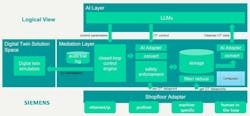
It directly addresses pitfalls of the AI-driven future by:
- Enforcing policy to prevent nonlinear failure. When AI tools optimize without oversight, they can push machinery beyond safe limits to achieve productivity gains. Orchestration enforces inviolable rules and constraints that can override AI recommendations in the event of overreach. This helps ensure that, no matter how efficient an AI tool becomes, physical operations remain within the bounds of physics and safety, turning potential systemwide failure modes into managed constraints.
- Maintaining global state awareness. The opacity problem arises when AI creates silos of operation. Orchestration counters this by maintaining a real-time view of the entire operation’s state—knowing what sensors are reading, which machines are running, and the status of production orders. It acts as a conductor, so when AI predicts a quality issue, the system can gracefully adjust downstream operations in synchronization. This creates consistency and prevents chaotic, cascading failures that characterize brittle systems.
- Institutionalizing knowledge via lifecycle management. To counter loss of institutional knowledge, an orchestration layer provides an enduring knowledge base for manufacturing, and oversees the lifecycle of every digital component. It facilitates the methodical rollout of AI models and control logic updates by validating results against expectations.
Get your subscription to Control's tri-weekly newsletter.
An orchestrator logs every decision and action into a human-AI system, creating a digital audit trail that replaces tribal knowledge. So, when production issues arise, engineers can replay the sequence of inputs and outputs to understand why. This transparency differentiates systems that can be repaired from those where recovery from failure is nearly impossible.
Vision and the human element
AI orchestration isn’t constrained exclusively to a software component because it also represents a shift in deployment mindset. To build resilience and avoid pilot purgatory, organizations should establish a vision to solve data contextualization issues, while keeping humans in the loop.
The companies that succeed start with the end in mind, so foundational steps support long term vision and goals. Also, organizations must standardize their data models before unleashing operational AI. This entails semantic contextualization—giving data meaning, so AI and humans understand what specific information means. Without this initial step, AI tends to hallucinate, while operators are led astray.
And, humans must always be the central component of every technological solution implemented to solve specific operational challenges. An orchestration layer integrates with supervisory control systems to provide context for operators in addition to alerts. In the same vein, if AI triggers an action, it must communicate its reasoning, and always offer users human-based override options.
Industrial AI must not take over the role of operators because, given enough time, failures will inevitably occur that require human intervention. It’s, therefore, imperative that operators remain active in workflows, not relegated to being passive observers.
Efficiency and recovery
In the wake of the AI revolution, the defining characteristic of industrial success isn’t how fast a company produces, but how quickly it can recover when the black box breaks.
The efficiency upside of AI can’t be overstated. However, we must stop deploying it as a series of disconnected, opaque scripts and software subsystems. Instead, these probabilistic models must be integrated with the guidance of a deterministic orchestration layer to ensure safety, enforce policy, and uphold operational stability.
About the Author
 Caleb Eastman
Caleb Eastman
Siemens Digital Industries
Caleb Eastman is the field chief technology officer (CTO) for the Americas at Siemens Digital Industries, where he works closely with manufacturers across the country to help translate emerging technologies into practical, scalable industrial solutions.
 Leaders Logo
Leaders relevant to this article: