Agentic environment uses AI to accelerate decision-making
Key Highlights
- Emerson integrates virtualization into DeltaV to simulate workstations, standardize models and support edge computing with containerized applications.
- AI-driven tools like DeltaV Virtual Advisor and AspenTech ASI provide real-time insights and decision support tailored to industrial environments.

Because virtualization and AI are such broad technological areas, developers and potential users view them in light of how they can aid existing processes and solutions. For instance, Emerson has been integrating virtualization into its DeltaV distributed control system (DCS), and employs it to simulate workstations for operator training, and standardize models for optimizing mainstream operations. In fact, fully 50% of its DeltaV software and other solutions have virtualized and AI-enabled capabilities, and now it’s emerging as part of Emerson‘s software-defined edge computing. For example, DeltaV Edge Environment hosts containerized and virtual machine (VM) applications to provide better operations technology (OT) data to enterprise users.
“The next level of edge computing will be software-defined control, abstracting from built-for-purpose hardware to server-based environments,” says Sean Saul, VP of the DeltaV platform at Emerson. “These new edge areas will use technologies like Type 1 hypervisors to perform deterministic behaviors based on real-time data. With more powerful edge computing aligned with real-time data, users can apply large language models (LLM) to streamline analysis and advanced control. We think this is really about using generative AI (gen AI) and orchestration agents with established HMI displays and control software.”
Consequently, Emerson is segmenting AI in two primary ways:
- Employing AI for machine learning (ML), basic control processes, neural networks and advanced process control (APC), such as Emerson’s AspenTech DMC3 software for building and deploying APCs.
- Using gen AI with model context protocol (MCP) to interface with LLMs, and give context and statefulness to production data. It’s also developing AI agents that can interpret natural language, and perform different tasks, such as sending, retrieving and validating data.
Get your subscription to Control's tri-weekly newsletter.
“We’re also integrating AI tools into our DeltaV Virtual Advisor software that’s embedded in the DeltaV Live platform. This lets users assess process conditions and documentation, instruct operators how to react, troubleshoot updates, identify root causes, and quiz users about procedures or next-best actions,” explains Saul. “Our approach to AI includes natural language, responses and receptivity, which are similar to consumer experiences with it. We’re just three years into working with this AI-model architecture, but it’s already matured enough to fit into mission-critical applications.”
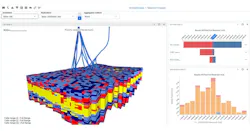
Guardian Virtual Advisor’s AI-fueled software supports end-to-end lifecycle management by allowing natural-language questions to access the deep domain expertise of Emerson’s Guardian Digital Platform. It mines more than 20 years of content to help users quickly evaluate and enhance automation system performance. Likewise, Emerson’s AspenTech Subsurface Intelligence (ASI) open, cloud-native, agentic environment uses AI to transform user experiences by accelerating subsurface-related decision making, while leveraging existing investments in legacy applications (Figure 1). ASI’s AI-powered guidance and library of domain-specific agents operate with the Open Group’s Open Subsurface Data Universe (OSDU) data platform to automate workflows and develop insights that improve the speed from data to results and decisions. ASI agents are deployed as cloud-based applications with an intuitive user interface or with AI-driven guidance from Emerson’s Aspen Virtual Advisor.
“The most important task is tailoring AI to the plant floor. While mainstream consumers can use AI to get approximate answers, we need it to give industrial-grade answers without approximations or fabrications, and we think we’re succeeding,” concludes Saul. “We believe some on-premises AI architectures are mature enough to serve in the process control space. By using specialized knowledgebases like DeltaV runtime data and customer-specific procedures, they can give users gen AI tools for operations, and configure control strategies in context within proven applications.”
This is part four of Control's April 2026 agentic AI feature story. Read the other installments here.
About the Author
 Jim Montague
 Leaders Logo
Leaders relevant to this article: