Do-it-yourself schooling teaches specialized skills
Key Highlights
- Process control professionals require skills beyond traditional engineering curricula, necessitating specialized training programs.
- EA University offers a five-week immersive experience with mock projects, real equipment and client interactions to develop practical control system skills.
- Training covers PLC programming, SCADA software, project management and soft skills like client communication and teamwork.
Because process control professionals need to learn so many skills that aren’t taught in colleges and universities, many employers must develop training programs to train new personnel in activities they’ll be required to practice in the field.
For instance, when Joseph Pallan graduated from U.C. San Diego in 2024 with a B.S. in mechanical engineering and a specialization in controls and robotics, he’d already developed a technical foundation through coursework in linear control, embedded control and robotics, and machine learning (ML). However, a presentation at the university’s career center by system integrator Enterprise Automation changed his career trajectory.
“Just the word ‘controls’ caught my attention,” says Pallan. “I’d spent years learning theory in class, but I wanted to see how those ideas were used in the real world.”
What he found at EA went beyond the classroom. The presentation introduced him to industrial automation as a practical field built around systems, panels, PLCs, SCADA systems, and other technologies that support industrial processes and critical infrastructure. That first encounter was his introduction to EA, which is headquartered in Irvine, Calif., and is a certified member of the Control System Integrators Association (CSIA).
“I really enjoyed learning controls in my classes. I especially loved the experimental techniques we used, such as measuring system responses, developing algorithms for signal processing, or even just visualizing poles and zeros in a Bode plot,” explains Pallan. “Despite never bringing up the theory I learned in class, I was immediately interested in EA's presentation because they mentioned many practical uses of control systems that I hadn't heard of or thought about before.”
One of those examples was the control panels used throughout industrial facilities and infrastructures. “This included the unassuming gray panels spread across neighborhoods and facilities that contained the process controls used to automate all kinds of processes,” adds Pallan. “After years of working through theoretical problems in class, it was exciting to see how those concepts were applied in practice.”
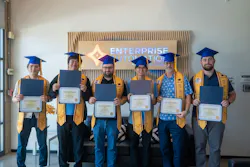
For Pallan, this appeal went beyond simply finding a job where he could use his degree. What he saw in EA reflected a side of engineering he hadn’t encountered in school—the practical challenges involved in taking engineering concepts and turning them into systems that must operate reliably in the real world. Soon after joining the company, Pallan entered EA University (EAU), which is a five-week, in-house training program designed to give new engineers a hands-on foundation in industrial automation.
“EAU was a crash course in the industry,” says Pallan. “It took everything I learned in school, and showed me how it applies in practice. It included everything from control strategy workshops and PLC programming to HMI screens, working with a difficult client, what happens when the project schedule changes, how do we deal with scope creep, and having difficult conversations.”
![Figure 1: Using appropriate safety gear, participants in Enterprise Automation’s homegrown EA University practice conducting a mock site investigation. They include (l. to r.) Joseph Pallan, controls engineer II, Cain Chen, controls engineer I, Atticus Binder, controls engineer I, and Alec Zerza, [ex]-controls engineer I.](https://img.controlglobal.com/files/base/ebm/controlglobal/image/2026/08/6a8db55ab05c84124b11aa37-eau_program__mocksite_investigation.png?auto=format,compress&fit=max&q=45)
This initial training became the foundation for the work Pallan does today. Since joining Enterprise Automation, he’s worked on projects across industrial automation industries, with a growing focus on water and wastewater infrastructures. His work has included supporting a SCADA roadmap effort at Jurupa Community Services District in Riverside, Calif., as well as reporting integration work at WaterOne in Lenexa, Kan. These projects gave Pallan the opportunity to work with many of the technologies he first encountered in school, while also dealing with the practical requirements that come with real automation projects, including controls programming, SCADA development, industrial networking, documentation, testing, commissioning, and working with operators, clients and other engineering disciplines.
“It's interesting because you realize pretty quickly that programming is only one part of the job,” explains Pallan. “You have to understand the process, how the operator will use the system, how the different pieces of the control system communicate with each other, and what happens when you put everything together onsite.”
This experience has also highlighted for Pallan the importance of developing engineers, who can bridge the gap between engineering education and the practical requirements of industrial automation. “There's a lot you can learn in school, but there are also things that are difficult to teach without actually working on a project,” adds Pallan. “You can learn control theory and PLC programming, but you also need to understand how those systems are designed, tested, commissioned, documented, and eventually operated by someone else.”
This combination is particularly relevant to Pallan's work in water and wastewater, where automation and control systems monitor and operate processes that communities rely on. What began as curiosity after seeing the word “controls” in a university’s career-center email evolved into a career applying controls and automation engineering to real-world infrastructures. Pallan’s path from U.C. San Diego to Enterprise Automation progressed from learning controls in the abstract to applying those concepts in the field, while continuing to develop the practical skills needed to contribute to the next generation of industrial automation and infrastructure.
This is the seventh installment of Control's August workforce cover story. Read the other installments here.
About the Author


Leaders relevant to this article: