Key Highlights
- The automation industry is shifting towards AI, digital twins and integrated software solutions to enhance operational efficiency and resilience.
- Geopolitical tensions, tariffs and supply chain issues continue to challenge growth but also drive reshoring and strategic investments in domestic manufacturing.
- Major acquisitions by ABB, Emerson, Honeywell and Siemens highlight a focus on expanding software, AI and energy management capabilities.

The automation marketplace is undergoing the most significant shift in our lifetimes. Last year, when we wrote this article, we forecasted challenging times for the industry. Still, automation suppliers have proven their resilience by adopting new technologies and new ways of doing business. This led to continued market growth in 2025, and we expect momentum to increase throughout 2026 and beyond as companies adapt to challenging, new economic and technology trends.
Significant headwinds persist. Geopolitical events such as the war in Iran and U.S. tariff policies continue to confound manufacturers, and make it harder for U.S. companies to compete effectively. Supply chains have become much more difficult to manage. Many end users continue to conserve cash as a hedge against these market uncertainties. The U.S. automation market thrives under true free-market conditions, but current U.S. economic policy has moved away from the “invisible hand” of the free market toward policies tied to political and ideological goals.
Despite these headwinds, the North American market continued to grow in 2025, albeit in the low single digits, which we originally predicted in last year’s article. The saving grace of today’s automation marketplace is the ability of suppliers to rapidly adopt new technologies like artificial intelligence (AI), and focus on new and emerging markets such as electrification, power infrastructure, and data centers. Globally, process industries clearly outperformed discrete industries in 2025. Discrete industries continued to suffer from destocking, backlog normalization and relatively weak investment.
Lagging U.S. economic performance hinders growth
The underperforming U.S. economy is limiting the breadth of the automation market recovery, and will continue to do so for the foreseeable future. Though investment in data centers, electric power infrastructure, defense, utilities and selected process industries remain strong, slower growth in manufacturing output, equipment spending, hiring and consumer demand is causing many industrial companies to delay or reduce the scope of capital projects.
This creates a bifurcated market in which large strategic programs continue to drive demand for controls, instrumentation, electrical equipment, software and services. Smaller modernization projects and capacity expansions are also facing greater scrutiny. The current environment favors automation suppliers with exposure to infrastructure and more resilient end markets. Still, it constrains order growth among vendors more dependent on machinery, automotive, consumer products and other cyclical discrete industries.
Tariffs continue to pose problems and risks
Ongoing U.S. tariffs add another layer of pressure by increasing the cost of imported metals, electronic components, drives, motors, sensors, control hardware and production equipment used by U.S. manufacturers and automation suppliers. The theory behind tariffs is that they can encourage reshoring investments over time, but their near-term effects remain largely negative, and we have yet to see substantial growth in reshoring initiatives. The strongest reshoring activity has occurred in semiconductors, batteries, data-center infrastructure, electrification equipment and selected, advanced-manufacturing segments. By contrast, more traditional manufacturing sectors continue to face cost, labor and supply-chain challenges.
Higher input costs compress margins, increase project budgets, complicate sourcing decisions, and contribute to inflation, which can keep financing costs elevated. Frequent policy changes also reduce planning visibility and encourage companies to postpone hiring and investment until trade rules become clearer. For the automation market, this uncertainty can lengthen sales cycles, and shift spending away from productivity and digital-transformation initiatives toward compliance, redesign and supply-chain mitigation, thereby reducing overall market growth even as a limited number of domestic-capacity projects move forward.
AI in manufacturing’s breakout year
AI remains the top technology impacting the process and discrete automation markets in North America. According to ARC Advisory Group’s research, industrial organizations have moved beyond asking whether AI has value, and are now focusing on deploying it at scale across operations, engineering, maintenance, supply chains and other asset-intensive environments.
AI is increasingly used to augment workers, automate routine decision-making, unlock insights from previously inaccessible data, and improve operational performance across all industries. We’re inching closer to a world where AI provides a foundation for autonomous operations. However, the human-in-the-loop is still an essential part of the equation for the volatile process industries, where safety and reliability are paramount concerns. Because this isn’t the case for less critical applications, however, we’re already seeing autonomous, AI-powered control in applications such as building automation.
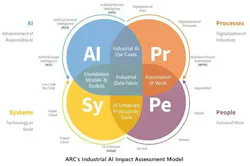
Rather than replacing industrial workers, AI increasingly assists operators, engineers, maintenance personnel, planners and managers. ARC's “Industrial AI Impact Assessment” framework emphasizes that AI's greatest value lies in augmenting human capabilities, closing skills gaps, and enabling faster, more informed decisions. Given the continued shortage of talent in automation and manufacturing, we see that AI isn’t replacing workers, but rather augmenting their skills. Organizations increasingly recognize that people augmented with AI will replace people without AI skillsets, so it’s important to get workers trained in how to use and obtain value from AI in their day-to-day operations (Figure 1).
If you’re an end user, you’ve probably seen some form of AI functionality embedded in just about every software application offered by suppliers today. From the HMI software in your refinery’s control room to AI-enabled industrial cybersecurity solutions that can identify anomalies well before any human can, end users are still figuring out how to use these advanced AI-driven features, and more importantly, how to secure these AI-enabled applications in their own enterprises.
AI push intensifies supplier M&As
Industrial AI adoption is accelerating M&A activity in the automation sector. Not surprisingly, most of these acquisitions revolve around software. We're also seeing activity in more targeted sectors, such as emissions monitoring, sensors, field devices and valves. Aside from software-driven investments in AI, we’re also seeing increased investment in new markets, such as engineering software and digital twins, robots (humanoid and otherwise), as well as investments to bolster supplier positioning in energy and power applications.
Across both process and discrete automation markets, suppliers are repositioning themselves around software, AI, digital twins, industrial data platforms, simulation, lifecycle management and enterprise operations capabilities. ARC’s research indicates suppliers are increasingly shifting from hardware-centric portfolios to integrated offerings that combine controls, software, analytics, AI and lifecycle services. However, this doesn’t mean that investment in hardware has ceased. Several suppliers have made targeted hardware acquisitions to round out their portfolios.
ABB acquires Sensorfact and Rotork
For example, ABB continued using acquisitions in 2025 to deepen its software, energy-management and electrification capabilities. It acquired Sensorfact in January 2025, adding energy-management software, industrial digitalization tools and sustainability applications to improve its operational efficiency and energy optimization. This move reflects ABB’s broader effort to expand recurring, software-enabled offerings around industrial energy performance.
Alternatively, ABB’s proposed acquisition of Rotork, announced in July 2026, represents a more direct expansion of its process automation portfolio. Rotork’s valve actuators and flow-control technologies would strengthen ABB’s position in intelligent actuation, and extend its reach among process-industry applications.
Emerson completes AspenTech purchase
Emerson completed its acquisition of Aspen Technology in May 2025. This is significant for the process and other industries because it moves Emerson from primarily being a process automation supplier to becoming a comprehensive, industrial software and AI-platform provider.
This shift is outlined in Emerson’s new Project Beyond initiative, which it describes as an enterprise-operations platform for connecting previously fragmented operational systems. By integrating data from automation systems, software applications, engineering environments and operational assets, Emerson aims to create a unified information environment that supports advanced analytics and industrial AI applications.
Honeywell refocuses on core automation
Honeywell’s reorganization this year is one of the most important corporate restructurings in the industrial automation sector in recent years. It moved away from its traditional, diversified conglomerate structure, and reorganized into separate, more-focused businesses centered on automation, aerospace and advanced materials. The company’s goals are simplifying operations, sharpening strategic focus, and letting each business make decisions based on its own market dynamics, rather than competing internally for capital allocation and management attention.
This metamorphosis has created three separate companies. Honeywell Technologies serves as a pure-play automation business, along with the overall corporation’s aerospace and materials companies. Honeywell Technologies further simplifies its automation portfolio into building automation, process automation and technology, and industrial automation, and concentrates investment around industrial AI and autonomy. This positions Honeywell to compete more directly with the other suppliers racing to deliver AI-enabled operations.
Mitsubishi Electric acquires Nozomi
Mitsubishi Electric Corp. acquired the rest of Nozomi Networks on Jan. 28. This turned the cybersecurity supplier a wholly owned subsidiary, while allowing it to continue operating under its existing brand, leadership team, product roadmap and partner ecosystem.
Hexagon spins off Octave software business
Octave Intelligence plc emerged earlier this year as an independent, industrial software company when Hexagon AB separated from most of its software businesses. Octave is a pure-play, software and software and a service (SaaS) provider with a portfolio spanning engineering information management, asset lifecycle intelligence, enterprise asset management, alarm management, operations technology (OT) cybersecurity, physical security, geospatial intelligence, quality management and project execution software.
Rockwell and Augury partner on AI solutions
Rockwell Automation partnered in 2025 with Augury, an industrial AI company that helps manufacturers improve equipment reliability, production performance and operational efficiency. It initially built its reputation in predictive maintenance and machine health monitoring, but expanded into a broader "production health" strategy that combines machine reliability with process optimization. Augury’s platform uses machine data, AI models, and edge-to-cloud connectivity to help manufacturers shift from reactive maintenance to proactive, increasingly autonomous operations.
Schneider adding Cognite for software and data functions
Schneider Electric expects acquire Cognite, which supplies cloud-native, industrial data and AI platforms. The acquisition will strengthen Schneider's capabilities in industrial data fabrics, information modeling, enterprise intelligence, and industrial AI.
Get your subscription to Control's tri-weekly newsletter.
Siemens buys Altair and Dotmatics for engineering and AI
From a discrete automation perspective, Siemens’ purchase of Altair for approximately $10 billion was one of the largest software acquisitions of in 2024. It expanded Siemens’ capabilities in engineering simulation, digital twins and computing.
Siemens also bought Dotmatics in 2025 for approximately $5.1 billion in 2025 to strengthen its AI-driven software portfolio, and extend the life sciences capabilities of Siemens’ Xcelerator program. Siemens positioned the acquisition as an expansion of its AI-enabled digital twin and lifecycle management capabilities.
Yokogawa shops for software suppliers
Yokogawa’s acquisition of Web Synergies (S) Pte., Ltd. in April 2025 strengthened its enterprise digital transformation and systems integration capabilities. Web Synergies brought expertise in application development, digital business services and enterprise integration, supporting Yokogawa’s ability to deliver broader programs spanning operational technology and information technology. The acquisition reflects the company’s continuing evolution from a traditional process automation supplier into a services-led provider of integrated, industrial digital solutions.
Yokogawa further expanded its digital portfolio with its October 2025 acquisition of Intellisync S.r.l. This transaction added industrial software, data integration and operational intelligence capabilities, which complement Yokogawa’s established process automation business. Intellisync also supports the company’s transition toward data-centric industrial solutions that connect plant operations with higher-level analytics and decision support.
Electrical and power investments drive growth
Rapid expansion of electrification and power infrastructures have become one of the most important growth drivers for the North American automation market. ARC's market updates consistently identified electrification, electric power, utilities, transmission and distribution upgrades, and grid modernization as leading contributors to automation demand throughout 2024 and 2025.
While many discrete manufacturing sectors grew more slowly during this period, investments in power generation, utility modernization, renewable energy integration and electrical infrastructure projects helped sustain automation demand across North America. A primary catalyst behind this investment cycle is unprecedented demand for electrical power driven by AI, cloud computing, data centers, transportation electrification and decarbonization initiatives.
In addition, utilities and other power providers are investing heavily in substations, high-voltage transmission networks, distribution automation, battery energy storage systems, microgrids and grid resilience projects. These facilities require OT infrastructures, including SCADA systems, distributed control systems, protection and control equipment, intelligent electronic devices, condition monitoring systems and advanced analytics platforms.
Datacenters everywhere drive AI infrastructures
Regardless of personal feelings about them, rapid construction of hyperscale and AI-oriented data centers across North America has emerged as one of the most important growth drivers for the automation market. Data centers were a leading contributor to automation demand in 2025, along with electrification, utilities and infrastructure investments.
Unlike traditional commercial buildings, modern data centers require extensive OT systems, including power monitoring and control, building management, environmental monitoring, industrial networking, electrical distribution, backup power management and cooling controls. This has created opportunities for automation suppliers to provide integrated solutions spanning electrical infrastructure, controls, software, instrumentation and lifecycle services.
Power infrastructure is probably the most critical automation requirement in modern data centers. AI workloads drive unprecedented electricity demand, resulting in major investments in substations, switchgear, transformers, medium-voltage systems, microgrids, backup generation, battery energy storage systems and power quality management. Automation suppliers are increasingly positioning themselves, not merely as controls providers, but as suppliers of integrated power, energy management and operational intelligence platforms, which optimize energy consumption, load balancing, backup power systems and cooling. The convergence of automation and electrification is especially benefiting suppliers with strong portfolios in both industrial automation and electrical distribution.
Similarly, cybersecurity and operational resilience are becoming equally important considerations as data centers evolve into mission-critical infrastructures supporting cloud computing and artificial intelligence. OT cybersecurity, asset visibility, environmental monitoring, predictive maintenance, digital twins and industrial AI are increasingly integrating into data center operations. In the future, the North American data center market will likely remain one of the most attractive growth segments for automation.
What to expect through 2026 and beyond
ARC’s outlook for the North American automation market is positive for 2026 and beyond, though we expect growth will vary by industry segment. Automation demand in the Americas continued to expand through late 2025, and overall market growth is expected to accelerate at mid- to high-single-digit rates in 2026. Growth will mostly be driven by data centers, electric power, LNG, semiconductors, life sciences, aerospace and defense, buildings and select process industries.
This growth is due to a new investment cycle centered on electrification, AI infrastructure and industrial modernization. Data center construction, electric power infrastructure upgrades, transmission and distribution projects, battery manufacturing, semiconductor investments and grid modernization are fueling broad demand. ARC also expects continued investment in utilities, transportation infrastructure, defense programs and warehouse automation, providing growth opportunities across both process and discrete automation markets.
In the process industries, ARC identifies LNG, gas processing, electric power, chemicals, mining and select oil and gas projects as some of the strongest growth segments. LNG remains one of the most attractive opportunities because of ongoing investments in liquefaction, gas processing, pipelines and export infrastructures. At the same time, refiners, chemical producers and other process manufacturers are investing heavily in modernization, operational flexibility, cybersecurity, advanced process control, lifecycle services and industrial AI to improve productivity and reliability.
While few large greenfield factories and plants are being built in North America compared with some other regions, substantial opportunity remains in facility upgrades, modernization projects and digital transformation of existing manufacturing assets. The role of software, industrial AI and autonomous operations will only increase. Software and industrial AI growth will outpace traditional hardware growth as manufacturers seek productivity gains, workforce augmentation and operational resilience.
However, the risks and headwinds we’re experiencing today will persist. Tariff uncertainty, supply-chain disruptions, higher project costs, interest-rate sensitivity and periodic manufacturing slowdowns will most likely continue to delay capital spending. Even so, ARC expects North America to outperform many other regions because it’s concentrating investments in data centers, electrification, semiconductors, defense, LNG, energy infrastructure and digital transformation initiatives.
Top 50 global automation vendors
Top 50 North American automation vendors
How the Top 50 lists are derived and assembled
ARC Advisory Group's analysts discover new firms to add to the Top 50 lists each year. If you find one that should be listed but isn't, let Larry O’Brien know, so it can be evaluated for potential inclusion. Though companies with increased sales are added, and those with decreased sales relative to the others or those that have been acquired are removed, the Top 50's basic analysis methodology hasn't changed for years. If anything, it's scope and focus on revenue generated by process control and automation activities have grown tighter.
Technologies included in the Top 50 definition:
- Process automation systems and related hardware software and services;
- PLC and related hardware, software, services, I/O and bundled HMI;
- Other control hardware components, such as third-party I/O, signal conditioners, intrinsic safety barriers, networking hardware, unit controllers, and single- and multi-loop controllers;
- Process safety systems;
- SCADA systems for oil and gas, water and wastewater, and power distribution;
- AC drives;
- Motion control systems;
- Computer numerical control (CNC) systems;
- Process field instrumentation, such as temperature and pressure transmitters, flowmeters, level transmitters and associated switches;
- Analytical equipment, including process electrochemical, all types of infrared technology, gas chromatographs for industrial manufacturing and related products;
- Control valves, actuators and positioners;
- Discrete sensors and actuators;
- All kinds of automation-related software from advanced process control, simulation and optimization to third-party HMI, plant asset management, production management (MES), ERP integration packages from the major automation suppliers and similar software, and other automation-related services provided by automation suppliers;
- Condition-monitoring equipment and systems; and
- Ancillary systems, such as burner management systems, quality control systems for pulp and paper, etc.
Technologies not included in the Top 50 definition:
- Pumps and motors
- Robotics
- Material-handling systems
- Supply chain management software
- Building automation systems
- Fire and security systems
- Processing equipment such as mixers, vessels, heaters, as well as process design licenses from suppliers that have engineering divisions
- Electrical equipment, such as low-voltage switchgear, etc.
About the Author
Larry O'Brien
ARC Advisory Group
Larry O'Brien, VP of research at ARC Advisory Group, provides oversight into ARC's research into process automation markets, including process automation systems, process safety systems, plant asset management systems, intelligent device management strategies and field networks. He can be reached at [email protected].
Allen Avery
ARC Advisory Group
Allen Avery, senior automation analyst at ARC Advisory Group, focuses on field systems, such as flow, level, pressure, temperature and gas detection, as well as and wireless networks, plant asset management and SCADA systems.
 Leaders Logo
Leaders relevant to this article: