Partial-Stroke Testing Reduces $99 Million Risk

Some valves are a little stickier than others. Some are a lot stickier.
Operators at Valeros refinery in Memphis, Tenn., had been suffering with an especially troublesome snort valve for several years until they got some help from their friends at VRC Co., Emerson Process Managements sales representative in Brunswick, Tenn. The 24-in Fisher 8532 butterfly valve and its accessories are part of the 186,000-bpd refinerys anti-surge application on its fluid catalytic cracking (FCC) unit.
The valves system also includes a Size 80 1061 piston actuator, go switch, manual operator, trip valve, accumulation tank and boosters on both sides of its cylinder. The valve itself is normally closed, opening only when a process upset occurs to release pressure to the atmosphere. This application also includes a 30,000 hp compressor and occupies a Class I, Div II area.
Zac Scott, VRCs account manager, reported that Valero needed to ensure that the snort valve opened when needed. However, the refinerys high temperature process and the valves metal bearing had combined to increase friction within it.
Unfortunately, if the snort valve ever failed to open, the refinery could lose $275,000 per hour because of the FCCs going down. Meanwhile, the valve would have to be disassembled and shipped to Houston for repairs, which could total $2 million. Scott says these repair costs and 12 to 15 days of lost production could quickly push the overall bill to $99 million.
And thats a relatively conservative estimate, says Scott, who presented The $99 Million Valve this week at the 2007 Emerson Global User Exchange. This is just a butterfly valve, but associated with a really critical application.
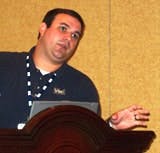
Its just a butterfly valve, but associated with a really critical application. VRCs Zac Scott explained how partial-stroke testing helps Valeros Memphis refinery ensure its valves work when called upon.
Scott said VRC and Valero evaluated several possible solutions and settled on implementing Emersons DVC 6000 SIS Tier controller. Though it meant a significant and somewhat unnerving change for the refinerys users, this solution also offered a lower installation cost than DVC 6000 ODV Tier, greatly improved diagnostics, partial stroking, digital positioning, modulating between 5% and95%, and documented performance and results.
This project represented a big change for this refinery, and the operators were understandably nervous about it, said Scott. However, they were able to come and see how the DVC 6000 SIS works, and they eventually decided to install it.
The complementary Valvelink software package produces testing documentation, as well as enabling offline testing, valve signature, step testing and other functions. The improved valve has operated without incident and worked properly during a couple of upsets, Scott concluded, and so the users found out that change can be good.
