Blood and guts


I recently overheard a process control engineer excuse himself to go to the bathroom by saying to a colleague, Well, time to go lower the tank level. And, like any good joke, Ive reused it to seek an occasional chuckle. Anything to break that face, as Jerry Seinfeld says about his father in his SeinLanguage book.
Of course, theres an endless supply of synonyms for urination, not to mention the trouble caused by all our other bodily functions. They have so many nicknames and are the source of so much preoccupation, embarrassment and amusement because, if they arent top of mind now, they will be shortlyespecially after a few cups if coffee. Got to go? Ill wait.
Welcome back. Anyway, its rare for one of these labels to be more than just thata simple euphemism. However, the engineer referring to his bladder as a storage tank was one of these exceptions. It sparked my imagination, and I quickly reasoned that all human, animal and plant biology is just an intricate, often-tiny series of process-control applications. All the classic elements are there. Flow, temperature, pressure and, of course, level are replicated in every biological process. Sensors, I/O points, wiring, flowmeters, transceivers, PLCs, SCADA systems, HMIs and software all have biological counterparts.
Besides our always-on alimentary canals, every skinned knee, stuffy nose or fever demonstrates flow, pressure and temperature. Even the classic science-fiction movie of Harry Kleiners Fantastic Voyage (1966) is now 40 years old. Remember Stephen Boyd, Raquel Welch, Donald Pleasance and their cool little Proteus submarine/spaceship being shrunk and injected into that scientists body, so they could travel through his heart valves, lungs and inner ear to laser a blood clot in his brain? Id never envied antibodies before, but I certainly did after seeing a bunch pursue and adhere to Ms. Welch. More biology.
Sure, it may be based successively on chemistry, physics and mathematics, but try to think of something that isnt immersed in biology. In fact, the most basic needs of survival, sustenance, shelter and convenience drove the invention and development of the process-control field in the first place. Biology rules everything.
Much of this metaphor is obvious, of course, but its useful because it suggests that taking a closer look at biological processes can help adapt or improve existing process controls and systems. And, as available biological examples grow increasingly sophisticated, this simple analogy may fuel more and better ideas on the process-control side.
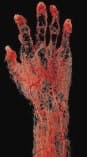
The arteries in a hand at the BodyWorlds exhibit show incredible details.
Consequently, even as I ride my Schwinn Airdyne bike and eat rabbit food to clean my own lines, I remember that arteries have the many of the same backflow preventers as industrial pipes. So, I think maybe studying capillaries elastic properties and epithelial cells may suggest some new flow-conditioning methods.
Likewise, low-voltage swapping across nerve-cell sheathes and neurons interactions with receptors and ganglia at either end are the basis for nervous system communications, and so they too might suggest better models for process-control networking. For example, artificial neural network (ANN) models and fuzzy logic software have long sought to mimic and benefit from biologically based decision making. Self-healing mesh networks already reroute data packets around obstacles, much like phone-switching protocols and neurological pathways.
Because it functions at every size from the visible to the microscopic to the molecular, biology also may be the key to developing and implementing many future nanotechnologies.
Though engineering, medicine and many other jobs require ever-greater degrees of specialization, its crucial to explore some other sciences besides those we know best. Excuse me. I have to see a man about an actuator, I mean, a dog.
