Anti-freezing sessions heat up ISA Will-DuPage tabletop show
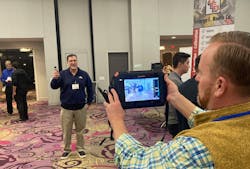
Joliet, Ill., is already famous because its landmark prison opens 1980’s classic Blues Brothers movie, but what’s it been up to lately? Well, among its other accomplishments, the city has hosted the ISA Will-DuPage chapter’s annual tabletop conference there for many years. Its latest edition on Feb. 26 drew about 120 attendees to the Holiday Inn’s Rock-Run Convention Center, where they visited more than 35 exhibitors, and attended six technical sessions in two tracks.
One of the first presentations, “Freeze protection and winterization of pressure instruments,” was delivered by Dustin Bizon, managing director at Multi Instruments Inc. He reported encountering many creative—and often seemingly desperate—techniques for combatting freezing issue in the field. These included pointing an open steam hose at a transmitter, and wrapping instruments in large balls of tape.
Bizon covered the traditional and long-accepted solutions for protecting instruments against freezing, including insulation blankets, soft packs and other remedies that are apparently often referred to as “tea cozies.” They typically have a Teflon, silicone or PVC outer jacket, and an inner materials made of glass wool or ceramic fiber.
“The main advantages of blankets and soft packs is they’re mostly lightweight, quick and relatively easy to install, and can be combined with other protections, such as heat tracing lines,” says Bizon. “However, their disadvantages are their insulation and coverage is sometimes inconsistent, so cold weather can penetrate. They may also have poor heat conduction, so heat can escape, and cold air and water can get in—not to mention animals, such as mice, wasps and ravens. Because of lengthy turnaround times, blankets and other coverings may come off, and then be like a difficult jigsaw puzzle to get back on.”
A second, common way to protect instruments against freezing is heated box enclosures, usually made of molded, glass-reinforced polymer. Their advantages are they provide weathertight space heating, and can be built to fit a variety oddball-shaped instruments. They typically carry NEMA 4 or 4X ratings, and they can’t be misplaced because they’re bolted on.
“However, the disadvantage of enclosures is they usually have generic designs that are less flexible, may have manually cut holes that affect their ratings, and may not easily accommodate all the components, lines and tubing bends inside,” explains Bizon. “Boxes are a heat-transfer medium, so they require time to warm devices inside—just as the air inside a refrigerator takes time to cool food and beverages.”
Beyond freezing, Bizon reported that field-based instruments and protection measures can also degrade and leak due to sunlight, summer heat, rain and other environmental conditions. In general, he reported that blankets are 25-50% reliable and effective, while boxes are 50-80% reliable and effective.
To achieve about 90% reliability, he recommends contact heating enclosure, which typically have a clamshell design that wraps around wetted parts of instruments, but leave their electronics outside because they don’t mind the cold. Conceptually, they’re similar to automotive engine block heaters that can deliver heat directly to equipment that users want to keep warm.
“These devices includes self-limiting electric or steam contact heaters,” adds Bizon. “Their features and advantages include high-efficiency heat conduction, universal power at 100-300 V and 50-50 Hz, low power consumption of 48 W or 29 W, and easy integration with heat controllers, as well as a single circuit for tubing bundle and heater. They also have CSA and Atex hazardous-area approvals, and offer extreme versions that can function down to -60 °F or -70 °F.”
Bizon concluded that a 40 W contact heater can save 300% on power compared to a 200 W heating system using blankets, boxes and related equipment.
Tracing heat, seeking leaks
A second popular session was “Heat tracing best practices” by Larry Kapalin, channel partner sales at HTS, who reported that thermal integrity begins with good insulation, which can also let users deploy less powerful, less costly heaters. However, the relative performance of various insulating materials can vary widely from foam glass with a 0.4 k-factor, fiberglass or mineral wool with 0.275 k-factors to Pyrogel with a 0.125 k-factor. K-factor is a measure of a material's thermal conductivity, or its inherent ability to transfer heat.
“To select the most suitable heat tracing solution and materials, we advise filling out an application data sheet, such as Enpro’s heat trace takeoff list, which can help users ask the right questions, and guide them to the most helpful answers,” says Kapalin. “It covers basic scope details of each user’s process application, heat trace types, methods and specifications, heat trace design temperature data, and other scope-supporting documentation.
Kapalin recommends using the classic heat-trace equation: pipe footage x 1.35 = heat trace footage. Having one-third again as much heat tracing is expected to cover most physical need and constraints that are likely to occur with a given amount of process piping.
Kapalin also covered several types of self-regulating and mineral-insulated cables, which use a line-sensing thermostat and panel-based controller to respond when ambient conditions get colder, and possibly cause current draws to ramp up. For example, HTS provides:
- MiX cables that run at 3-60 W per foot, 120-480 V, and 1,200 °F maximum exposure;
- HXR cables that run at 5-30 W per foot, 120-277 V, and 450 °F maximum exposure;
- LXR cable that run at 3-10 W per foot, 120-277 V, and 185 °F maximum exposure; and
- MXR cable that run at 5-15 W per foot, 120-277 V, and 360 °F maximum exposure.
Finally, while the event’s 35 exhibitors showcased a variety of innovative products and services, one standout included Crysound USA’s (https://www.crysound.com) handheld, acoustic imager, which has a highly sensitive microphone that listens ultrasonically for any gas or vacuum leaks, shows the location and intensity of leaks, and can even discern between different gases (Figure 1).
About the Author
 Jim Montague
 Leaders Logo
Leaders relevant to this article: