Schneider, Aveva and Nvidia develop blueprints for AI factories
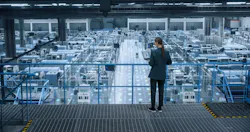
Schneider Electric reported Mar. 16 that it and Aveva’s are working with Nvidia to design, simulate, build, operate and maintain AI data center infrastructures. They’re producing a Vera Rubin reference design that: validates power and cooling for its rack-scale architectures; integrates digital-twin capabilities in Nvidia’s Omniverse DSX blueprint and ecosystem; and tests agentic AI for data-center, alarm-management services using Nvidia’s Nemotron open models. Schneider adds these efforts strengthen it and Nvidia’s existing collaboration, and establishes a foundation for developing efficient, AI-driven, gigawatt-scale factories.
The AI reference design is validated with ETAP models for electrical system design and ITD CFD models for layout and air flow, and is one of the first created for Nvidia’s Vera Rubin NVL72 racks. It covers power and cooling, and is integrated with Schneider’s reference designs for controls. This design addresses infrastructure requirements and considerations for Nvidia’s rack-scale systems, including:
- Enabling power distribution with increased, 480 VAC supply voltage.
- Allowing higher, 45 °C, TCS loop supply temperature for enhanced efficiency.
- Supporting IT room architecture with clusters of AI racks sharing centralized networking, storage, CPU, and support racks. This lets every Nvidia rack-scale system stay physically close, while allowing separate, higher-voltage for GPU racks, which enables larger clusters and optimizes power delivery.
- Maximizing token performance by designing data centers to accommodate various operating points of GPU racks, such as Nvidia’s MaxP and MaxQ. Operating at MaxQ can achieve more tokens per watt to override power constraints, and optimize computing performance with redundancy. Overall, the reference design enables more tokens per watt when incorporating MaxQ’s operating point.
Digital twins for GPUs
In addition, Aveva, Schneider and Nvidia developed a lifecycle, digital-twin architecture that maximizes GPU efficiency and accelerates deploying AI factories. Schneider Electric reports it’s committed to creating SimReady assets and digital twins with Omniverse supported by Aveva’s software, which is embedded throughout Omniverse DSX Blueprint. This is projected to accelerate time-to-token through domain-specific simulations, digital visualization and collaborative design tools.
For example, after a system architecture is assembled in Omniverse, Aveva executes multi-domain simulations to validate operational behavior under realistic conditions. This includes computational models for power distribution, thermal dynamics, airflow performance and controls. These simulations enable iterative design optimization, rapid evaluation of multiple scenarios across load and environmental conditions, and final system verification prior to building the physical environment. The result is a fully validated, performance-optimized design that reduces engineering cycles and improves deployment accuracy.
“As AI workloads scale in size and complexity, the margin for error in data center design becomes incredibly small,” says Manish Kumar, SVP of secure power and data centers at Schneider Electric. “Delivering AI at scale requires tightly integrated electrical, cooling and digital architectures that can support unprecedented performance demands, while maintaining peak energy efficiency. By combining advanced software, digital twins and validated reference designs, operators can simulate and optimize infrastructure before a single rack is deployed. This approach reduces risk, accelerates deployment and ensures the efficiency and resilience needed to power AI factories.”
Vladimir Troy, AI infrastructure VP at Nvidia, adds, “Gigawatt-scale AI factories demand a new, energy-efficient, predictable infrastructure. Together, Nvidia and Schneider Electric are providing the power, cooling and digital twins needed to accelerate time-to-token.”
Agentic AI model testing for alarm management
Schneider Electric adds it also successfully tested Nvidia’s Nemotron model for agentic AI alarm management. This service addresses a longstanding challenge for data centers—interpreting alarms at a system level to identify root causes and determine corrective actions. Leveraging real-time streaming IoT data across multiple systems, Schneider Electric’s agentic AI autonomously analyses, diagnoses and recommends actions with integrated tools. Working with technicians, the technology delivers faster and more consistent issue resolution, reduces unnecessary dispatches, and enhances operational resilience.
About the Author
 Jim Montague
 Leaders Logo
Leaders relevant to this article: