In keeping with its informal motto of “giving back 10 ideas for every one presented,” the Control System Integrators Association (CSIA) provided mass quantities of useful content to almost 500 visitors at its 2026 conference on May 4-8 in Baltimore. The event’s 15 educational sessions covered wide range of technical, economic, workforce and other skills that system integrators can take advantage of to run their businesses more effectively.
The event kicked off with CSIA’s recently appointed CEO Adrienne Meyer reporting on its recent activities and several new goals, such as expanding its services, and reaching more system integrator companies. Its priorities for 2026-27 include membership growth, retention and experience, and establishing a dedicated role for recruiting and retaining members.
The organization also gained 41 new members since June 2025, while eight members achieved CSIA certification status during the same period.
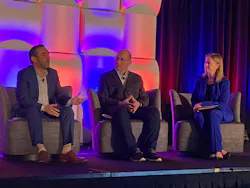
The conference’s opening panel discussion reiterated many of the best practices and community support that CSIA’s members get from being part of the organization. “We get many crucial skills from CSIA, such as financial management best practices,” said Daniel Gomez, CEO of Omnicon, a five-time CSIA-certified integrator in Houston. “However, it also helps us develop the long-term vision for running our businesses and scaling them up. In fact, right after we got audited and certified, a large client asked about many of the same capabilities we’d just learned, so we were able to work much better with them.”
The panelists added that CSIA’s community and its level of sharing helps its individual members see potential issues long before they could identify them otherwise. “This is a unique community that’s just a niche, just a few percentage points of the overall system integrator market, but we share experiences and advice with each other, and that helps us see the peaks and valleys that are always coming,” said Luigi D Bernardini, CEO at Autoware, a CSIA-certified integrator in Vicenza, Italy. “We don’t have to seek answers by ourselves. Even during the COVID-19 pandemic, we were able to share and get advice from each other that was crucial during that time.”
Replacing retribution
In his “Finding value in nonconformance,” Mike Howard, EVP at George T. Hall Co., a CSIA member integrator in Anaheim, Calif., reported that it uses nonconformance reporting (NCR) as a practical tool, not an audit checkbox. “In our ISO9001 and CSIA-certified quality program, NCRs help us capture what went wrong, understand why it happened, and make sure the fix sticks beyond current project,” said Howard. “We don’t celebrate mistakes, so NCRs document when a product or service fails to meet requirements, and gives a place for the problem to live. Our focus isn’t on paperwork; it’s on learning from real-world issues reducing repeat problems, and achieving better delivery of complex integration projects.”
Howard reports that NCRs can also help participants get over their fears of retribution and worries that colleagues may throw them under the bus when a problem arises. Because they bring visibility that strengthens processes and procedures, NCRs can also reveal if a problem is a one-time event or if it’s systemic.
“One reality of the system integration business is there many opportunities for ambiguity and missed expectations,” explained Howard. “NCRs remove emotional bias and barriers, and lets participants clearly state problems without fear of retribution. This makes it easier to conduct root-cause analyses, solve problems, and replace blame cultures that hide problems with learning cultures that resolve problems. In fact, people usually aren’t the root cause of problems. It’s usually some type of system failure. So, if people are seen as the problem, it’s usually because the investigation isn’t digging deep enough.”
To conduct its own NCR lifecycle review, George T. Hall spent part of 2025 collecting 187 NCRs, and developing a catalog of issues it could drill down into to identify weakness patterns in its organization, such as lacking documented verifiable procedures, standards and training to alleviate issues.
“The benefit of NCRs is they reduce repeat errors, improve training, strengthen processes, and improve project outcomes,“ added Howard. “They move individuals into the system. Someone may make a heroic effort to solve a problem in the field, but if the underlying issue isn’t documented, then we still risk repeating it. The business impacts of NCRs include reduced rework, improved project margins, better consistency and organizational learning.”
Brewing in Brazil
In his presentation, “From system integrator to value creator,“ Renato Leal, executive director at GreyLogix, a CSIA member integrator in Florianopolis, Brazil, showed how his company designed and built a small, standalone, pilot brewery in nearby Rio Negro to demonstrate its technologies, services and other capabilities. The facility is not only sustainable with intelligent controls, mainly Siemens Simatic, but all of its manufacturing stages are simulated as digital twins by Comos software, which also created a digital rendering of the entire plant. This enables diagnostics, full production and greater efficiency, but it also lets GreyLogix show its clients that it’s investing in its own technologies. Plus, its demonstrations are definitely enhanced by the system integrator serving frosty cans of its GreyBeer to visitors touring the facility.
The brewery has six tanks, and has already produced 4,000 liters of GreyBeer, though it has the capacity to produce 15,000 liters, and its modular design could be scaled up to 100,000 liters. It’s roughly 1,000 tags and Simatic PLC also use Siemens’ Braumat software.
The digital plant developed with Comos also:
- Analyzed thermal and electrical energy consumption,
- Analyzed production operations cycles.
- Defined all standard equipment and their dimensions for better energy efficiency, and
- Defined new equipment for energy integration based on their emulations obtained from the digital twin.
“What drives evolution? We think it’s mostly two things: survival that creates a sense of urgency, and curiosity that shows our desire for a better life,“ said Leal. “In this case, small breweries face, a lot of challenges competing with big companies that have more resources and capabilities. By simulating and running all the stages in our brewery, we estimate can save 25% on energy costs and capital expenditures (capex). We also recently added wireless sensors for condition monitoring.”
Awards and winners
As always, the CSIA conference was highlighted by the presentation of its five traditional awards. They included:
- Integrator member company of the year was presented to Interstates, an eight-time CSIA-certified, national, U.S. Midwest-based integrator with more than 1,700 employees.
- Partner member company of the year was awarded to Wipfli, an audit, tax and corporate finance advisory firm that’s partnered with many of CSIA’s integrator members.
- Emerging leader award was won by Ryan Crownover, digital plant director at Vertech, a CSIA member integrator based in Phoenix.
- Social responsibility award was presented to aeSolutions, a consulting, engineering firm and CSIA-member integrator in Greenville, S.C.
- The Charlie Bergman “Remember Me” award was presented posthumously to Rick Pierro, cofounder of Superior Controls and chief strategy officer of the life sciences division at E Tech Group, who died of cancer on Dec. 12, 2025.
Named for one of CSIA’s founders, the Bergman award is generally viewed as CSIA’s highest honor because it recognizes someone who exemplifies its core aim convincing formerly competing system integrators to work together to make their profession better. The unanimous sentiment at this year event was that no one advanced and championed CSIA principles and goals more than Rick.
During the ceremony, Matt Wise, CEO at E Tech, reported that, after shaking hands and seeming to know everyone at multiple events and venues, Rick would eventually see someone he didn’t recognize. Wise said he’d ask, “Who’s that?” And Rick would say, “I don’t know. Let’s go find out.”
“In minutes, they’d be talking like old friends,” said Wise. “Rick made everyone feel like they were part of the family.”
About the Author
 Jim Montague
 Leaders Logo
Leaders relevant to this article: