Schneider helps Bilfinger’s unmanned, offshore buoy run autonomously for 1,000 hours
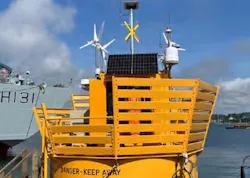
Schneider Electric reported June 18 that it’s partnering with Bilfinger U.K. Ltd. to develop controls for a first-of-its-kind floating power and control demonstrator of a Normally Unmanned Installation (NUI) buoy. The project employs Schneider Electric’s open, software-defined EcoStruxure Automation Expert (EAE) software that enables the buoy’s autonomous operations in the North Sea.
Bilfinger was appointed by Buoyant Production Technologies (BPT), a subsidiary of Crondall Energy, to design a scalable and repeatable solution capable of supporting autonomous operations at remote and marginal offshore platforms. Their objective was to create a system with a renewable energy microgrid that provides reliable power for mission critical, subsea, tieback systems.
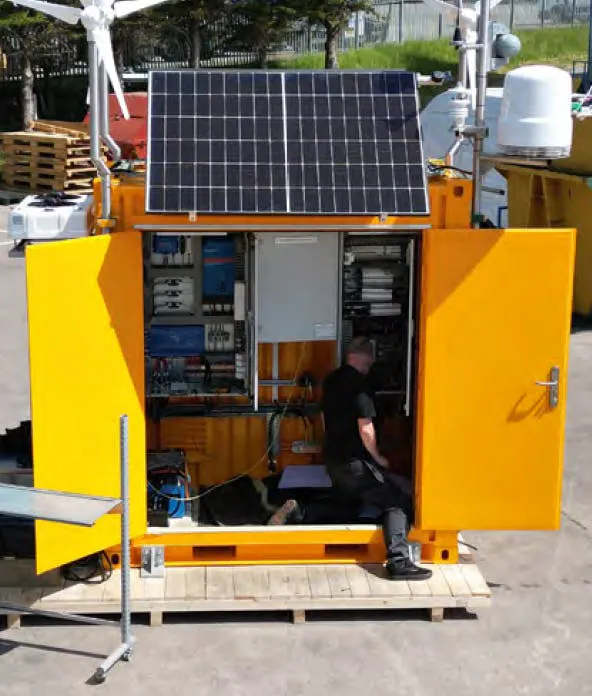
Built on open, software-defined automation (SDA), NUI demonstrator buoy is a compact, autonomous offshore platform. It generates its own renewable energy, and manages subsea control locally, removing the need for onsite personnel or a connection to a distant platform, which saves power and reduces emissions. Since it was deployed in late 2025, the buoy has met every success criteria, completing 1,000 hours of fully autonomous operation without incident, and achieving technology qualification within its 10-month target.
The partners report that using SDA and EAE supports a flexible approach by eliminating vendor lock-in and decoupling applications from their hardware. This lets users integrate technologies not previously combined in one offshore system. NUI provides a cog alternative to conventional subsea tie-back infrastructures, which are increasingly under strain as operators expand into more remote and deeper locations.
“Traditional automation architectures make customization very difficult, especially for first-of-their-kind projects,” explains Steven Parkinson, automation, production and service director at Bilfinger U.K. “This approach simplifies integration between renewable power generation, remote operation and autonomous control, while overcoming long lead times, high capital costs and limited flexibility associated with traditional infrastructures.”
The buoy’s integrated control and power scheme includes Schneider’s Modicon M580 dPAC controller for core process control and I/O integration, alongside a renewable energy microgrid controller to coordinate wind, solar PV, battery storage and diesel generation. The solution is supported by SCADA servers running Aveva’s InTouch and PI software for visualization, data management and analytics. High-availability communications are enabled via 5G and Starlink, while onboard safety systems cover fire, gas and smoke detection. The entire system is underpinned by a layered, built-in cybersecurity framework.
“This project proves a new operating model for offshore assets, and supports our mission to decarbonize hard-to-abate industries,” adds Devan Pillay, president of heavy industries at Schneider Electric. “Our close collaboration with Bilfinger and adopting SDA were critical to a successful and timely delivery. The real opportunity now lies in replicating and scaling this approach across future assets to enable a lower-carbon offshore industry.”
