Record-breaking ICC unleashes innovations
Just as it famously “takes a village to raise a child,” it requires a vibrant and growing community to exchange all the ideas and tweaks needed to grow useful innovations. Fortunately, that’s just what Inductive Automation has using and refining its Ignition web-based HMI-SCADA software.
In this case, a record-breaking, 1,900+ showed up at this year’s Ignition Community Conference 2026 on Sept. 22-24 in Sacramento, Calif., including more 60% first-timers, who showed just how fast its community continues to develop. Naturally, once they came together in person, the community only ramped up its collaboration, cross-pollination and inspiration activities, presenting and attending more than 60 sessions led by Inductive’s experts, fellow end-users and technical partners.
For instance, ICC’s opening, technical keynote highlighted how more than 650 updates, enhancements and security updates enhanced Ignition 8.3 web-based HMI/SCADA software this past year, and taught thousands of worldwide production environments to trust it. Building on this foundation, Inductive is migrating to an annual-release model starting with Ignition 2027 software in February, which will balance steady, reliable innovation and long-term support.
Ignition 2027 on the way
While 8.3 focuses on making complex architectures possible, Ignition 2027 will make internal capabilities easier for teams to use, rather than just advanced specialists. Ignition 2027 will be fully compliant with European Cyber Resilience Act (CRA) requirements, ensuring it and subsequent versions deliver secure-by-design software for operations across Europe. For organizations that prefer stability and longer upgrade cycles, 8.3 remains the present, long-term support release through 2030.
Ignition 2027 upcoming features include a native Beckhoff ADS driver, supporting TwinCAT2 and TwinCAT3 without a third-party OPC server. On the data-visualization side, it will introduce 16 charting components with cohesive color palettes and a gateway-level, chart-style editor, along with Power Chart updates, such as type-to-find tag searching and filtering.
Ignition 2027 also provides redundant OPC UA client-connection support; support for multiple identity providers at login across the gateway, designer and workstation; and a native, onscreen keyboard for Perspective Workstation software. The release expands HTTP API access to operational data with full programmatic ability to browse, read, write and configure tags, as well as query and ingest historian data; adds searchable previous values to the audit log to meet strict regulatory compliance standards; and broadens import/export options to include Excel for round-trip management of UDTs, security settings, alarms and history configurations.
Ignition 2027 will also enable new possibilities for historian data, according to Colby Clegg, CEO at Inductive Automation, and Mike Freedman, CTO and co-founder of Tiger Data, who reported on their partnership at ICC. To meet increasing demand for query performance, high availability and storage without compromising Ignition’s openness, the two companies are collaborating on a new enterprise historian module for TimescaleDB software and a new edition of TimescaleDB for Ignition.
Closing out the technical keynote, Carl Gould, CTO at Inductive, announced a shift in its AI strategy. Instead of releasing a standalone model context protocol (MCP) module, Inductive is introducing Ignition Catalyst to integrate AI natively into the platform. Its two sections are Catalyst Core module and Catalyst Agent module.
Gen AI aids Ignition
Included in the platform at no additional cost, Catalyst Core uses generative AI (gen AI) to make Ignition easier to use with hyper-localized, hyper-contextualized Catalyst Assistants embedded throughout its Ignition Designer software. Catalyst Core also includes Catalyst Diagnostics, which inspects gateway subsystems to summarize errors, thread pool exhaustion or performance bottlenecks, helping users maintain system reliability.
The second section, Catalyst Agent, provides a user-defined framework for teams to build, run and embed AI agents of their own design directly within their applications. Built using a bring-your-own-model approach compatible with Claude, OpenAI or local models via Ollama, this module includes a Perspective AI chat component and bidirectional MCP functionality for hosting tools or connecting to external capabilities. Together, Catalyst Core and Catalyst Agent exemplify Inductive's push to make advanced AI tools accessible in a secure development environment.
Following the Catalyst announcement, Reese Tyson, strategic solutions architect at Inductive and Matthew Rayburn, sales engineering manager at Inductive, presented “AI unleashed—how to leverage AI with Ignition,” which explored the transition from traditional manual AI prompting to integrating autonomous AI partners directly into industrial Ignition ecosystems. Using a project they built with Ignition Catalyst, Tyson and Rayburn demonstrated, not only what using AI in Ignition could look like, but how to do it. Their project employed Catalyst Core to run AI diagnostics summaries for diagnosing and fixing problems in the Ignition Gateway webpage; used Catalyst Agent to develop custom AI agents that connect to tools or resources for added data context; and moved beyond simple AI prompts in the Ignition Designer for creating expression bindings, UDT definitions, and even scripting from scratch
Tyson and Rayburn presented practical advice and practices for easily converting industrial data streams into actionable insights. They showed how to combine AI and Ignition to build responsive, self-augmenting architectures with the potential to shift the role of engineers from hands-on configurers to managers.
Discover Gallery’s Firebrand award winners
While not yet AI-assisted, ICC’s Discover Gallery video showcase highlighted 2026's most innovative Ignition projects. Submitted by integrators and end users, and narrowed down to 20 featured solutions, the projects were screened on-demand at interactive kiosks during the conference. This year's Firebrand Award winners innovated in multiple industries from oil and gas to renewable energy to municipal transit. Their developers used Ignition's open architecture to break free of rigid, siloed SCADA platforms and vendor lock-in. The six winners included:
- East 15 Technologies unified six vessels and four terminals in Canada into one Ignition-based platform for Seaspan Ferries, giving the fleet a true end-to-end performance view.
- Contel Smart Energy worked with EDF Power Solutions (https://edf-powersolutions.com) on an advanced urban microgrid in Israel for a school campus in a dense metropolitan area.
- Autexopen and ASE Global helped deliver one of the largest Ignition deployments in Latin America's oil and gas sector, moving a major Argentine energy company off legacy systems by using flexible UDT templating and an MQTT Sparkplug B edge architecture.
- The Tempo project, a partnership between Australia's Cromarty Automation and Tilt Renewables replaced hundreds of individual screens with a single dynamic monitoring view.
- Martin CSI built a centralized data platform in the U.S. at IGS Energy's RNG digester sites, enabling real-time visibility and rapid expansion.
- Bouygues Energies & Services replaced RATP Dev's legacy SCADA system for the Bibus Brest transport network in France with a fully web-based solution integrating low-latency video and rail signaling.
Two special Firebrand Awards recognized contributions to industrial education and community involvement:
- Turks and Caicos Islands Community College received the Educational Engagement Firebrand award for a low-cost agricultural IIoT platform built using ESP32 microcontrollers.
- Nader Chinichian received the Community Impact Firebrand award for vCortex, a reusable component pack that extends Perspective with ECharts integration and a node-based flow diagram editor, giving worldwide teams new tools for building more sophisticated solutions.
Even though they didn’t win Firebrand awards, the Discover Gallery’s other projects were also recognized for confronting and pushing past conventional wisdom and methods. For example, OperaMetrix built a hyperbaric safety tracker for tunnel boring machines, and CSE Icon automated the translation and onboarding of millions of data points from legacy systems into a modern Ignition architecture in a matter of weeks. Rounding out the projects were Logical Systems, MVP Holdings, Avadine, Nautilus, Concept Reply, E Tech Group, Multi-Dimensional Integration, Texas Automation Systems, and AT-Automation.
Plenty of panels
The record-breaking attendance at ICC also had the chance to attend more panels discussion than ever, more of which were led by their fellow community members. The resulting flurry of insights, opinions and takeaways included:
"Avoiding million-dollar mistakes in automation projects" was led by Adrienne Meyer, CEO of Control System Integrators Association (CSIA), who moderated a discussion with Cassy Gardner of E Tech Group, Elizabeth Reed of DMC and Ryan Crownover of Vertech. The four experts explored topics like working with end users to define a problem properly before moving forward with a solution, how disconnects can arise between tech specs and business justification, involving plant-floor experts in decision-making, setting priorities, and comparing agile versus waterfall methodologies. The panelists also drew on projects that hadn't gone according to plan, and shared candid, hard-won lessons from those experiences.
This year's ICC industry panel was moderated by Alex Chausovsky, president and CEO of 3DM Consulting, who led panelists Jeff Winter of Belden, Sam Russem of Kanoa, Jonathan Meredith and Corey Carolla of BIS. The five discussed shifting dynamics in operating environments, scalability concerns, how to allocate money for maximum competitive advantage, supply-chain disruptions, coming retirement waves in manufacturing, practical applications of AI, and growth opportunities heading into 2027.
"Leading the enterprise: how executives navigate digital transformation with Ignition as the strategic foundation" was led by Chris Barnes, VP of AI and digital transformation at Flexware Innovation, who talked with Jeff Winter of Belden, Justin Skaggs of Worthington Enterprises and Christine Polarine of Mitsubishi Chemical Advanced Materials. The four discussed how to secure executive buy-in and funding for enterprise-wide initiatives, the value of building cross-functional coalitions to make the business case, balancing standardization with the need for plant-level autonomy and customization, questions around data ownership, and how AI is shortening feedback loops and may become an ‘invisible’ part of everyday processes.
"Architecting the future of OT: legacy of open standards, OPC UA and OPC UA companion specs, and MQTT/Sparkplug" started with remarks by Thomas Burke, technology evangelist at Inductive Automation and former president of the OPC Foundation. He was joined by CESMII's John Dyck, COPA's Bob Hagenau, and Cirrus Link Solutions' Arlen Nipper, who discussed covering the history and current state of open standards in industrial connectivity, Inductive's contributions to that ecosystem, and how OPC UA and Sparkplug function as complementary rather than competing standards. They also discussed standards relevant to robotics before closing with a live demonstration of Ignition's interoperability in practice.
"Garbage in, confidence out: what industrial AI needs from you first" consisted of a discussion by Leor Fishman of Axilon, Bryan Thyken of Sorba.ai, Jeff Knepper of Flow Software, Remus Pop of Concept Reply, and Bob van de Kuilen of Thred Cloud. The five talked about the trust gap surrounding industrial AI, the guardrails needed to prevent damaging hallucinations, how inference and data triangulation can fill in gaps, and the need to broaden how the industry defines and uses unified namespace (UNS) data designating and organizing software. They also shared how their platforms put these ideas into practice, from anomaly and drift detection to turning raw operational data into actionable insight.
BW Design Group wins Build-a-Thon
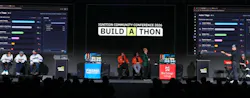
ICC’s traditional Build-a-Thon title was captured by BW Design Group (BWDG) and its “Folsom 1” data center model in a closely-contested victory. Its “Inductive Aerospace” project won by just 10 votes, edging Prime Controls’ Grillbert LLM for barbeque pitmasters.
Their projects were developed using Opto 22’s diminutive, panel-based, data centers, which fit onstage at ICC, but still contained fully-capable CPUs, servers, power, cooling, and networking for capturing and publishing edge data to a Chariot MQTT broker. Using their demo build panels and an exclusive Ignition 2027 alpha version, each team tracked and controlled processes and operations for fictitious data center customers. They employed HMIs, Opto 22’s groov EPIC PLCs, Ignition Edge and Cloud Edition software, and a Tiger Data TimescaleDB Postgres database.
BWDG’s team used these tools to design, build and launch Folsom 1 data center into a virtual orbit, where it received live audience requests via chat, and visualized KPIs, radar charts and more.
Suppliers present sessions, too
Because innovators need components, tools and other materials to bring their ideas into reality, ICC also featured more than 50 exhibitors. They reportedly better repesented Ignition’s overall technology ecosystem was also better-represented at ICC than ever before. Beyond promoting their solutions at tradeshow booths, almost half of ICC’s exhibitors at presented full sessions called Solution Showcases technical sessions, which provided even more ways to gain knowledge and enable innovations. They included:
- Sepasoft explained how real production activity from Ignition and MES can be turned into scheduling contexts that keep operations running smoothly.
- Flow Software showed how to build a governed manufacturing knowledge graph using Timebase and Ignition UDTs to give every system and AI agent a unified ontology of plant-floor data.
- Opto 22 demonstrated how groov devices pull data from invisible or legacy assets and connect them directly to Ignition using open standards like MQTT Sparkplug.
- Beckhoff and DMC showcased how combining Ignition and TwinCAT brings modern software practices like Git source control and CI/CD pipelines to OT environments.
- 4iR Solutions described how businesses can scale multi-site digital transformations quickly and reliably using FactoryStack software for enterprise SparkMES deployments.
