Moore Industries adds EtherNet/IP to bridge HART instrumentation and modern control systems
Key Highlights
- The addition of EtherNet/IP support allows direct communication with Rockwell Automation controllers, eliminating the need for additional protocol cards or middleware.
- EtherNet/IP uses a producer-consumer model with implicit messaging.
- HES will organize HART data into EtherNet/IP assembly objects, enabling seamless integration of process variables and diagnostics into PLC tags for tighter control and monitoring.
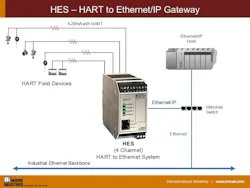
Moore Industries-International, Inc. will soon announce the addition of EtherNet/IP to the protocol lineup of its HES HART to Ethernet Gateway. The HES already supports MODBUS/TCP and HART-IP for connecting HART field instruments to Ethernet-based control and asset management systems. With EtherNet/IP on the horizon, we sat down with Roy Diza, Application Specialist at Moore Industries, to get answers to five key questions about what this new capability means for plant engineers, system integrators and the millions of installed HART devices waiting to share their data.
Q: The HES has supported MODBUS/TCP and HART-IP since its introduction. Why is Moore Industries now adding EtherNet/IP as a third Ethernet protocol option?

A: The HES has always been about giving our customers flexibility and maximizing the value of their existing infrastructure. MODBUS/TCP and HART-IP have served a wide range of applications very well, but we consistently hear from end users and system integrators working in manufacturing and discrete process environments that many of their smaller to midsize control platforms are built around EtherNet/IP. Many of those facilities run Rockwell Automation PLCs and other EtherNet/IP-native controllers throughout multiple parts of their facility, and until now, getting HART data from the HES into those systems required an additional protocol card in their rack or a middleware solution.
By adding native EtherNet/IP support, the HES can now speak directly to those controllers as a standard EtherNet/IP adapter device. That means process engineers can map HART process variables, device diagnostics, and status data directly into their PLC's I/O tree without any intermediate gateway or translation layer. It closes a connectivity gap and opens the HES up to a significant segment of the industrial market.
Q: For readers who may be less familiar, can you briefly explain what EtherNet/IP is and how it differs from MODBUS/TCP, which the HES already supports?
A: EtherNet/IP and MODBUS/TCP are both industrial protocols that run over standard Ethernet hardware, but they differ significantly in architecture and how they are used in practice.
MODBUS/TCP is a straightforward request-response protocol. A host initiates a query, and the device responds with register data. It is simple, widely understood, and has been a staple of industrial communication for decades. The HES currently supports up to four concurrent MODBUS/TCP connections, with a configurable and compressible register map that allows users to optimize polling efficiency across all connected HART devices.
EtherNet/IP, on the other hand, is based on the Common Industrial Protocol, or CIP, which was developed by ODVA. It uses a producer-consumer model that supports both implicit messaging, sometimes called I/O messaging, for time-critical cyclic data exchange and explicit messaging for configuration and parameter access. EtherNet/IP is deeply integrated into the Rockwell Automation ecosystem and is the native protocol for their family of PLCs and many other automation platforms. Where MODBUS/TCP is polled by the host, EtherNet/IP implicit connections allow the HES to publish data at a configured rate that the PLC subscribes to, which can reduce network overhead and improve determinism in control-critical environments.
Q: How will EtherNet/IP access the HART data that the HES collects? Will users be able to expose the same process variables and diagnostics available through MODBUS/TCP?
A: The goal is to make all the rich HART data the HES already collects equally accessible over EtherNet/IP. The HES currently gathers dynamic variables—the primary, secondary, tertiary and quaternary variables—as well as device variables and additional status data from each connected HART field device using HART commands 3, 9 and 48. In the four-channel configuration, that can mean data from up to 64 HART devices simultaneously.
Get your subscription to Control's tri-weekly newsletter.
With EtherNet/IP, that same dataset will be organized into an EtherNet/IP assembly object structure that a PLC can consume via an implicit I/O connection. The HES will present itself as an EtherNet/IP adapter and the controller, whether it is a Logix-based system or another EtherNet/IP scanner. It will also establish a connection and receive cyclic updates of the HART data at a configured rate. Users will be able to bring HART process values and diagnostics directly into their PLC tags, enabling tighter integration with control logic and alarm management systems without needing to write custom MODBUS polling routines or map registers manually.
Q: Many plants already have HART instruments wired with 4-20mA loops and no existing path to get that diagnostic data into a Rockwell PLC. Is EtherNet/IP on the HES a practical retrofit solution for those sites?
A: Absolutely, and that is one of the most compelling use cases for this addition. The HES was designed from the beginning as a retrofit-friendly device. It snaps onto a standard 35-mm DIN rail, operates on 9-30 VDC power, and connects directly to an existing 4-20mA loop with HART capability without disturbing the existing field wiring. The HES four-channel model supports up to four devices across four separate loops.
There are more than 40 million HART field devices currently installed in plants across every major industry. Many of those installations predate the modern push toward IIoT and predictive analytics, so the HART digital data those instruments have always been capable of providing has often gone uncollected. With EtherNet/IP now on the HES, a plant that has already invested in a Rockwell control system and an Ethernet infrastructure can use the HES as the bridge between those legacy or newly installed HART loops and their modern PLC, without replacing instruments, running new signal wiring or adding a separate protocol converter. The diagnostic data the HES collects, including HART command 48 status bytes that indicate device health, can feed directly into the PLC for predictive maintenance workflows. That is a meaningful upgrade in capability for a relatively modest investment.
Q: Will EtherNet/IP support change anything about how the HES is configured or ordered? Will users be able to easily program the HES to take advantage of the new protocol?
A: From an ordering standpoint, EtherNet/IP will be offered as an additional protocol option alongside the existing MODBUS/TCP output, which is currently required for all HES configurations. Users who need EtherNet/IP connectivity will be able to specify it when ordering, and it will be available across both the single-channel and four-channel HES models.
The HES keeps setup simple, a free Moore Industries IP address utility and an intuitive DTM for PACTware or other FDT container, are all that's needed for complete configuration, eliminating the complexity often associated with other protocol gateways and proprietary software. Users familiar with configuring EtherNet/IP adapters in Studio 5000 or RSLogix will find the configuration process straightforward in defining the connection parameters, selecting the appropriate assembly, and adding the HES as a module in the PLC project.
