You Look Like You Could Use a Little Stress


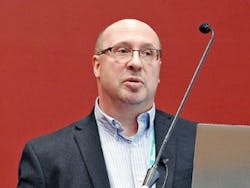
“We have one tank of emotional energy. When you are tired, it’s a lot harder to think about difficult problems and control your emotions.” Exida’s Todd Stauffer explained how to turn stress and rest into mental growth.
The next time someone tries to hand you a stress ball at a trade show, just say no. “Stress is not necessarily bad for you,” said Todd Stauffer, director, alarm management, at Exida. “Alternating it with rest helps you to grow.”Stauffer explained how to combine stress and rest to develop better mental abilities and improve your performance to a packed room at the Emerson Global Users Exchange this week in San Antonio. Developing optimal daily routines, designing your day to maximize productivity and defining the purpose of your work to increase motivation are great steps toward peak performance, but understanding the brain helps you to understand how and why to change your thoughts and behaviors.
“The bar for human performance is at an all-time high,” said Stauffer. “There is so much pressure to perform. We’re put in a pressure cooker because of the technology changes. There’s a global talent pool of people who can do the same jobs we do, perhaps at a lower cost. One of the ways to deal with that is to get better at what you do by improving your performance.”
Many people feel overwhelmed all of the time or part of the time because we feel the need to always be reachable. “People check their cell phones on average about 150 times a day,” said Stauffer. “The Internet has given us access to more information, but that can be overwhelming. The average person works 47 hours/week and leaves five vacation days unused.”
We are living in the age of the performance-enhancement culture demonstrated by dramatic increases in steroids and other performance-enhancing drugs for sports and Adderall in professionals age 25-45, said Stauffer. These individuals are under a lot of pressure to perform well, and that creates stress, which isn’t a bad thing. Stress + Rest = Growth.
“If you’re trying to work out, you’d go to the gym and pick an exercise that isolates that muscle you want to increase, and then you’d rest, so your body would recover, so you’re just a bit stronger than you were before,” explained Stauffer. You stress the muscle and then rest. The end result is stronger muscle. “It’s the rest that allows you to grow your muscle. Why can’t we apply that same methodology to our brains?” asked Stauffer.
Battle of evermore
Much of human behavior results from the struggle between the amygdala, the fight-or-flight part of the brain, and the prefrontal cortex, where higher logic occurs. The amygdala, or reptilian brain, is the part that influences anger and aggression. “It activates if we respond emotionally,” explained Stauffer. “It’s the part of our brain that is active and dominating. The prefrontal cortex is where your executive functions occur. It’s a battle between these two parts of the brain. The amygdala is a quicker responder. Those two can work together or against each other.”
We’ve been able to understand how these two parts of the brain work thanks to functional magnetic resonance imaging (fMRI), which allows us to see which parts are active when certain stimuli elicit certain responses.
“There’s a fixed amount of cognitive energy we have for all of our tasks,” explained Stauffer. “We have one tank of emotional energy. When you are tired, it’s a lot harder to think about difficult problems and to control your emotions. Your prefrontal cortex goes dormant, but your amygdala is still active.”
Go with the flow
Mihaly Csikszentmihalyi is know as the father of “flow,” a term for being so mentally engaged in something that you lose yourself in the task. “When you’re at work and you’re really focused and involved, you sometimes lose track of time,” said Stauffer. “That’s when we do our best work. Csikszentmihalyi studied geniuses. Those people spend their time in two ways—either engaged in an activity with ferocious intensity, which is flow, or in complete restoration and recovery.”
Your most creative thoughts usually occur in the shower or similarly nontraditional think tanks. “There’s a conscious mode in the brain, which thinks logically and is task-oriented, and an unconscious mode for processing what’s going on, and that’s when moments of creativity come,” explained Stauffer. When you hit an impasse, to tap into your creative, unconscious mode, step away, listen to music, go for a walk or sleep, he suggested.
Stress test
“I always thought stress was bad,” admitted Stauffer. “That’s not actually true. It depends on the stress and the amount of stress. Your body releases biochemicals that help you to get bigger, better, faster and stronger. Stress is key to growth.”
People learn and retain the most when they have to struggle with a concept up to the point of failure, he explained. “Productive failure causes you to think about things in a different way,” said Stauffer. “How we think about the world also makes a big difference. You have either an innate mindset with fixed skills that don’t change over time or a growth mindset, in which things can change over time. The way people respond to stress is very different, depending on their mindsets.”
Stress definitely comes into play before a big game or a talk or a presentation. “Stress drives you to prepare and give your best performance,” explained Stauffer. “One trick to pre-performance stress is to think about it as excitement instead of worry. Get out of your own head. Great performers work in 60-to-90-minute chunks. Organizing your work that way helps you to give the best performance.”
To prime yourself for the actual event, put yourself in a positive mood. The fMRI results show that negative moods create reduced activity in areas of the brain used for problem solving and creativity. Think positively about people in the audience. Avoid negative people, places and things. A positive mental buildup can change what’s happening in your brain, said Stauffer.
And all the rest
The average American sleeps for 6.8 hours a day, even though what’s recommended is 7-9 hours, said Stauffer. “Not getting enough sleep affects our ability to concentrate and focus,” he explained. “It’s almost as if your IQ drops when you’re really tired. You don’t have access to the same mental faculties. Sleep is when your brain processes the events of the day. If you’re not getting enough sleep, your memory is also impacted.”
Not all of us can nap at work, but a short nap can improve focus and concentration. NASA has done studies that show a 25-minute nap can be beneficial, said Stauffer. “More than 30 minutes puts you into a deep sleep, which makes you groggy when you wake up,” said Stauffer. “The best thing you can do is go for a short walk outside in nature. Walking keeps your conscious brain preoccupied enough that your unconscious brain has time to work. Also, mindfulness meditation is an exercise for people who can’t turn off work. It’s sitting in a comfortable spot and focusing on your breathing as a means to replace fleeting thoughts. It helps to reduce blood pressure and allows you to consider your feelings before acting on them.”
Grow your own
How does someone become an expert? “The common thinking is that practice and experience makes you an expert,” admitted Stauffer. “But it’s actually not the amount of time you spend; it’s how you practice. The great performers aren’t just going through the motion of practicing; they’re truly focused on improving a specific area, a specific skill or muscle, with a coach or mentor who can provide feedback. We need to change that saying of ‘practice makes perfect’ to ‘perfect practice makes perfect.’”
The two subsystems that exist in the game are autopilot, which is the default because it uses less energy, it’s automatic and it’s active most of the time; and a more thoughtful and analytical subsystem, which addresses effortful mental activities. In order to achieve mental growth, shoot for “just manageable” challenges. Take on a task that is just beyond your skill set.
The multitasking myth
The ability to multitask is the exception and not rule; in fact, 99% of us cannot multitask effectively, explained Stauffer. “When they do the fMRI brain scans, the quality and quantity of what you can do suffers when you multitask,” he said. “The recommendation is to focus and complete one individual task.”
Smart phone addiction is not just something we’ve made up to describe the frustrating behavior of our kids. It’s an actual chemical thing. “Our brains react to the interface like a gambler does,” explained Stauffer. “We get a dopamine rush each time we anticipate a new post or message. We get a craving to look at the phone. The recommendation is to put your phone out of your view. When you can see it or feel it, then that impacts your ability to ignore it. Put it out of sight and out of mind.”
We’ve all heard stories of superhuman feats of strength—mothers lifting automobiles off their injured children. “Those people are so focused on helping another person and not on their own constraints that they’re able to access all of their strength and do things they can’t normally do,” explained Stauffer. “Creating a purpose is motivating. The formula for improved performance is a purpose, which gives the motivation. That provides a willingness to apply greater effort, which results in better performance.”

The editors of Control are on-site at the 2018 Emerson Global Users Exchange conference to bring you breaking news, innovations and insights from the event. Once it is over, the editors will put together an event report featuring the top news. Pre-order your copy of the report today.
About the Author
Mike Bacidore
Mike Bacidore
 Leaders Logo
Leaders relevant to this article: