Valve monitoring via IIoT supports Petrobras’s decarbonization program
Key Highlights
- Systems can be “controlled” yet still be poorly observed. Missing measurements limit optimization.
- Sometimes the best improvement isn’t a new controller—it’s a new measurement.
- For retrofit projects, wireless sensors may have better ROI than wired alternatives.
- Instrumentation projects fail when they stop at data collection. Users need actionable logic.

Brazilian national oil and gas company, Petrobras, produces 2.7 million barrels of oil equivalent daily from 56 production sites and rigs, with the product refined at 11 facilities. Like many companies, Petrobras has set environmental goals across all operating areas, including reducing absolute operational emissions by 30% compared to 2015 levels with a deadline of 2030. It also has a long-term goal to become net-zero by 2050. As is common in many companies, it’s necessary to analyze which technologies and work practices are necessary to achieve these goals.
One major area is flare systems, which are essential safety systems in refinery operations. During imbalances between gas production and its transformation into products, flare systems relieve excess pressure and prevent equipment from over pressurizing. They convert process gases—such as hydrocarbons—into compounds with less environmental impact in the atmosphere, such as carbon dioxide.

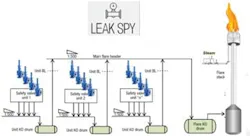
Within a refinery, most of what’s flared comes from pressure relief valves (PRV) responding to over-pressure incidents by opening. PRV outlets are generally connected to flare header systems, ultimately terminating at a flare (Figure 1). A typical refinery can have thousands of PRVs.
The following operational events result in gases being directed to the flare system from gas releases through PRVs:
- Over-pressure incidents, which suggest that a process upset has occurred or that a PRV is set to a pressure lower than what’s compatible with the process design; and
- Worn or malfunctioning PRVs that don’t close completely and leak, often continuously.
Any product going to the flare header system is lost product, and burning it creates emissions.
PRVs have no internal electronic components capable of providing a data trail or diagnostic information, leaving operators to ask, “How can we determine where this product is escaping from our production system, and why?” In some operational events, it’s possible to estimate whether a PRV has relieved by observing the data registered in the distributed control system (DCS) by surrounding the valve with electronic pressure transmitters. However, in general, identifying the source of gas directed to the flare, i.e., which PRV was activated,isn’t a trivial task.
The traditional answer is manual inspection—a slow and costly process since PRVs are often difficult to access because they’re usually placed at high points in the equipment. When this is multiplied against the large number of PRVs, manual inspections become too infrequent to be effective. Even if an inspector can access a PRV, it might be inactive at that moment, so the probability of catching an intermittent problem as it’s happening is typically low. Also, it’s not desirable to increase manual inspections because they require several hours of work, and expose personnel to the risks in operational areas.
Automating inspections
By collaborating with Emerson, Petrobras identified an acoustic sensor (Figure 2) that can be mounted on any PRV, usually on the outlet pipe, without a process penetration. The Rosemount 708 wireless acoustic transmitter’s base mounts on the pipe in any position with a pair of hose clamps. It’s entirely self-contained and requires no cabling. It communicates via WirelessHART, which is the most broadly used, industrial, device-level, wireless networking protocol, covering a wide variety of instruments and valve actuators. In practical terms, once a maintenance technician has reached the PRV, mounting takes just minutes, and battery life is more than five years.
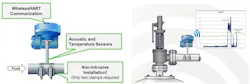
These sensors enable the identification of PRV releases, either during system protection events, or in cases of leakage caused by malfunctions. The sensor operates at ultrasonic frequencies, and detects the turbulent flow created when fluids pass through a nozzle or other restriction. This is the same principle used in PRVs, where acoustic sensors pick up high‑frequency turbulence as the valve opens or leaks. Because steam traps also create turbulence at internal orifices, ultrasonic sensing can also be used to determine whether they’re closed or passing through.
The same sensors can also be installed on steam traps to determine which are functioning correctly compared to those likely stuck closed (not draining condensate) and others stuck open (releasing live steam). This project at Petrobras was called LeakSpy (Figure 3) because any PRV or steam trap could be monitored remotely and continuously. These types of sensors can also detect changes in pipe temperature, and support operations teams performing leak analyses.
Implementing the concept
While it sounds like a simple concept, initial implementation of Rosemount 708 wireless acoustic transmitter was more complicated. Refineries are, and must be, highly conservative when evaluating new technologies because there’s so much at stake, especially regarding personal, environmental and operational safety.
Implementing LeakSpy therefore required an eight-month process of evaluation and testing prior to initial deployment. As this marked the first major implementation of the underlying wireless and Industrial Internet of Things (IIoT) infrastructure, the full project involved the simultaneous adoption of two technologies: acoustic monitoring and wireless networking.
PRV monitoring tests were carried out at Emerson’s test facility in El Campo, Texas, and steam trap monitoring tests were performed at the Pickle Center the the University of Texas at Austin. An IT architecture and cybersecurity assessment to ensure compliance was conducted by Emerson’s team in Shakopee, Minn. Finally, a three-month field test involving eight acoustic sensors was conducted at Petrobras’ Presidente Bernardes de Cubatão (RPBC) refinery in Sao Paulo, Brazil.
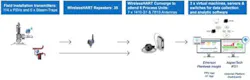
After clearing these hurdles, the initial large-scale deployment at RPBC (Figure 4) started with the following activities:
- Installing 120 acoustic sensors, with 114 on selected PRVs and six on steam traps, spread across six processing units in the larger refinery;
- Installing approximately 30 WirelessHART repeaters to boost network density, and support meshing capability because the site covers a large area;
- Installing seven WirelessHART gateways sitewide to capture data from all the sensors;
- Assembing three data collection and analysis workstations with supporting Ethernet hardware and Emerson PRV and steam trap app software; and Developing a 36-month service contract with Emerson to support implementation and operation.
Get your subscription to Control's tri-weekly newsletter.
This WirelessHART system is now installed at the Sao Paulo refinery, and has the capacity to handle several hundred more sensors, so this approach is highly scalable.
Analyzing data
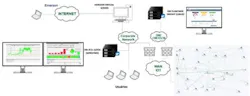
This system at RBPC generates huge amounts of data, so Emerson provided Plantweb Insight applications for PRVs and steam traps to collect and analyze their data, supported by AspenTech’s InfoPlus.21 historian platform. Extensive IT networkupgrades (Figure 5) were required to support this implementation, along with other corporate network areas in the facility.
Promising results
Once the system was fully operational, the RPBC refinery started benefitting very quickly. The maintenance and reliability site teams understood they now had far more insight into their equipment than was imaginable during manual inspections.
For example, if any of the sensor-equipped PRVs open due to an over-pressure condition, multiple teams receive a notification that a release is in progress. Operators can see the duration and severity of the release, allowing them to determine how much product is being forced to the flare. They can also look at surrounding conditions to determine if there’s an actual upset, or if the affected PRV simply has an incorrect setpoint.
Maintenance can watch what happens after the release to see if the valve closes properly and completely, or if it continues to simmer, releasing product after the incident ends. Alerts can come directly to workstations, the control room, and even as emails to specific individuals. Historical information is also easily accessed to see if a given valve experiences frequent events or misbehaves often.
This approach also applies to steam traps, also using the same acoustic sensor technology. Issues with these can be nearly as costly as a problem PRV if a steam trap is stuck open and loses expensive steam (energy, in other words), or stuck closed, allowing condensate to back up into steam pipes, fouling heat exchangers. Steam loss also has environmental implications, as steam is produced using natural gas-fired boilers.
First major win
Early in the initial phase of LeakSpy running in a refining unit, operational conditions were identified that generally aren’t detected by conventional methods: short and occasional relief events in PRVs. These result from dynamic process variations, and can be see in early indications of an increasing trend of leakage through PRVs, signaling progressive degradation of the sealing surface.
The first condition was associated with transient pressure oscillations of low amplitude and short duration. This was sufficient to trigger relief, but difficult to capture with manual measurements or indirect monitoring instruments, as previously explained. These oscillations originated from gas compression systems operating at pressure ranges close to the PRV setpoints.
The second condition, although theoretically detectable through periodic and recurring spot inspections using portable devices, becomes operationally impractical in plants with thousands of valves, such as the unit in question, making early identification extremely challenging.
Applying LeakSpy enabled immediate detection of these relief and leakage events, allowing for detailed analysis of the causes behind pressure variations and facilitating adjustments in operational strategies to mitigate future occurrences. Furthermore, early identification of leakage trends made it possible to investigate the root causes of sealing degradation, which was linked to previous damage and maintenance interventions performed on PRVs.
Detecting these conditions at an early stage was essential for accurate diagnosis, and for defining appropriate corrective or preventive actions, ensuring greater operational reliability, reducing emissions, costs associated with unplanned shutdowns, and enhancing overall plant safety.
Lessons learned and looking forward
While this program has been hugely successful, implementing it took Petrobras down new paths. Using WirelessHART presented some challenges with antenna and device placement, but it was still far easier and faster to install than wired solutions. Now that the WirelessHART infrastructure is in place, adding additional sensors only requires mounting a transmitter and adding it to the existing network.
The larger challenge was simply wading through the initial data to benchmark where Petrobras was and to establish next steps. Emerson worked with our site team to establish processes needed to identify problem valves and steam traps, and lay out plans for more efficient maintenance planning. As these aspects are addressed, Petrobras’ staff expects to reduce the volumes sent to flares, saving product and reducing emissions. Staff are also using data analysis tool to discover other things, such as operational maneuvers that can be improved by avoiding PRV openings. The result is improved overall operation, increased safety and reduced emissions.
About the Author
Adelino Dias
Petrobras
Adelino Dias is a senior information technology business analyst at Petrobras, where he supervises system engineering for refineries and other facilities.
André Kuramoto
Petrobras
André S. R. Kuramoto is an industrial automation consultant at Petrobras, where he has worked since 2006.
Marcio Donnangelo
Emerson
Marcio Donnangelo handles global application enablement customer success at Emerson in Shakopee, Minn., specializing in wireless measurement instrumentation technologies.
