Gas analyzer combines laser and paramagnetic detection
Key Highlights
- Combines paramagnetic O2 detection with quantum-cascade laser spectroscopy for multiple gases in one compact device.
- Reduces system complexity, maintenance and operational costs by replacing multiple traditional analyzers.
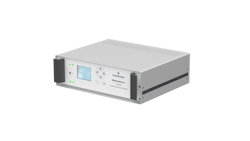
What’s better than getting several devices to merely cooperate? Totally integrating them into one solution that can perform all their former jobs faster and with unprecedented efficiency.
For example, just as a Swiss Army knife combines several essential capabilities in one tool, Emerson’s new Rosemount QX1000 continuous gas analyzer merges paramagnetic detection for oxygen (O2) and quantum-cascade laser (QCL), direct IR-absorption spectroscopy for other gases to meet stringent requirements. This hybrid, modular analyzer is ideal for cold-dry continuous emissions monitoring systems (CEMS) required by facilities with gas-to-atmosphere-emitting processes, but it’s flexible, single-system solution is also suitable for continuous ambient monitoring systems (CAMS), DeNOx/selective catalytic reduction (SCR), carbon-capture utilization and storage (CCUS) and other applications.
“The big difference is QX1000 is the world’s first analyzer that combines laser spectroscopy for gases like NO2 and SO2 with paramagnetic O2 measurement,” says Dr. Beth Livingstone, global product manager for process gas analyzers at Emerson. “It replaces two or more devices that used to be required to make these measurements with a single, streamlined, harmonized, hybrid platform that makes it a best fit for many applications.”
QX1000’s paramagnetic O2 module measures oxygen level percentages in sample gases, while up to three QCL detectors precisely monitor concentrations of other gases within the stream, including CO, CO2, NO, NO2 and SO. Different configurations can detect up to four or five of these regulatory gases, and it delivers continuous, real-time results as parts per million (PPM) or percent-range measurements. It can also measure other gases, such as CH4 and N2O. Thanks to its high-selectivity and accuracy, QX1000’s measurements are ideal for CEMs in the chemical, oil and gas, power generation, pulp and paper, refining, water/wastewater and other industries.
In addition, QX1000 provides:
- Repeatability of ±1 % of measurement or limit of detection (LOD), whichever is greater;
- Inherent linear response from direct absorption spectroscopy;
- LOD that’s typically less than or equal to 1% of full range, depending on application;
- Greater than 0.1 Hz measurement rate;
- 5-50 °C (41-122 °F) ambient operating temperature and sample gas temperature ranges;
- Maximum 80% relative humidity for temperatures up to 88 °F (31 °C), and decreasing linearly to 20% relative humidity at 122 °F (50 °C); and
- 100-240 VAC (50 to 60 Hz) power supply.
“QX1000’s laser technologies have also been redesigned to be more cost effective,” explains Livingstone. “This will enable it to better serve in essential applications and compete in global markets, which are being tasked with new regulations and added sustainability challenges.”
Get your subscription to Control's tri-weekly newsletter.
Livingstone reports that QX1000’s robust design and low-maintenance requirements reduces its lifecycle costs and potential downtime. Its reliability is likewise enhanced by eliminating moving parts that are typically prone to failure and frequent replacement, which further minimizes space constraints, maintenance and ownership costs. Its reduction of consumable technologies is especially useful and valuable to CEMs, where ongoing costs can be a barrier to implementation. By reducing system downtime and maintenance needs, QX1000 also helps users maintain continuous compliance with regulations, and avoid costly penalties associated with taking systems offline.
“QX1000 combines well-proven and reliable technologies with low failure rates, as well as low maintenance and service requirements, and accomplishes all of these goals at less cost,” adds Livingstone. “Being able to install one hybrid gas analyzer instead of several traditional analyzers means more flexibility for brownfield facilities and greenfield applications alike. It’s also easier to coordinate measurements in one device, and it’s simpler to calibrate and validate it, too. It’s also launching with a web-based, cyber-secure HMI and Ethernet networking, so users can set up, configure, monitor and work with it using their PCs and laptops.”
In addition, QX1000’s cold-dry capability simplifies measurements and reduces maintenance. Its sample-conditioning system transports gas extracted from a user’s process to the analyzer via a thermoelectric chiller. This reduces its temperature to about 4 °C (39 °F), so most moisture condenses and drops out. This lets QX1000 easily integrate into existing plant infrastructures. It can also deploy as part of an overall, Emerson-based solution, such as sample-conditioning systems.
QX1000 is the first member of Emerson’s new QX portfolio. It’s expected to be joined soon by an explosion-proof version for hazardous-area applications, such as natural gas facilities.
For more information, visit www.emerson.com/RosemountQX1000
[PHOTO ID: QX1000 - LOI Display]
[CAPTION] Rosemount QX1000 continuous gas analyzer. Source: Emerson
