UV-visual meter eases wastewater analytics
Key Highlights
- Martinez Refining Co. produces up to 2 billion gallons of fuel annually, supplying a significant portion of the Bay Area’s gasoline and jet fuel needs.
- The refinery uses advanced automation and water recycling techniques, including cooling towers and wastewater treatment, to minimize water consumption and environmental impact.
- The implementation of ABB’s UviTec TOC field meters has significantly improved the efficiency and cost-effectiveness of wastewater monitoring at the facility.

Everyone gets parched in the desert. Even halfway up the California coast, it’s still mostly desert to the east and a liquid desert to the west. Thirst lies in either direction. Likewise, lots of fresh, clean water is also needed to refine oil into gasoline, diesel and jet fuel. Unfortunately, if you’re close to San Francisco Bay, you can’t use its water either because it’s brackish and far too salty.
What to do? Well, Martinez Refining Co. (MRC) reports it manufactures the world’s cleanest motor fuels, providing an affordable and reliable supply of gasoline, diesel and jet fuel to the Bay area. Successful and efficient water reuse/recycling and wastewater treatment makes it possible to produce its products.
Covering 860 acres and containing 35 process units, the refinery expanded in the 1960s, 1980s and 1990s, and prides itself on being a modern operation that uses advanced automation, controls and other technologies (Figure 1). Built to process heavy crude oil from California’s San Joaquin Valley, MRC is one of the most complex refineries in the U.S., which lets it source and process various crude oils from Alaska to South America. The refinery can produce up to 2 billion gallons of fuel per year. Its production scope includes providing:
- 25% of the Bay Area’s gasoline,
- 55% of Oakland and Sacramento airports’ jet fuel, and
- 40% of San Jose and San Francisco airports’ jet fuel.
As a proud member of the Bay Area community, MRC also makes sure its operations comply with all state and federal air and water regulations. Similar to all refineries, it uses water throughout the facility for heat exchange, process treatment and utilities, such as steam production during the refining process to make clean-burning fuels. MRC reports one of its key goals is being mindful of its water use, and seeking ways to reduce, reuse and conserve water in its operations in safe, reliable, environmentally responsible and community-friendly ways.
Many process units in the refinery contain water that reaches very high temperatures. To continually reuse and conserve water, it’s sent to be cooled in the refinery’s cooling water towers. As hot water enters the towers, it’s cooled to 95-100 °F by an airstream that’s blown on it. This process enables some heat exchanger water to be recycled and reused throughout the refinery, or discharged to the effluent treatment plant. Other excess water at the refinery, such as collected storm water, water removed from crude oil during processing, and regular wastewater from the facility’s more than 500 employees, must also be monitored and treated before being discharged to the environment as effluent.
Corralling carbon to keep bugs comfy
MRC’s onsite wastewater treatment facility is critical to making sure all its wastewater meets regulatory requirements, and fulfills its sustainability commitment to the local community. The refinery discharges about 5 million of gallons of treated wastewater effluent per day in conjunction with its national Pollutant Discharge Elimination System permit. Treatment methods include various stages of oil/water separation, solids removal, biotreating, carbon polishing and others.
MRC reports that it complies with hundreds of regulations from the U.S. Environmental Protection Agency, California Regional Water Quality Control Board, Bay Area Air District, California Dept. of Toxic Substances Control, Contra Costa Health Services and others. It’s Joel Hawes’ job to make sure the company complies with these environmental regulations. MRC has dozens of procedures to manage compliance, and all its employees and contractors are trained regularly to help it achieve continued compliance.
Hawes is senior coordinator for quality assurance (QA) at MRC, where he has been employed for more than 12 years. He works with chemist Robin Segala in the company’s QA lab, which focuses on wastewater treatment.
Similar to most industrial and municipal effluent-producing facilities, the refinery’s wastewater treatment plant uses a biological treatment process that employs microbes or “bugs” to help break down organic pollutants in the wastewater. One of the critical measurements this treatment process requires is routinely checking total organic carbon (TOC) at various points. Biotreater feeds typically aim to maintain 100-300 ppm TOC for optimal treatment.
“We need to know the TOC range in the feeds to the biotreaters to make sure we're not overloading their treatment capacity,” explains Hawes. “We also need to ensure we’re not too low on carbon, which can starve the bugs. They have a delicate range, and if there's not enough carbon to transform, they'll begin to die off. Both cases can lead to a failure in the treatment process, which could potentially result in an effluent discharge that doesn’t meet federal and state regulations, and result in significant fines.”
Because monitoring TOC is so important, the QA team needs regular tests performed at different sections of the refinery, which feed into the biological treatment facility. MRC has 18 lab technicians with scientific backgrounds, who work 10 hours per day conducting TOC and other tests. However, due to the refinery’s size, they also rely on process operators in different parts of the plant to take samples and conduct local tests, such as pH, ammonia, total suspended solids and hydrogen sulfide, which are then reported to the lab team.
Hawes reports there were some challenges with traditional testing. “MRC had been using combustion catalytic oxidation analyzers, which were the long-time industry standard for TOC analysis,” he says. “These analyzers are complex, with a catalyst, ovens, and a dedicated air supply. Testing samples must be free of particles and oil. They also have a complicated interface. So, we’d run into issues all the time with plugged filters and switched-off ovens that resulted in contaminated samples and dead detectors.”
An UV-visible vision for dealing with carbon
Get your subscription to Control's tri-weekly newsletter.
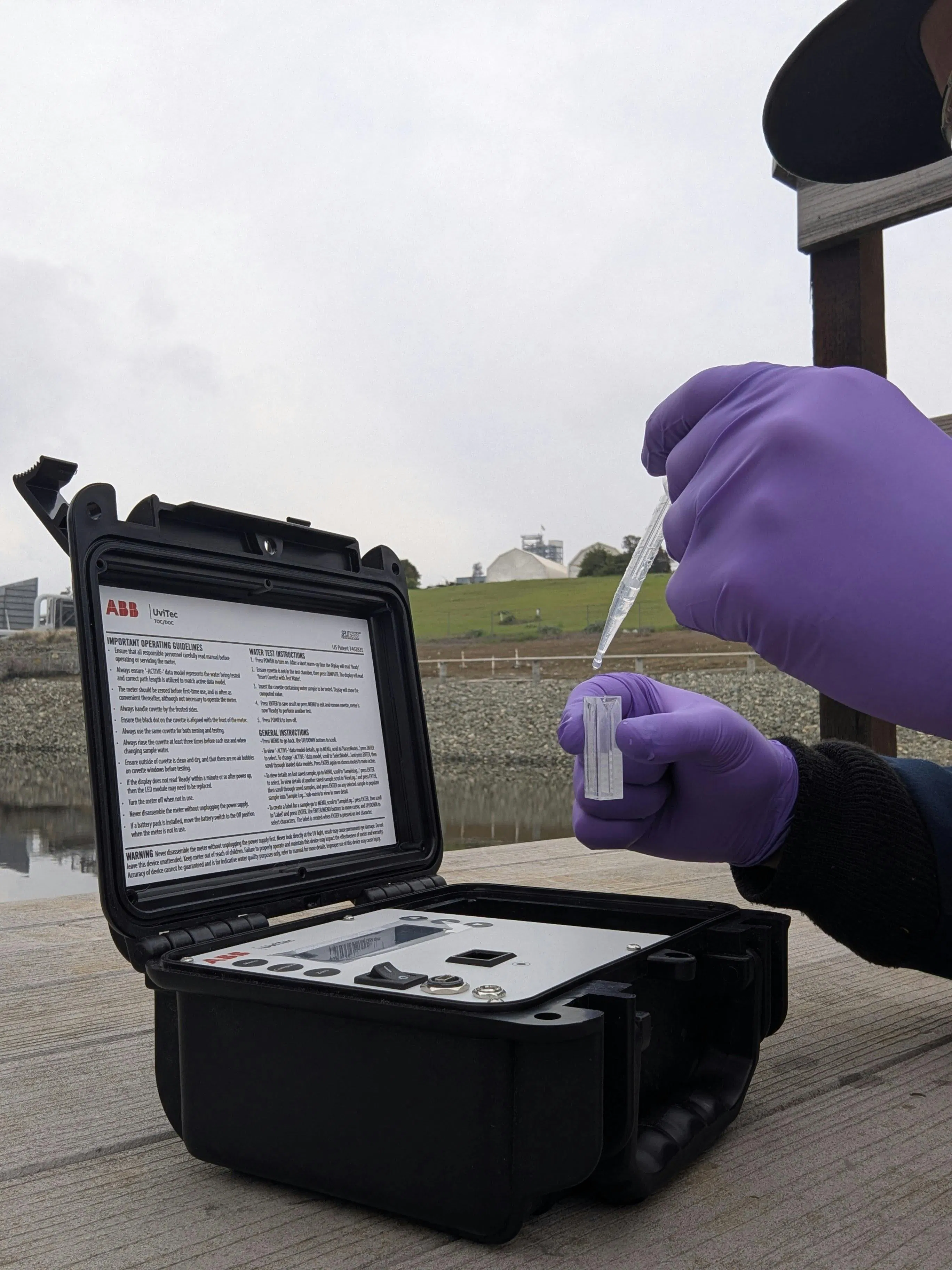
To take a measurement, a sample is poured into a small, tube-like, quartz cuvette, and inserted into a slot on the top of the analyzer (Figure 2). A few simple button presses, and about five seconds later, the TOC measurement is displayed on an easy-to-read display. Because the sample doesn’t touch the detector, no filtering or other treatment of the sample is required. Given its low price compared to the existing combustion catalytic oxidation analyzers, Hawes bought a UviTec TOC field meter in January 2025 to try it out and test it with his operators. Its success was immediate.
“I love that it’s small and portable, very easy to use, only requires a small sample size, requires no filters, ovens or reagents, and we get our analysis in 90 seconds from powering it on,” says Hawes. “It’s been amazing so far.”
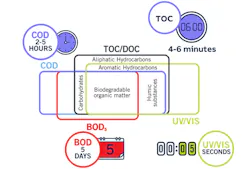
ABB’s UviTec family of analyzers delivers fast, accurate measurement by employing UV and visible LEDs across multiple wavelengths of light. Organic compounds absorb light in the UV-vis spectrum at specific wavelengths, and that data can be used to calculate TOC levels in seconds compared to hours or even days when using lab-based analyzers, which measure. UviTec analyzers are deployed in a variety of municipal and industrial wastewater applications to quickly measure TOC, dissolved organic carbon (DOC), biochemical oxygen demand (BOD) or chemical oxygen demand (COD), again, in about 5 seconds, saving time and operating costs (Figure 3).
TOC measurements are calculated based on UV-vis absorbance, so they can vary depending on which types and amounts of organic compounds are in the sample. Consequently, when the UviTec field meter is used for the first time, it’s important for users to employ a calibration model that matches the location’s site-specific water characteristics to achieve the most accurate results. The analyzer is shipped with a selection of common calibration models, and others can be set up by ABB or users based on their local requirements.
Hawes reports setting up his initial calibration, and hasn’t touched it again for more than a year. By running 15 samples from the refinery’s various wastewater streams on both the combustion catalytic oxidation analyzer and the UviTec field meter, he was able to create a calibration model in the lab’s longtime Liquid Ai data management software from ABB that continues to provide accurate results.
Liquid Ai lets users create customized data models or calibrations for their processes, in this case, with UviTec field meter. The software analyzes absorbance data from the field meter, and creates correlations based on corresponding lab data. Once the device is adjusted and validated using the software, operators can use the field meter to perform spot checks and obtain results in seconds.
“I go and check UviTec periodically against the certified reference material, and it’s incredibly stable and accurate,” explains Hawes. “We’ve had no issues at all. It’s just a win-win all around, extremely easy to maintain for the operators to run. I periodically have issues with operators crushing cuvettes, but if that's the only problem, I'll take it!”
Building on savings from UviTec
Hawes adds that UviTec field meter won’t replace the catalytic combustion TOC analyzer entirely because MRC still needs it to measure inorganic carbon and other parameters like total nitrogen. However, he plans to buy more of the new field meters to make regular TOC measurements, and gain early indications of any changes in TOC load that could impact the refinery’s wastewater treatment plant.
Beyond helping the refinery avoid non-compliance costs from overloading, Hawes adds that UviTec field meter also helps save operational expenses. “Compared to using a catalytic combustion TOC analyzer, it’s not only much less costly to buy, but less expensive to operate and service, too,” he says. “For instance, it doesn’t need a multi-thousand dollar annual service contract because there are no ovens, filters or other items needing service. Using UV-vis light means the sample only comes into contact with a very low-cost quartz cuvette that’s easy to stock and replace if needed. In addition, because it’s portable and easy to use by anyone at the site, we don’t need to staff our lab 24 hours a day to have constant reliable TOC monitoring. I’m also saving up to 15 hours of my time a month on training and troubleshooting the catalytic combustion TOC analyzers used by our operators.”
In short, Hawes sees many other uses for UviTec field meters at MRC. For example, it enables a quick 90-second TOC check of the refinery’s storm water ponds after heavy rainfalls, which would otherwise take an hour with the catalytic combustion TOC analyzer due to its start-up process and rinses are required for dirtier samples. In addition, he envisions having a UviTec field meter in his main lab to test samples contaminated with very fine, sub-micron particles that ruin the detector in the catalytic combustion TOC analyzer, which occurred recently and cost thousands of dollars to replace. In fact, avoiding one detector failure means UviTec field meter can pay for itself overnight. Finally, from a quality control system perspective. UviTec field meters provide a stable measurement check to compare the lab’s TOC analyzers with to validate performance, and help identify any detector degradation issues.
About the Author
 Jim Montague
 Leaders Logo
Leaders relevant to this article: