How patents help companies succeed in the flowmeter market
Key Highlights
- Major companies like Emerson, Endress+Hauser, Yokogawa, ABB and Krohne owe part of their dominance to strategic patent portfolios.
- Innovators like Paul Kollsman, John Pearson, Roby White, Yao Tzu Li, Anatole Sipin, and ultimately Jim Smith shaped the Coriolis flowmeter principle.
Today, much of the discussion around flowmeters focuses on present innovations and future developments. Examples include communication protocols, the Internet of Things (IoT), the limits of accuracy and repeatability, lighter and more durable materials of construction, and artificial intelligence. These examples are all important, and they influence the direction of flowmeter technology in the future.
What is sometimes lost in this discussion of future trends is the significance of past events and their role in shaping present and future trends. For example, to understand the existence of the Western and Eastern bloc countries, it is helpful to know that these political divisions were created because of the end of World War II. The United States led the Western bloc and advocated capitalism. The Soviet Union led the Eastern bloc and advocated communism. The result was the Cold War, which dominated global dynamics for several decades.
In looking at the dominant flowmeter companies today, it is natural to wonder how they achieved their leadership roles. Example of leading flowmeter technology companies include Emerson, Endress+Hauser, Yokogawa, ABB and Krohne. All these companies are leaders in one or more new technology flowmeters. While there are multiple reasons why these companies lead in different technologies, one major contributing factor is patents and the role they played in the development of these companies and their technologies.
What is a patent?
A patent is an exclusive right granted by a government to an inventor, giving them the exclusive right to produce, use and sell the invention for a limited time. A patent excludes others from copying or making use of this invention during this time. Patents are administered by different agencies in different countries. Some of these are explained as follows.
In the U.S., patents are granted and administered by the United States Patent and Trademark Office (USPTO). This agency grants design patents for 15 years and utility patents for 20 years.
In October 1973, the European Patent Convention established the European Patent Office (EPO). European patents are granted by the EPO, but they must be validated in individual member states. Examples of organizations in individual countries that administer patents include the German Patent and Trademark Office (DPMA) and the UK Intellectual Property Office (UKIPO). The EPO is made up of 39 member states.
Patents in the People’s Republic of China are administered by the China National Intellectual Property Administration (CNIPA). The CNIPA grants design patents for 15 years and invention patents for 20 years.
In Japan, patents are controlled by the Japan Patent Office (JPO). The JPO grants patents, including utility patents, for 20 years.
Patents and Coriolis flowmeters
While Coriolis flowmeters were not introduced until 1977, patents relating to Coriolis meters were approved in the early 1950s. In July 1952, Paul Kollsman presented an “Apparatus for Measuring Weight Flow of Fluids.” While it does not mention a Coriolis force, it does introduce the idea of measuring the weight or mass of a fluid. The following year, in January 1953, John M. Pearson, on behalf of the Sun Oil Company, patented a meter using a gyroscopic principle. This patent is simply called “Flowmeter,” and the meter was designed to measure mass flow.
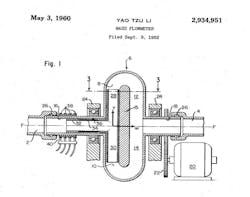
The earliest patent that includes the term “Coriolis flowmeter” was granted in 1958 to Roby White. This patent was called “Coriolis mass flowmeter” and it proposed subjecting the fluid to tangential acceleration in a whirling tube. In May 1960, Yao Tzu Li patented an invention called “Mass flowmeter” that involves rotating the flow. In 1965, Anatole Sipin was granted a patent called “Mass flowmeter systems.” He was critical of previous patents that called for rotating the fluid, saying these were too large to be practical. Instead, he proposed oscillating the fluid.
When Jim Smith came along and applied for his patent in 1975, he continued with the oscillation method introduced by Sipin in 1965. Even though this was a departure from the mechanical rotation of motion described by Gustave Coriolis, he kept the name “Coriolis.”
Jim Smith founded Micro Motion out of his garage in 1977. Micro Motion debuted its first Coriolis flowmeter in 1977—an “A” meter for laboratory use. It was followed by the “B” meter in 1978. In 1981, Micro Motion introduced the first single-bent tube Coriolis meter, the “C” meter. Then in 1983, the company added the first dual-bent tube Coriolis meter, the “D” meter, which had a 2-inch diameter. In 1984, Emerson acquired Micro Motion. This proved to be one of the most successful acquisitions in flowmeter history.
What early Coriolis patents tells us
The early patents by Smith gave Micro Motion the exclusive right to the Coriolis operating principle. This enabled the company to dominate the Coriolis flowmeter market in the early going—a dominance it has maintained to this day. Emerson Micro Motion has continued to file patents to protect different aspects of its Coriolis meters throughout the years including 2025. While other companies have generated highly successful Coriolis businesses, no one has yet been able to equal Micro Motion in terms of market share.
Get your subscription to Control's tri-weekly newsletter.
The following are advantages that patents give to companies that hold them:
- Patents can provide protection for the operating principle of a flowmeter.
- Patents protect the long-term investment needed to develop new products. It can take five years or longer to create a new flowmeter product and require substantial investment. Industry approvals may be required, along with extensive testing. Patents can protect this long-term investment by preventing other companies from coming out with a similar product during this time.
- Patents create an opportunity for long-term revenue through product design and via licensing opportunities. They also create added value during acquisitions and enhance opportunities for partnerships.
- Patents determine product categories. In the case of Coriolis meters, they determine what sensor tube shapes can be created. For vortex meters, shedder bar shape, bluff body geometry, and sensor type are all protected.
- Patents create barriers to entry by forcing potential competitors to design around existing patents. To enter the field, a company may face protected tube designs, patented sensing methods, and algorithms protected by instrumentation patents.
- Patents help companies position themselves for potential acquisition. The existence of strong IP (intellectual property) can significantly increase a company’s value.
- Patents reduce litigation risk by reducing the chance of accidental infringement and by creating negotiating leverage.
- Patents are an open book about the history of a technology. They can reveal who first came up with an operating principle, what companies first dominated a market, and when technological shifts occurred.
- Patents can create a long-term competitive advantage. Companies that receive patents and maintain them and then go on to introduce new patents can gain a competitive advantage by owning the rights to certain methods or technologies.
- Patents protect the investment behind a flowmeter design, feature, or principle, and enable companies to maintain long-term leadership. Patents can provide technological differentiation and enable companies to ride out the long-life cycles of flowmeter product lines.
There is more patent activity among companies making new technology flowmeters than among those making conventional meters. The principles of operation for most conventional flowmeters, such as positive displacement and turbine, were invented between 1950 and 1950 and initial patent protections have expired. These meters also tend to be more mechanical in operation, so there is less patent activity surrounding electronics. The principles of operation are well understood, and incremental changes may be difficult to patent.
New technology flowmeters, by contrast, were invented after 1950. They are predominantly electronic and operate using advanced communication protocols and advanced sensing technologies. New technology meters are more accurate than many conventional meters, and they are widely used for high value measurement. As a result, there are patents surrounding sensor type, materials of construction, ultrasonic path configuration (ultrasonic), tube design (Coriolis), and many other advanced features. Companies that invest heavily in research and development and translate this effort into patents are the ones most likely to succeed in the flowmeter world.
About the Author
 Jesse Yoder
Jesse Yoder
Columnist
Jesse Yoder is founder and president of Flow Research Inc., which conducts market research studies in a wide variety of areas, including the flowmeter market.
 Leaders Logo
Leaders relevant to this article: