Why tight coupling is a key to high flowmeter performance
Key Highlights
- The most important factor behind flowmeter accuracy is how tightly the meter’s operating principle is coupled to the actual flow variable (mass or volume).
- Meters that infer flow indirectly (using heat transfer, vortices, pressure drop, or empirical correlations) are inherently less accurate than meters that directly measure mass or volume.
Flowmeters come in many types: Coriolis, magnetic, ultrasonic, vortex, differential pressure, turbine and variable. Each measures flow in a different way and comes with its own accuracy specification. However, the question that underlies all this is why some flowmeters are more accurate than others.
I believe the single most important factor is that the most accurate flowmeters have a close connection between the operating principle of the flowmeter and the variables it depends on to generate the output. When those variables are small and can be precisely determined, it’s tightly coupled. A flowmeter is loosely coupled when its output is influenced by variables whose values are not precisely determined by the operating principle.
Some flowmeters are more accurate than others because their operating principle is tightly coupled to mass or volumetric flow. Others require inference, modeling or secondary variables that introduce uncertainty because they cannot be measured with precision. What is tight coupling and why is it a key to understanding flowmeter accuracy?
A new thinking on flowmeter accuracy
Many flowmeter discussions focus on electrode materials, bluff body geometry, signal processing, Reynolds numbers, transducer signals or installation effects. Beneath all of that lies a simpler, more fundamental truth: flowmeters differ in accuracy in part because they differ in how much the output value depends on precisely measured values.
The relationship between coupling and accuracy can be viewed as a continuum. In general, tightly coupled flowmeters tend to support higher accuracy, moderately coupled meters tend to support moderate accuracy, and loosely coupled meters tend to support lower accuracy. The concept of tight vs. loose coupling can be most easily seen by looking at examples.
Coriolis
Coriolis flowmeters have tight coupling. They measure mass via the deflection of a vibrating tube caused by inertial mass. The fluid particles experience inertial forces due to the combination of their linear flow through the tubes and the oscillatory motion of the tubes. These inertial forces result in a secondary twisting motion in the vibrating tubes. Inlet and outlet sensors detect the phase shift caused by the induced twisting motion. The phase difference (ΔT) detected by the inlet and outlet sensors is directly proportional to mass flowrate. There are few intervening variables.
Positive displacement
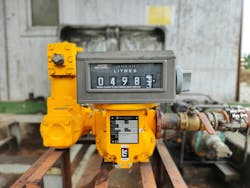
Positive displacement meters have tight coupling. Each “fill and sweep” cycle displaces a known volume. Almost no assumptions are involved. Positive displacement meters measure actual volume, although as mechanical meters they are subject to wear. Their accuracy can also be affected by variations in temperature and pressure, and by entrained air or gas in the fluid. These meters can cause pressure drop, especially at high flow rates. Despite these known issues with their operation, their output depends on few if any imprecisely defined variables when they are working properly.
Magnetic
Magnetic flowmeters measure velocity via Faraday’s Law: when a conductive liquid flows through a magnetic field generated by the meter, it induces a voltage signal proportional to the fluid's velocity. Using velocity, we can calculate that volumetric flow = velocity × pipe area.
Magnetic flowmeters require conductivity but few secondary factors. They are very stable if the pipe is full and the diameter is known. Magnetic flowmeters rely on magnetic field strength, electrode spacing and induced voltage to determine flow velocity. These are precisely determined variables.
Magnetic flowmeters precisely determine the electromagnetic interaction between the fluid and the measuring field, but their output remains influenced by velocity profile and conductivity distributions that are not precisely determined by the operating principle. Factors that affect velocity profile include upstream piping, elbows, valves and reducers. Swirl and asymmetry shift the effective averaging. Partially conductive fluids or coatings change current paths. Electrode fouling alters the effective measurement volume. Particulate matter such as sand can damage or erode the electrodes and can cause uneven flow. Air bubbles can disrupt the conductivity of the meter. Because these variables are not precisely determined by the operating principle, magnetic flowmeters are moderately coupled.
Vortex
Vortex flowmeters are moderately coupled. They operate by measuring the frequency of vortices generated downstream of a bluff body—a phenomenon that depends on velocity but is influenced by flow profile, pipe geometry, Reynolds number, bluff body shape, vibration, and installation conditions. Vortex meters just count the vortices without regard to their size, strength, and coherence. They have looser coupling than Coriolis meters because the accuracy of vortex meters depends on a variety of imprecisely determinable conditions. This explains their lower accuracy under real-world conditions. Temperature and pressure readings are required for mass flow measurement, introducing two more variables.
Get your subscription to Control's tri-weekly newsletter.
Thermal
The operating principle for thermal flowmeters requires heat transfer from the sensor to the flowing fluid. Heat transfer is proportional to mass flow, but the reading depends on fluid properties whose value is not determined by the principle itself. For example, heat capacity depends on gas composition and varies with temperature and pressure. Thermal conductivity also varies with gas composition. Heat transfer varies significantly with laminar vs. turbulent flow. While thermal flowmeters are good for clean uniform gases, they do not perform as well for varying gas mixtures. Most thermal meters do not perform well on liquids. Flowrate is inferred from heat-transfer behavior, which itself depends on multiple fluid properties that are not precisely determined from the thermal flow principle. As a result, thermal flowmeters are loosely coupled.
Variable area
Variable area flowmeters have loose coupling. The float position is affected by viscosity, density, friction, and user interpretation. Manual reading introduces additional looseness. Even though some suppliers have introduced transmitters to read the height of the fluid, the connection between fluid height and flowrate remains loose.
How to improve performance
This analysis can be performed for any flowmeter. The ones described here are a representative sample. In general, a tight physical coupling between a flowmeter occurs when the reading depends on few variables and these variables can be determined with a high degree of certainty. The coupling becomes looser as the flow reading depends on more variables and these variables cannot be measured precisely. Values such as temperature and pressure that are read “live” and that reflect current conditions are preferable to ones read off a table.
Proper calibration, a favorable flow profile, removing impurities from the fluid, and proper installation can all improve the performance of any meter. However, the principle of operation of certain meters such as vortex and thermal make it unlikely that these meters will achieve the accuracy of Coriolis and positive displacement meters.
In addition to the type of meter, fluid type plays a major role in flowmeter performance and accuracy. Even Coriolis meters cannot achieve the same high accuracy on gas as they do on liquids, while vortex meters perform well on steam. Both vortex and differential pressure (DP) flowmeters use temperature and pressure values, along with volumetric flow, to determine mass flow. Multivariable vortex and DP flowmeters incorporate temperature and pressure sensors to provide an “on-board” way to provide mass flow.
One approach that suppliers can take to improve performance is to identify any imprecisely determined variables that affect a flowmeter’s performance and try to make them more precise. This could involve replacing a thermistor with an RTD, improving the pressure reading, or removing impurities from the flowstream. It could also involve adding diagnostics to the flowmeter. It is important to keep in mind that not all applications require custody transfer accuracy, and identifying the variables that help determine flow output can often be a path to better performance.
About the Author
 Jesse Yoder
Jesse Yoder
Columnist
Jesse Yoder is founder and president of Flow Research Inc., which conducts market research studies in a wide variety of areas, including the flowmeter market.
 Leaders Logo
Leaders relevant to this article: