Stronger-than-steel magmeter liners
Everyone talks about external threats and shielding, but as usual, there seem to be few discussions about internal protections. Well, over the years, chemical manufacturers have implemented increasingly durable piping and liners, which can armor-up and restore the insides of pipes to water mains and sewers. More recently, cross-linked polyethylene (PEX) has become common in various chemical applications, and now others can benefit as well. Traditionally, a common liner material in industrial applications has been polytetrafluoroethylene (PTFE), which contains per- and polyfluoroalkyl substances (PFAS) or “forever chemicals.”
“Most magnetic flowmeters use similar plastic or rubber liners to protect against abrasive substances and harsh chemicals, but they’re also needed because these liners are made of non-conductive materials. This prevents measurement interference, allowing the electromagnetic coils in a magmeter’s pipe section induce a magnetic field and collect its measurements,” says Laura Chemler, product manager for magnetic and vortex flowmeters at Emerson. “Different liner materials exist to support a variety of process application needs, including durability, chemical compatibility, and recently the additional concern around PFAs.”
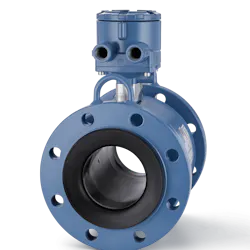
Fortunately, Emerson took these lessons to heart, and is releasing PEX liners for its Rosemount 8750W magnetic flowmeters, Rosemount 8705 flanged magnetic flowmeter and Rosemount MS magnetic flowmeter sensors, which are designed to process conductive fluids from water and wastewater to harsh chemicals to slurries or other abrasive media. Reported to be the world’s first PEX liners for magmeters, they give users longer-lasting, PFAS-free protection that improves reliability in chemically aggressive conditions, while also simplifying stocking and compliance tasks.
“PFAS can be eliminated from 95% of PTFE applications by using PEX liners,” adds Chemler. “PEX has similar chemical compatibility to PTFE. Plus, PEX is four times more durable than carbon steel, which means users may have to replace their pipes before their magmeter because the pipes are more likely to wear out first.”
Another longstanding problem with the plastics traditionally used in flowmeter liners is they can become distorted and flare while waiting in storage before installation, or if they aren’t installed properly, or if they’re removed temporarily for maintenance and then reinstalled. These issues this can cause fitting and maintenance problems later.
Get your subscription to Control's tri-weekly newsletter.
“There’s been constant R&D about liner types and materials over the years because users need a variety of suitable capabilities. However, they also don’t want endless solutions, so there are efforts to consolidate, and focus on the most useful options,” explains Chemler. “PEX was identified because it’s more durable than steel and ceramics. It’s a natural fit for magmeter liners because it’s already so widely accepted in plumbing and other applications. However, PEX has usually been deployed in smaller, narrower pipes, so we also had to work on adapting it for larger, wider pipes. PEX liners are presently available for Rosemount magmeters up to 8 inches, and larger sizes are in development.”
Because they’re made of just one type of plastic, PEX liners simplify material selection and stocking requirements compared to fluoropolymer-based liners, which typically employ different construction materials depending on each application, and are usually more expensive. In addition, PEX features:
- NSF/ANSI/CAN 61 approval for drinking-water applications;
- Chemical resistance similar to PTFE, but covering a wider range of conductive chemicals. This enables PEX liners to often cover a facility’s entire range of applications, unlike PTFE; and
- Process flow temperature range from 0 °F to 203 °F (-18 °C to 95 °C).
“Magmeters require almost no maintenance, so they can last as long as their liners and electronics hold out. Of course, their lifecycle also depends on the severity of each application,” adds Chemler. “Users want PEX because it’s a familiar, proven material, it has PTFE’s capabilities, it doesn’t contain PFASs, and it’s affordable. This is a win-win-win for users that meet their needs where they are.”
For more information, visit www.emerson.com/magneticflowmeters
