Large pipe flow measurement: large sensors or small meters?
Key Highlights
- Rather than building ever-larger Coriolis, vortex or ultrasonic sensors, engineers can use smaller measuring paths and combine their outputs to accurately measure flow in large-diameter pipelines.
- Dual-tube designs simplify sensor construction, enable redundancy and fault detection and may reduce manufacturing and calibration costs while maintaining measurement accuracy.
- The architecture can integrate Coriolis, ultrasonic, vortex, thermal, DP and other measurement technologies into a single hybrid, multivariable platform with enhanced diagnostics and verification capabilities.
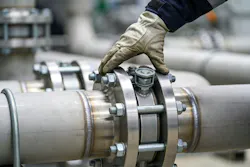
Flow measurement in large pipes presents a challenge for many types of flowmeters. Coriolis meters become heavier, more unwieldy, and more expensive as the line sizes they are measuring increase.
Vortex meters face similar issues. As line sizes increase, bluff bodies grow larger and vortex shedding frequencies decrease. Ultrasonic meters do better as line sizes increase, but large acoustic path lengths may weaken the signal. Both clamp-on and insertion ultrasonic meters address the issue of line size, but their performance does not typically rise to the level of inline meters.
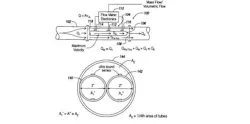
Dual-tube meter
The assumption underlying most attempts to measure flow in large pipes is that it is necessary to build a measuring element at roughly the size of the pipe to accurately measure flow through a large pipe. For Coriolis meters, the vibrating flowtubes for a 12-inch meter are roughly 12 inches in diameter. The traditional approach of Coriolis meter designers to measuring flow in large pipes is to build a larger flowtube, increase tube diameter, increase driver power, manage vibration and structural issues, and measure all flow through one Coriolis meter.
An alternative approach might be fruitful. What if instead of building larger sensing elements, we divide the flow into two or more smaller paths, measure the flow within those paths, and combine those measurements to determine total flow through the large pipe? For example, instead of building a single 12-inch Coriolis meter, the flow could be divided into two 4-inch measurement tubes. Once the two flows are measured through those tubes, they are reunited and flow measurement through the large pipe can be determined. This makes the Coriolis measurement possible with smaller and more manageable vibrating tubes.
It is not even necessary to divide the flow. One approach uses a flow splitter to route the flow though the two tubes suspended inside the meter body. Another approach simply allows the flow to pass through the tubes, with the remaining flow passing around the tubes. Either design can be effective and it is a question for empirical testing which one is superior.
The same principle can be applied to other flow technologies, including at least vortex, ultrasonic, turbine, thermal, differential pressure (DP) and magnetic sensors. Rather than continuously building larger flow elements, divide the flow, measure it in smaller and better controlled passages and combine the results. Or simply allow the flow to pass through and around the tubes, sending it back into the pipe after the measurement is made.
Smaller Coriolis tubes are easier to vibrate, and smaller vortex meters generate higher shedding frequencies and stronger signals. Yet, the result is the same: measurement of flow through a 12-inch or other large pipe. Smaller measuring elements may also be less expensive to build and calibrate than a single large sensor.
This concept is not purely theoretical. I was issued patents in 2015 and 2017 covering dualtube architecture based on this principle. Turbine and vortex prototypes were subsequently built by two manufacturers and then evaluated at CEESI in 2019 and 2020. Following the tests, the CEESI engineer responsible for the work stated, “We were able to prove out the basic principle of the meter. I also agree that this design can also be applied to larger geometry.”
Get your subscription to Control's tri-weekly newsletter.
The testing at CEESI demonstrates that flow can be divided, measured through multiple internal measurement paths, and then recombined to determine flow in a larger pipe.
Two tubes are better than one
There are many reasons why two tubes are better, in many cases, than one, depending on the application. This arrangement supplies redundancy; if one tube fails or gets clogged, the two outputs won’t match, and an alarm can be set. Two tubes provide additional diagnostics. Because each tube serves as an independent measuring sensor, after calibration the two results can be sent to a transmitter or flow computer where they are blended to yield a single measurement.
Another option is putting different technologies in the two tubes. A thermal meter can be paired with an ultrasonic meter to enhance performance at both low and high flows. This is like the design of a compound meter that combines a turbine with a positive displacement meter to better manage low flows and high. Compound meters are used in apartment buildings to measure high flows during the morning and evening and to measure low flows at night.
The concept of measuring flow through a small tube inside a larger meter body is not limited to dual-tube meters. It can also apply to placing a single tube inside a large meter body. One approach, for example, calls for placing a 4-inch Coriolis meter inside a 20-inch pipe. The flow through the 20-inch pipe can be determined by measuring the flow through the 4-inch tube with proper calibration and by applying a correction factor. It is much easier to oscillate a 4-inch tube than a 20-inch tube. No one has successfully built or marketed a 20-inch Coriolis meter with a 20-inch measuring tube. Size and physical constraints make it difficult to oscillate a 20-inch measuring tube.
The story doesn’t end there. This concept has evolved into a broader hybrid measurement platform. Because the measurement is technology-independent, different flow technologies can be combined in the same system. One possibility is combining Coriolis and ultrasonic measurement paths. The entire structure also serves as a primary element, since there is pressure drop, yielding a third measurement of DP flow. Such a hybrid meter would have powerful diagnostic capabilities. Adding a densitometer enables mass flow calculation, while adding temperature and pressure measurement provides additional diagnostics and verification.
Viewed this way, the dual-tube architecture becomes more than a single meter design. It becomes a platform for combining multiple measurement technologies within a single flow measurement system. The underlying idea is simple: Rather than continuously building larger measuring elements, it may sometimes be more effective to measure them in smaller and better-controlled passages and then recombine the results. The flow does not necessarily have to be divided. Single or dual measuring tubes that flow over and around the tubes can also be successful.
This was the design that was evaluated at CEESI. The original dual-tube prototypes demonstrated the principle. The next step is to explore how that principle can be extended into a new generation of hybrid and multivariable flow measurement systems.
For more information, visit https://worldflow.com/wp/.
About the Author
 Jesse Yoder
Jesse Yoder
Columnist
Jesse Yoder is founder and president of Flow Research Inc., which conducts market research studies in a wide variety of areas, including the flowmeter market.
 Leaders Logo
Leaders relevant to this article: