Why a pipe’s inside diameter is vital for accurate flow measurement
Key Highlights
- The cross-sectional area used in flow calculations depends on the actual inside diameter, which can change after installation because of scaling, corrosion, deposits and temperature effects.
- Calibration typically occurs under controlled conditions with a clean, well-defined flow passage. Changes to the pipe geometry or flow profile in service can introduce additional measurement uncertainty.
- Inline and clamp-on ultrasonic meters depend on the physical dimensions of the pipe and the path of the ultrasonic signal. Deposits and changes in the flow passage can affect both signal propagation and calculated flowrate.
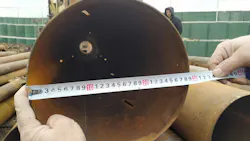
Every flowmeter uses one aspect of the fluid as its fundamental measuring principle, and nearly every flowmeter must ultimately account for the geometry of the flow passage. The cross-section of the pipe is one of the fundamental quantities underlying flow measurement and determining that area requires knowing the inside diameter of the pipe.
What is volumetric flow?
Fluid volume is the three-dimensional amount of fluid contained in a bounded region. This definition distinguishes fluid volume from length, which is one-dimensional, and from area, which is two-dimensional. When we measure fluid volume, we compare the amount of volume to some specific unit of volume. Examples of volumetric units include teaspoon, quart, gallon, liter, cubic inch, cubic foot, cubic centimeter and cubic meter.
When we measure volumetric flow, we measure the volume of fluid that passes a point in a specified amount of time.
Examples include:
- Cubic feet per second;
- Cubic meters per hour;
- Gallons per minute; and
- Liters per second.
Measuring flow in round pipes
The value of Pi (π) plays a crucial role in flow measurement. There is no escaping the need to measure the area of a pipe when calculating flow. The formula for measuring volumetric flow is:
Q = A * v
Here, Q is the volume of flow that passes a specific point in a unit of time, and A is the cross-section of the inside of the pipe. Meanwhile, v is the average flow velocity. Cross-sectional area is calculated using the formula:
Area = π * r2
This means that the formula for area is a part of most calculations for the flowrate for fluid flowing through a round pipe. Engineers typically use 3.14, 3.1416 or 22/7 as the value for π. According to traditional mathematics, this gives an approximation of the area, since we cannot truly know the value of π. The result of The Rope Experiment is that we can know the actual value for area. The precision required dictates how many digits should be used in each situation.
The average fluid velocity (v) is the average velocity across the cross-section of the pipe. The velocity of a flowing fluid is usually not the same at every point in the pipe. Different flowmeter technologies determine this average velocity in different ways. The average velocity is the single velocity value that, when multiplied by the pipe cross-sectional area, gives the correct volumetric flowrate.
Measuring a round pipe
The Greek philosopher Plato said mathematics is not about actual squares and circles, and other geometric shapes, but about the ideal shapes that these figures represent. For example, if the surface of a desk does not have perfectly straight edges, we still feel comfortable using the formula length x width to calculate its area. Another way of saying this is that geometry is about ideal shapes and figures even though the actual objects we are talking about are not ideally round or ideally square.
In the case of pipes that contain fluid to be measured, there are other issues that affect the measurement besides the fact that the mathematics assumes an ideally round pipe. If all pipes were perfectly round, then there would be no issue with using the formula for the area of a circle to calculate their area. But there are multiple factors affecting the roundness of a pipe.
When considering the area of a pipe, it is important to consider the fact that pipes are three-dimensional objects. Pipes have an outside diameter (OD) and an inside diameter (ID). It is only the inside diameter of the pipe that is used when cross-sectional area is being calculated.
Inside diameter
The inside diameter of a pipe is often treated as an assumed rather than a measured length. It may be determined from pipe size, or the value used upon commissioning of the flowmeter. The reality is that the inside diameter of the flow passage can change over time after the flowmeter is installed and fully operational.
Get your subscription to Control's tri-weekly newsletter.
Not all pipes are perfectly round. When flowmeters are calibrated, they are calibrated on clean pipes with no sediment or buildup on the walls. Once flowmeters reach the field, they enter a new world where sediment and buildup can occur. This can occur in many ways. Many physical processes can alter the inside diameter of a pipe after it has been installed.
Scaling: When hard water is heated, minerals can precipitate and form hard, chalky deposits in pipes because of the high levels of calcium and magnesium in hard water. This scaling hinders water flow, reduces appliance efficiency and increases energy costs. Over time, it narrows the pipe’s diameter, increasing the chances of blockages and leading to more frequent maintenance and potential replacements. Chlorine and disinfectants in municipal water supplies can react with pipe materials, degrading the pipe’s inner surface.
Corrosion: Corrosion in water pipes is the result of the interaction of water, oxygen and other elements of a pipe’s environment. Corrosion can weaken the interior and exterior of the pipes. Aging pipes are subject to corrosion when exposed to oxygen and water, especially pipes made from metals such as iron, steel or copper. The process degrades the material, forming rust and releasing sediments into the water supply. The weakening integrity increases the risk of leaks and can lead to significant water damage and costly repairs. Rust and other compounds can build up on the inner pipe wall, reducing the internal diameter of the pipe and restricting the flow and increasing pressure loss.
Temperature changes: Extreme temperature changes can cause minerals to precipitate and solidify, forming deposits on the inner surfaces of pipes. In hot water systems, heat can induce calcium carbonate precipitation. These deposits can reduce pipe diameter, increase pressure, and decrease water flow.
Inside diameter is especially important for ultrasonic flowmeters, which use the distance from one side of the pipe to the other in their computation of flowrate. While this can be an issue for inline ultrasonic meters, it is also important for clamp-on ultrasonic meters. Clamp-on ultrasonic meters base their flowrate calculations on a signal sent through the pipe wall and to the other side of the pipe. Buildup in the pipe can contribute to the attenuation of the signal. It can also affect the calculation of the flowrate.
There are many other issues providing uncertainty in flow measurement including flow profile, cavitation, turbulence, repeatability and two-phase flow. These issues must be addressed, and this is what manufacturers do in their research and development efforts, using the math that is available to them. Having a rational value for the area of a circle may reduce one source of uncertainty.
Since the cross-section of the flow passage is fundamental to most flowrate measurements, whether volumetric or mass, understanding how that area is determined is essential to understanding flow measurement itself. Having a rational value for calculating cross-section is another step toward producing accurate and repeatable flow measurements.
Where is the ID?
The cross-section used in flow equations is often represented as though it were an infinitely thin mathematical plane. Actual flow measurement is different. Every flowmeter senses flow within a finite measuring region. The cross-section is not an abstract geometric surface but the cross section of a three-dimensional flow passage having finite dimensions. Consequently, the cross-sectional area may vary with location, wall deposits, corrosion, manufacturing tolerances and other physical conditions. The geometry used in flow measurement is therefore the geometry of physical objects, not ideal mathematical figures.
About the Author
 Jesse Yoder
Jesse Yoder
Columnist
Jesse Yoder is founder and president of Flow Research Inc., which conducts market research studies in a wide variety of areas, including the flowmeter market.
 Leaders Logo
Leaders relevant to this article: