80 GHz frequency-modulated continuous wave radar level transmitters
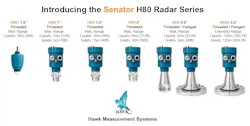
The Senator H80 Radar Series is a line of 80 GHz frequency-modulated continuous wave (FMCW) radar level transmitters aimed at liquid, slurry and solids applications across process industries.
The series extends Hawk Measurement Systems’ existing level measurement lineup, which includes acoustic, ultrasonic, microwave, guided wave radar, fiber-optic, laser and sonar technologies, enabling a single point of contact for facilities that need to match different measurement technologies to different vessels or process conditions within the same plant.
The Senator H80 line consists of two variants built around the same 80 GHz radar platform.
The Senator H80C (compact radar) is a smaller-footprint unit intended for tighter installation points and moderate measuring ranges up to 30 m (98 ft). It targets tanks, sumps, and process vessels where space or budget constraints rule out larger radar installations.
The Senator H80I (integral radar) is a ruggedized version built for harsher service, with measuring ranges extending to 120 m (393.7 ft) on both liquids and solids. High-temperature variants are rated for process temperatures up to 260 °C (500 °F). The H80I includes an onboard keypad and display for local configuration and diagnostics without a separate handheld or laptop connection.
At 80 GHz, the units produce a narrower beam angle than lower-frequency radar transmitters, which Hawk says improves signal clarity and measurement reliability in vessels with obstructions, agitators or nozzles, as well as in atmospheres carrying steam, dust, foam or vapor—conditions that commonly degrade radar and ultrasonic signal return.
Both models connect via Bluetooth to PC-based configuration software, allowing setup, calibration, and diagnostic checks to be performed without opening the transmitter housing or working directly at the process connection.
The Senator H80 Series as suited to mining and minerals processing, oil and gas, chemicals and petrochemicals, cement and building materials, food and beverage, pulp and paper, and water and wastewater treatment. As a non-contact measurement technology, the radar units avoid direct exposure to process media, which is intended to support longer service life in corrosive, abrasive, or otherwise contaminated environments compared with contacting level technologies.