Mainstream wireless monitoring and maintenance
Key Highlights
- Wireless technologies such as WirelessHART, LoRaWAN and cellular are increasingly used for data collection and monitoring in industrial environments, offering longer distances and lower costs.
- Case studies demonstrate how Emerson’s wireless solutions have enabled plants like LyondellBasell to extend preventive maintenance cycles from months to years, saving thousands of man-hours.

Depending on the industries and applications where its deployed, wireless has been proving itself on plants floors and out in the field for 15-20 years or more, typically for data gathering, monitoring and other non-control tasks. Some wireless technologies, like radios and satellite communications, have been widespread for decades. Several others, like Wi-Fi, Bluetooth and cellular, emerged more recently, achieved standardization, and quickly became ubiquitous. Their deployments are based largely on the different distances, signal strengths, power requirements and data volumes they provide, and how well they can meet users’ requirements.
“We’re still seeing a lot of conversations about which wireless protocols are most effective for reporting data and what their tradeoffs are for production devices. The main competition used to be between ISA100 and WirelessHART standards, but long-range wide-area networking (LoRaWAN) and low-power cellular have been gaining popularity for IIoT applications,” says Andrew Cureton, business development manager for Emerson’s Pervasive Sensing division for the chemicals industry. “There’s value in each depending on what individual applications need, but users continue to demand longer distances, greater data fidelity and reduced costs.”
For instance, 20 miles east of downtown Houston, LyondellBasell’s 4,000-acre Channelview petrochemical complex employs more than 1,900 staffers, and is one of the largest on the Gulf Coast. To improve continuous field instrument and valve monitoring, and extend preventive-maintenance (PM) cycles, the company recently needed to integrate Emerson’s AMS Device Manager PM software with two olefin units controlled by non-Emerson DCSs. These dissimilar systems could be integrated using multiplexers, but that method is often time-consuming.
Jerry Thompson, I&E maintenance specialist at LyondellBasell’s Channelview North division, reports it initiated a small, seed project to determine if Emerson’s Smart Wireless technology could obtain diagnostic data from the plant’s smart field devices and other equipment. The project established two WirelessHART mesh networks in the benzene and toluene (BT) unit by attaching Emerson’s Smart Wireless THUM (The HART Upgrade Module) adapters to 65 instruments and digital valve positioners. These adapters can be retrofitted onto existing two- or four-wire HART devices to continuously transmit diagnostic data produced by those devices. Each THUM not only transmits data wirelessly, but also acts as a router for other adapters on the network, and relays transmissions along until they reach one of Emerson’s Smart Wireless Gateways. If there’s an obstruction, this self-organizing network seeks and finds an alternate path.
Next, information received by the two gateways is passed via Ethernet to AMS Device Manager in the BT unit’s I/O room. Device information is viewed on a client PC in the instrument shop, where a technician checks AMS Device Manager’s Alert Monitor each day for signs of degradation or lagging performance, which means there is much less chance of something happening without warning. If a status change of status is noticed, supervisory personnel have plenty of time to determine what type of maintenance or repair is necessary, and when to perform it. The resulting comfort level enabled LyondellBasell to reduce routine PMs on its devices from monthly to once every three years, eliminating multiple PM cycles. Since every scheduled PM takes a minimum of four hours to complete, the plant eliminated 1,400 man-hours of work. Thompson reports big savings can be realized by extending PM schedules on hundreds of control valves and other instruments.
“We forged a new frontier by monitoring our installed instrument base using wireless, and we proved it to be a useful technology,” says Thompson. “If you have the latest instrument technology and AMS Device Manager to monitor it, you can push preventive maintenance out four to seven years. Our next goal is to get wireless diagnostic data onto our process control network, so users can see these points at any time.”
Get your subscription to Control's tri-weekly newsletter.
Likewise, to alleviate severe corrosion among pressure-relief valves at the top of a crude distillation column, Preem’s Lysekil refinery in Sweden initially redesigned the area’s complex arrangement of piping and valves, and replaced a broken injection quill that injects corrosion-neutralizing amine into the pipes. This solution worked briefly, but a high rate of corrosion reoccurred after a few months.
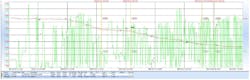
Preem’s corrosion engineer, Joakim Nilsson, deployed Emerson’s Rosemount Wireless Corrosion and Erosion transmitters to continuously monitor the column’s corrosion rate and identify its root cause. Correlating corrosion and process data using AspenTech IP.21 software showed the persistent corrosion was caused by high salts in a specific crude slate, which produced corrosion further down the process (Figure 1). However, when this new crude was blended back out, the corrosion still didn’t stop. The refinery’s team inspected the injection location again, and found the injection quill was broken again, likely causing inhibitor to spread along the pipe wall where the non-intrusive transmitters were located.
Consequently, the problematic amine injections were stopped in July 2021, which reduced the corrosion rate. A second new injection quill was installed in September 2021. Preem has prevented further corrosion, ensured the pipes’ integrity and longevity, and implemented more effective predictive maintenance that avoids unexpected shutdowns. “Using Rosemount Corrosion and Erosion Transmitters with AspenTech IP.21 software, we quickly detected and diagnosed the corrosion’s root cause, which let us take measures to prevent it from happening again,” says Nilsson. “This also avoided further unplanned outages, saving time and money.”
To make wireless sensing more affordable and widespread, Cureton reports Emerson is introducing Synchros low-cost, compact, surface-mount, WirelessHART sensors for numerous common, time-consuming jobs, such as heat-trace and environmental temperature monitoring. In the future, it also plans to introduce Synchros sensors for level, pressure, electrical measurement and discrete detection, and enable them to support other protocols.
“While traditional sensors must measure parameters like temperature accurately, newer, lower-cost devices can check temperatures for indication. They’re still reporting values, but they don’t need to be as accurate because their users just want to know, for example, if a process or product is within a 10 °F range,” explains Cureton. “Sensors like Synchros are also communicating and interoperating more often with cloud-computing services, so we’re also pursuing more analytics and maintenance in the cloud, too. They can be integrated with valves, transmitters and other components, and make them more usable and streamlined for users, who typically have to manage hundreds or thousands of these devices.”
This is part one of Control's February wireless feature. Read the other installments here.
About the Author
 Jim Montague
 Leaders Logo
Leaders relevant to this article: