Have lower power, will travel—by wireless
Key Highlights
- Wireless protocols such as ISA100, WirelessHART, Wi-Fi, Bluetooth and LoRaWAN are increasingly used in industrial environments for monitoring and control.
- LoRaWAN offers low-power, long-range communication ideal for simple data transmission over extended distances, leveraging sub-GHz spectrum around 900 MHz.

While two of the longest-established wireless protocols based on the IEEE 802.15.4 standard, ISA100 and WirelessHART, have been up and running for many years, they’ve recently been joined by ubiquitous, mainstream protocols like Wi-Fi and Bluetooth. However, because in-the-field users always need more capabilities, they also spurred development of lower-power protocols like LoRaWAN that can send less data over often longer distances, which better suits many process applications.
“We’ve been deploying wireless for more than 15 years, and we’re a founding member of the ISA100s standard. However, in 2019-20, we also started working with LoRaWAN, and introduced our Sushi wireless sensors for monitoring vibration, and later added versions for checking pressure, temperature and steam traps,” says Steven Webster, emerging solutions product manager at Yokogawa. “We’re also extending Sushi with cloud-based solutions such as Wide Area Monitoring (WAM) and Asset Health Insight (AHI). Yokogawa also has standalone, data acquisition (DAQ) software called GA10 that comes with preinstalled artificial intelligence (AI) functions to improve predictive maintenance.”
Before implementing these innovations, Webster reports it’s still crucial for users to walk through their facilities, conduct a site survey, and test Sushi sensors and other wireless components to make sure they can deploy them properly and successfully.
“LoRaWAN leverages sub‑GHz spectrum around 900 MHz to support low‑power, long‑range communications with more consistent coverage in complex environments than higher‑frequency, wireless technologies such as 2.5 GHz Wi‑Fi,” explains Webster. “LoRaWAN is also low-power, so it can use 3.6 VDC batteries. However, it’s data rate is small, so it typically relays simple information like tag names, process variables, or GPS coordinates. It can also go longer distances if line-of-sight is available, and also benefits from one-to-one gateway connections that can help reduce latency.”
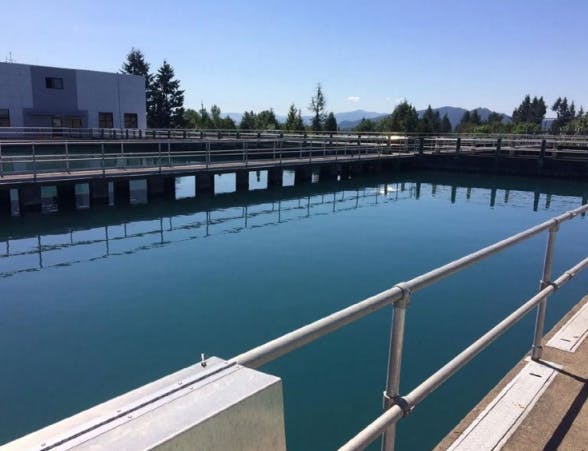
Similarly, Oregon’s largest, customer-owned utility, Eugene Water & Electric Board, recently sought mobile access to its wastewater control system for its operations and maintenance staff from anywhere in its facility. The single plant has multiple building and other structures that could interfere with wireless signals, but the municipality required 100% wireless coverage with no access loss. It operates five main processes, and can treat up to 277 million gallons per day for the city’s 200,000 residents (Figure 1).
Get your subscription to Control's tri-weekly newsletter.
EWEB collaborated with Yokogawa to develop a dedicated, cybersecure wireless network with remote connectivity. Their site survey identified optimal, indoor and outdoor locations for wireless access points, and its subsequent report specified suitable networking hardware, and secure network segregation and integration based on the IEC 62443 standard. The design also included installation and configuration of centralized patch management and antivirus software, backup and recovery functions, and system hardening. To implement the design’s capabilities, the utility adopted Yokogawa’s VTS Portal software to provide secure remote access and monitoring via its wireless network.
“Beyond performing site surveys and initial testing, Webster adds that users should be trained to recognize potential issues when deploying LoRaWAN or other emerging wireless technologies. He also recommends starting with a small pilot, such as deploying five to 10 Sushi sensors, and verifying their performance in the specific application and operating environment before scaling up to dozens or hundreds of instruments.
“It’s also important to evaluate the capacity of LoRaWAN wireless gateways, such as Yokogawa’s MultiTech, to ensure they can support the required number of devices,” says Webster. “For applications where devices communicate at longer intervals—every 10 to 15 minutes or up to once per hour—a single gateway can typically support up to 200 devices or more.”
This is part two of Control's February wireless feature. Read the other installments here.
About the Author
 Jim Montague
 Leaders Logo
Leaders relevant to this article: