Electricity over nearby wireless data network
Key Highlights
- Transmits data at 100 Mbps and power up to 50 W within a 4 cm range, suitable for industrial automation needs.
- Protocol-agnostic and transparent to Ethernet, allowing easy integration without configuration or permissions.
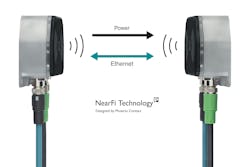
Innovators have long sought to send power over communication wires, or relay data over power cables. Both efforts have had varying and typically limited degrees of success usually because of power limits and other physical constraints. However, transmitting power via wireless was always a hard stop due to even greater limits. Until now.
Phoenix Contact recently introduced its NearFi wireless power and data transmission device in the near-field, centimeter range. It can communicate 100 Mbps of data at 60 GHz and up to 4 cm, and transmit power at up to 12 mm. It can even transmit through non-metallic material, such as glass, plastic or wood, enabling communications with clean rooms or other enclosed settings. Its six basic parts are available in three versions: power and data, data only and power only. Each version consists of a base coupler and a remote coupler.
Get your subscription to Control's tri-weekly newsletter.
NearFi provides proprietary, bit-oriented data transmission. Its components are transparent to any Ethernet network, so it doesn’t use IP or MAC addresses. This makes it protocol-agnostic, plug-and-play, and able to integrate without configuration or requiring permissions. These capabilities enable NearFi to replace the need for slips rings and pluggable connectors on robot arms, automatic guided vehicles (AGV), rotating machines and other equipment, and reduce or eliminate associated maintenance and downtime costs. It can support rotating equipment up to 1,400 rpm, though one user is reportedly already testing higher speeds.
“Because NearFi uses bit-oriented data transmission, it has a latency of 1 microsecond, which is effectively 0. As a result, NearFi is faster than 5G with the only thing faster being wire. It also delivers 50 W at 2 Amps and 24 V,” says Danny Walters, product marketing specialist for wireless and Ethernet connection solutions at Phoenix Contact. “Because of its short range, NearFi’s 60 kHz radio is effectively immune to radio interference, which can be a challenge for other wireless components in increasingly saturated environments. This allows equipment like AGVs or autonomous mobile robots (AMR) to roll up to a workcell or loading dock, communicate wirelessly without Wi-Fi, and get precise position confirmation or to perform other tasks.”
This is part three of Control's February wireless feature. Read the other installments here.
About the Author
 Jim Montague
 Leaders Logo
Leaders relevant to this article: