Key Highlights
- The HY.City.Bremerhaven project demonstrates the integration of IT and OT for secure, decentralized hydrogen production using a comprehensive 360° cybersecurity approach.
- Phoenix Contact’s security solutions, including FL mGuard routers, protect control systems and facilitate safe, reliable data exchange between onsite automation and cloud-based management.
While it’s important to view IT and OT holistically to establish unified cybersecurity solutions, this perspective is even more crucial for decentralized and mobile applications.
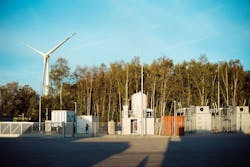
For instance, the HY.City.Bremerhaven green-hydrogen project is a joint venture by energy system integrator GP Joule and multi-company partnership Greenfuels GmbH, and consists of a green-hydrogen production plant and refueling station on Germany’s northwest coast (Figure 1). The rural facility’s electrolysis units use locally sourced, renewable electricity to produce hydrogen that typically powers vehicles operated by the region’s public transportation service, BremerhavenBus, which can rely on their fuel cells to drive the longer distances required by their rural routes.
While implementing a regenerative production application for HY.City.Bremerhaven, GP Joule recently installed a 360° security solution from Phoenix Contact to protect the facility against cyber-threats, -intrusions and -attacks. The company reports its 360° program can result in some organizational changes for participants because it includes instilling common cybersecurity practices for OT and IT that gain acceptance in the minds of affected managers and employees.
“For sustainable cybersecurity, a process needs to be established in which IT and OT work together,” says Hauke Kästing, security expert at Phoenix Contact. “The aim of this approach is to secure the overall value chain without overlooking the special features of both areas.”
Likewise, while production automation is usually OT’s job and cloud computing is IT’s responsibility, GP Joule reports that HY.City.Bremerhaven’s operations are closely coordinated at its green-hydrogen plant. In fact, these links don’t simply analyze data and provide dashboard, but manage centralized control tasks via the cloud, and relay instructions to the onsite automation system. The system integrator adds it sends electricity market data securely from the cloud to help the plant balance the most lucrative times to sell its renewable power, or run its electrolyzers and make hydrogen.
Get your subscription to Control's tri-weekly newsletter.
“We have bidirectional data flow with specific command sequences,” explains Marian Hieke, engineering head and GP Joule’s hydrogen division.
In this case, the 360° cybersecurity program employs Phoenix Contact’s FL mGuard security and maintenance routers and TC mGuard cellular router in the control cabinet of GP Joule’s HY.Runner mobile production trailer it operates at HY.City.Bremerhaven (Figure 2).
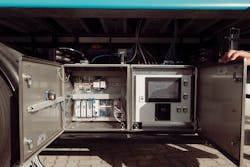
These controls form a logistical link between the electrolyzers and the plant’s managers and consumers, ensure that signals and production data are flowing properly, and maintain contact with higher-level, cloud-based, control-room functions. The central task of this data exchange is coordinating HY.City.Bremerhaven’s subprocesses, and maintaining the interface for cost-effective plant operations and business-level tasks such as billing.
In addition, the trailer also performs functional safety tasks including safe-stop with help from a SIL 2 safety controller, It’s integrated with HY.Runner’s onsite automation, and monitors operations such as pressure limits when refueling a mobile storage tanker. If mGuard wasn’t in place, Hieke reports that a cyber-intrusion might be able to shift the plant’s control limits. “In this scenario, the safety devices would essentially be blind, and would assume that all system are in the green zone,” he adds, which could have potentially disastrous consequences due to hydrogen’s high reactivity.
About the Author
 Jim Montague
 Leaders Logo
Leaders relevant to this article: