Experion updates advance modular upgrades, AI operations and cybersecurity
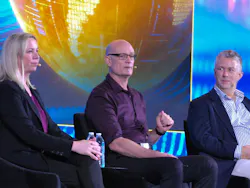
At the 2026 Honeywell Users Group (HUG) conference in Phoenix, Honeywell executives Alicia Kempf, director offering management, Honeywell Process Automation (left in image); Colin Hams, offering manager (center); Paul Hodge, product line manager (right); and Johan School, global product marketing manager, provided a detailed look at the future of the Experion platform. The session covered upcoming Experion Process Knowledge System (PKS) R530 feature packs, the launch of Experion Cognition R100, major enhancements planned for Experion PKS R600 and the evolution of Honeywell's Safety Manager portfolio.
Feature packs continue to drive incremental innovation
Honeywell continues to expand its feature packs for Experion PKS, allowing customers to access new features without having to do a major migration. "We've introduced feature packs, which are actually by subsystem, which makes them less risky to take on, as well as easier to install," Kempf said. Feature packs are optional and remain supported throughout the life of the base release, which for R530 is until March 2030.
Feature pack 3 is a tools and controller update for Experion PKS R530, planned for release in the third quarter of 2026. It will support Module Type Packages (MTP), an emerging vendor-neutral standard designed to simplify modular automation deployments by defining functional descriptions for modular plants. Feature pack 3 includes a process orchestration layer (POL), typically the distributed control system (DCS). It also includes process equipment assembly (PEA), which enables predefined process equipment assemblies, such as control strategies, graphics, alarms, and conditions, to be imported directly into the control environment. Users can pre-validate and pre-configure imports into the POL, and the system communicates through OPC UA. Kempf said the new feature pack will reduce engineering effort, while supporting modular production strategies and flexibility to respond to changes in production.
Feature pack 3 also introduces version two of Honeywell's Unit Operations Controller (UOC), including a new retention redundancy module that preserves controller memory during power loss. It also comes preloaded with UOC firmware, eliminating firmware loading steps.
Later this year, feature pack 4 will introduce new migration capabilities for Honeywell's C300PM controller platform, giving users the ability to migrate legacy Process Manager environments to the C300 architecture while plants remain operational. "What we're introducing now in the tools and controller feature pack four is that you will be able to do an on-process migration loop by loop to move things over to the C300 environment," Kempf said.
Experion Cognition brings AI into the control room
Honeywell also introduced Experion Cognition R100, a new platform for AI-assisted operations. “Today’s control systems, we know they work incredibly well during steady-state conditions. However, we’re still dependent on human expertise to handle conditions outside normal operation,” Hams said.
As a response to workforce challenges facing industrial operations, including operator retirements, inconsistent performance between shifts, and the impact of human factors on plant reliability, Experion Cognition provides a digital companion to operators to help fill the knowledge gaps and experience workload.
"The average unplanned outage costs over $2 million, and plant performance can vary 10 to 25% between shifts based on the varying levels of operator expertise," Hams said.
According to Honeywell, approximately 40% of abnormal situations and unplanned shutdowns are linked to human error, creating an opportunity for technologies that assist operators in identifying and responding to process deviations more effectively. "Experion Cognition bridges the knowledge gap and elevates operator expertise by providing them with expert guidance that's derived from your process experts from your operational history and uses proven methodologies," Hams explained.
Initial capabilities in the first release of the agentic AI architecture include alarm guidance, predictive alerts, sensor malfunction detection, process anomaly management, and tools for capturing operational expertise. The system can either guide operators through response procedures or autonomously execute approved actions when appropriate.
Hams characterized the launch as the beginning of a broader transformation across process industries, moving toward autonomous operations. "Industrial process control is in the very earliest stages of adopting artificial intelligence," he said.
R600 focuses on modernization and accessibility
Honeywell also provided new details on Experion PKS R600, scheduled for release in the first quarter of 2027. The release expands Honeywell's modernization strategy through web-based access, virtualization, protocol integration, and AI-assisted engineering tools.
The latest update includes new Experion Remote Gateway Station Clients for operational support personnel. The Read-only Station Client provides live updates including alarms and events, and the Light Read-only Station Client provides a subset of system displays to minimize load on the system.
"Imagine a client that has no impact on control system performance, regardless of the number of users connected," Hams said. The lightweight version leverages adaptive caching to minimize subscriptions to the control system, while still providing near-real-time visibility into process conditions.
R600 will also introduce a virtual Ethernet Interface Module (EIM). "The virtual EIM eliminates the need for physical hardware to connect to your peripheral devices," Hodge said.
The virtual EIM supports Honeywell's Control Hive architecture, providing protocol support for Modbus TCP first, then eventually, OPC UA, IEC 61850, EtherNet/IP, and Profinet. “The vision is that it will be one common gateway solution for a wide range of different protocols,” Hodge said.
Honeywell is also investing heavily in engineering productivity. New browser-based engineering tools will incorporate AI guidance for converting process and instrumentation diagrams (P&IDs) and control narratives into graphics and control strategies, reducing manual engineering effort and lowering barriers for less-experienced users.
Safety roadmap converges cybersecurity and functional safety
Honeywell's process safety portfolio is evolving to meet growing cybersecurity requirements. Johan School outlined ongoing investments in both Safety Manager and Safety Manager SC platforms, first introduced in 2018 to replace Fail Safe Controller (FSC), which has been phased out after 38 years. The newer safety system design already includes new diagnostics, and future updates will add automatic device commissioning support, scaling and alarming for fire-and-gas applications, and cybersecurity updates.
Scheduled for 2027, a new universal safety interface will be released. “We will bring Safety Manager and Safety Manager SC platforms closer together,” School said. "This will allow Safety Manager users to comply with latest cybersecurity standards, but also will give access to Safety Manager SC I/O technology.” The future updates also work toward compliance with the European Union Cyber Resilience Act, which is driving new cybersecurity requirements across industrial technology suppliers.
"Safety Manager SC has been tested and certified to the highest international safety and security standards," School said. The platform provides support for independent safety applications and secure integration with Experion to push out relevant safety data and integrate it into a single operational window. “By default, the Experion environments will not have any access to the safety controller, the safety databases, or the application,” he added.
Across the Experion roadmap, future innovation will be delivered through modular upgrades, AI-enabled operator support, simplified migrations, and deeper alignment between safety and cybersecurity.