Honeywell Digital Prime tackles asset cognition issues
Produced with support from Honeywell Technologies
This show takeover was sponsored by our 2026 Honeywell Users Group coverage partner, Honeywell Technologies. See more coverage on our 2026 Honeywell Users Group page.
Know thyself, assets! If increasingly digitalized hardware and software are going to model and reproduce human tasks, they’d better develop some self-awareness, too.
Intelligent devices and processes will need these strengths to take on the challenges people have faced all along as they strive to monitor, manage and optimize their automation systems, and protect their critical infrastructures. As always, these challenges include unplanned downtime risks, increased operating costs, cybersecurity issues, plus workforce and visibility problems. Each difficulty, or a combination of all of them, can impact operational integrity, safety and revenue.
A responsive strategy called asset cognition refers to the acquisition, processing and presentation of the right information in the right context at the right time for faster, better decisions with less effort. It grew out of earlier efforts to support production systems by integrating diverse information sources such as databases, associated applications, reports, support services, and inventory, migration, assessment, maintenance, audit, performance analysis and diagnostic tools. Sadly, most of these proliferating data sources and tools are uncoordinated, require multiple installs, duplicate data, overlap development and support, don’t produce unified insights, and don’t have common cybersecurity policies.
An expanding portfolio
To combat these problems in the context of industrial systems, Honeywell launched its Enabled Services (ES) program in 2020, which uses a unified data collector (UDC), standard and secured data movement, and cloud-hosted, secure processing for tasks such as inventory, lifecycle audits, performance and availability monitoring, and notifications. Users could also monitor individual nodes, check for and report failures, and use other tools to manage their processes.
More recently, it debuted Digital System Insight (DSI) solution enhancement support program (SESP) in 2023 for inventory, lifecycle and product notifications, as well as diagnostic data capture and uploading to Honeywell’s Global Technical Asset Center (GTAC). Next, the company launched its Digital Prime Twin program that consists of a cloud-hosted, secure, virtual lab system.
However, not all of the products and services that users wanted could fit into ES, while other users wanted a unified integration/coordination layer on one landing page or portal. Consequently, Honeywell released its Digital Prime Portal last year, which delivers the sought-after integration layer, while each of its software applications also provides a widget that presents useful information and other capabilities. These applications are paid for, but not the portal itself.
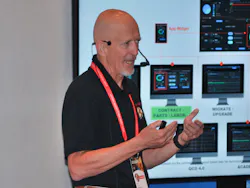
“Digital Prime Portal is a launching pad enabler for viewing Honeywell’s application-enabling products and services, cybersecurity capabilities and other applications for achieving asset cognition,” said Bart Winters, Enabled Services offering manager in the lifecycle support services (LSS) division at Honeywell, who delivered a spotlight presentation in the Innovation Center at Honeywell User Group 2026 this week in Phoenix. “Users can also bring allocation widgets into the portal, but they don’t need to change its code to deliver their data. Common ES functions are also visible via the Digital Prime ecosystem.”
A comprehensive asset view
Winters added that Digital Prime Portal is available to users who already have DSI and ES. It also has a new landing page with direct access to DSI and ES, as well as a new lifecycle roadmap view. Prerequisites for Digital Prime Portal include having UDC installed with its data uploaded, an active process.honeywell.com account, and ES or DSI. UDC is typically the source of information that’s viewable in the portal.
Digital Prime Portal’s core-capability widgets include:
- Asset inventory with installed assets organized by type with drill-down and export functions
- Lifecycle overview with support status by asset type, such as current, supported or phased out
- Lifecycle planning and roadmap, which lets users view their equipment’s location on the Experion lifecycle timeline, as well as individual nodes, and which ones need updating
- Product notifications, such as Experion releases and compatible applications, function comparisons and available updates
- Contract usage reporting, such as what parts have been used, amount of labor consumed and training provided
Other applications that can be integrated into the Portal include those for governance, risk and compliance (GRC), workforce competency, advanced process control (APC), asset performance management (APM), operator training simulation, production accounting and reconciliation, and alarm management among others.
“We’re not selling Digital Prime Portal by itself," Winters added. "Users sign up for other products, applications and services, and get Digital Prime Portal along with them. The purpose of asset cognition is increasing uptime and safety, and reducing cost, and that’s how Digital Prime Portal works.”
About the Author
 Jim Montague