


Brown presented the session, “The Once Impossible Becomes Real: How Data Analytics Is Shaping the Industrial Landscape,” at Honeywell Users Group 2016 this week in San Antonio.
“Do you have an analytics strategy?” Brown asked. Many plants see the value of digitizing operations for analysis of critical equipment, “to find that needle in a haystack and predict that failure before it occurs,” he said. “But there are more opportunities.”
Honeywell Uniformance Suite, a new, fully integrated system of process software solutions, can turn plant data into actionable information to enable smart operations, Brown said.
More than just sensor data
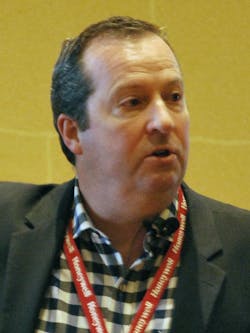
“Where things really start to change is in terms of collaboration.” Honeywell’s Mike Brown on the promise of data analytics to fundamentally change decision-making in the process industries.
Collected data must be contextualized: collected along with information that allows it to be related to the asset, problem or parameter under study. Then it becomes possible to use analytics to detect and predict issues and visualize the results. These can include trends to find opportunities for improvement or key performance indicators (KPIs) to track performance. Visualizations can be shared and used collaboratively by personnel in engineering, operations, management, and maintenance and reliability.At least that’s the theory. In practice, “we’re greatly increasing sensor data, but our ability to take action is not,” Brown said. “We have more and more information coming in at the application level, such as the KPI management system, and the data wants to be looked at. For example, a loop performance management system has data on stiction, loop tuning and valve travel – information we could use to enhance operations.”
Individual solutions within Uniformance Suite address this situation using a common asset model that allows users to:
- Capture and store relevant real-time process and event data (Uniformance PHD);
- Detect and predict risks and opportunities with asset-centric advanced analytics (Uniformance Asset Sentinel);
- Connect process intelligence to critical business decision-making (Uniformance KPI); and,
- Visualize information in an asset-centric context and apply powerful analytics (Uniformance Insight).
“Where things really start to change is in terms of collaboration,” Brown said. When the historian and analytics move to the cloud, corporate-level experts, suppliers and third-party specialists can access the same data and visualizations as plant personnel. For example, specialists such as Flowserve (for pump diagnostics) or UOP (for process expertise) can collaborate to help solve problems and recommend improvements.
“Uniformance Insight opens the system to partners to get the best applications and technology,” Brown said.
Seamless data sourcing
One of those partners is Seeq. “The engineer needs data from any source, anywhere, anytime, easily. Not to wait a week to get it,” said Brian Parsonnet, Seeq CTO and founder. With the Seeq Workbench application, “All the data is online – there’s no data link. The engineer doesn’t need to know or care where the data is.” A Capsule Series engine puts time-series data together with transactional data to provide data in context. Users’ formulas automatically scale “on the fly, and very quickly,” Parsonnet said. Searching functions reveal patterns, limits, boundaries and logic, with “no data scientist necessary,” he said.
On-the-fly calculations and a collaborative user interface mean, “When you click, 500 things happen. It’s like the iPhone’s Siri – you don’t have to know, or care, how it works,” Parsonnet said.
“The key here is, you don’t have to break the workflow,” Brown said. “You can combine data from three sources in real time, identify problems and opportunities, and if the value is there, make them into a KPI. And it’s collaborative, with the subject matter expert looking at the same thing in real time.
“It’s a new way of thinking about applying analytics to process data.”
