Survey: AI delivers measurable value gains for control engineers

A recent poll of 300 engineers finds AI has moved from pilot to payoff. For control teams in industrial processing, the biggest gains are in the areas where time is hardest to find: testing, validation and iteration
The main takeaway for control engineering teams from the poll, conducted by SimScale, a Munich-based cloud-native, AI-native computer-aided engineering (CAE) software company, is that 92% of engineers see measurable value.
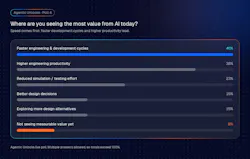
The poll, taken at the company’s Agentic Unlocks event, found respondents are getting measurable value from AI. Among those:
- 46% report faster engineering and development cycles;
- 39% report higher engineering productivity;
- 23% report reduced simulation or testing effort; and
- 15% say they are making better design decisions, and another 15% are exploring more design alternatives.
For control engineering teams, the testing and simulation figure matters most. Validating control strategies before they reach a live process is where schedules tend to slip, and it’s where nearly a quarter of respondents are already cutting effort.
Cost isn’t the metric that matters
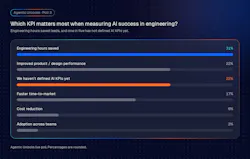
Only 5% named cost reduction as their most important KPI for AI projects. The rest pointed elsewhere:
- 31% chose engineering hours saved;
- 22% chose improved product design or performance; and
- 17% chose faster time to market.
For lean control teams supporting multiple projects and plant upgrades, hours saved are the metric most likely to resonate: more capacity without more headcount.
More options, explored faster
Among engineering firms with more than 10,000 staff, 14% are now testing over 200 design variants.
“Last year was all about engineering organizations starting pilots, selecting specific workflows and testing out how the technology can improve and speed-up the engineering design process,” said David Heiny, co-founder and CEO of SimScale. “This year, those organizations are now reaping the benefits of those pilots—three times faster simulations, three times more design variants, RFQs submitted three times quicker—and are now rapidly accelerating adoption across multiple workflows and product ranges. The race is on, and the teams that can achieve the highest engineering velocity while making better design decisions by using AI are way out in front.”
For process industries, that points to the chance to test more control strategies and operating scenarios before commissioning.
The gap is widening:
- 9% say they are ahead of where they expected to be on AI adoption, and over a third say they are on track;
- 34% haven’t started AI projects, yet; and
- 20% say they are behind where they expected to be.
Earlier, SimScale research found that 99% of engineering leaders expect tangible return on investment (ROI) within 12 months, and 100% of engineering organizations are planning for universal AI expansion. In 2025, 14% of leaders said AI wasn’t a priority. In 2026, none did.
The question for control teams is no longer whether to adopt AI but how quickly they can embed it in the workflows where time is tightest.
About the Author
 Len Vermillion
 Leaders Logo
Leaders relevant to this article: