Key Highlights
- The industry faces a significant skills gap due to retiring engineers and a shift in technological expertise from ladder logic to coding languages like Python and Java.
- Educational programs focusing on robotics, mechatronics and Industry 4.0 are crucial for preparing students for modern control system roles.
- Practical training, certifications and apprenticeships help bridge the disconnect between academia and industry.
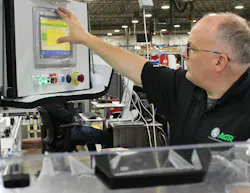
While the ongoing brain drain or silver tsunami continues to deplete the ranks of process control engineers, the resulting knowledge gap is further widened by the differences between the practical, industry-specific experience that’s leaving and the academic, generalized know-how coming in, which is itself driven and altered by digitalization and other recent technological advances.
“People that grew up with PLCs and Ladder logic programming are going away, but the kids coming up don’t know Ladder logic, and are more familiar with code for gaming or scripting languages such as Java and Python,” says Brian Romano, technology development director at Arthur G. Russell (AGR), a machine builder in Bristol, Conn., and a member of the Control System Integrators Association (CSIA). “This is why it’s difficult to find control system engineers. It’s also why some candidates actually read AI-generated responses to questions during job interviews when they’re faced with our job descriptions. So, we ask questions to get them to think, and understand that there are places where they can’t consult AI all the time.”
Though there’s still a huge disconnect between U.S. academia and industry, Romano reports that some colleges, universities and community colleges focus more closely on teaching robotics, mechatronics, automation and control systems. For instance, as a longtime alumnus of the University of Hartford, Romano later developed its automation minor and concentration, which teaches skills needed by local industries, and was more recently expanded to include Industry 4.0 technologies at the graduate level. He also teaches robotics and mechatronics classes at Central Connecticut State University and has hired graduates from both universities’ programs.
“If you can’t find engineers, sometimes you have to make them,” adds Romano. “This situation also allows us to cherry pick candidates. I think we’ve hired three or four graduates since 2018-19.”
Break down academic disconnects
Romano reports that some Connecticut companies like Trumpf North America want improved apprenticeship programs for their candidates and are partnering with the state’s government to develop and offer classes in electronics and controls technologies. He adds these kinds of educational programs also help reduce some of the disconnect between traditional bachelor’s degree programs at colleges and universities and the associate degrees and certificates at community colleges and other training programs.
“We’re still dealing with some educational snobbery. There’s a lot of value in the well-roundedness of a bachelor’s degree, but certificates are also extremely useful for training qualified personnel,” says Romano. “I originally tried to get a bachelor’s degree in engineering, but my financial aid got canceled, so I couldn’t do it. Instead, I earned an associate’s degree in electronics engineering, and later earned a bachelor’s degree in information systems, a master’s degree in applied computer science, an MBA with the focus on data analytics, and a PhD in technology and innovation. Consequently, whether students pursue certificates or associate, bachelor’s or other degrees, I think they can take in useful education and training at any level.”
To gain specific process control and automation know-how, Romano suggests that one effective education path is learning to wire and troubleshoot panels in high school, and then earning an associate degree at a community college. These programs should include instruction in PLCs, circuits and programming, but they don’t necessarily require instruction in deep theory, and can be modified to suit the direction that students want to take and the jobs they’re seeking.
Get your subscription to Control's tri-weekly newsletter.
Get well-rounded to fill gaps
Despite the scope and flexibility of community college programs, however, Romano acknowledges that bachelor’s degrees have a sweet spot of providing specific subject technical matter, which can gel with other skills, such as critical thinking, teaching methods, applicable calculus and physics, more in-depth control disciplines and business topics. While many master of business administration (MBA) programs are available everywhere, he adds that the International Society of Automation offers a 10 week, mini-MBA that can give technical professionals some of the business acumen they might not get elsewhere.
“Engineering is a different mindset that seeks perfection in satisfying operating parameters, but it often doesn’t include concepts like budgeting and business scheduling. Engineers need some experience with these, too, especially if they’re going to work in leadership roles,” explains Romano. “Likewise, many engineers also need to learn soft skills, such as public speaking, empathy, emotional intelligence, and learning to understand what other people are experiencing.
“For example, I was very shy growing up. Public speaking was not a skill I looked forward to during my early days in education and in the profession. You can’t help but immerse yourself in when you take a leadership role, whether it be as a manager or as a volunteer in the soccer club. The more you do, the more accustomed you become. It also got easier when I started teaching, and since then I’ve given 20-30 conference presentations. Early on, I got stage fright, but not anymore, which I think also comes from mastering my subject matter. If you speak from a position of confidence, you’re only speaking about what you know.”
Similarly, Romano reports that guiding new employees consist of a combination of thoughtful coaching. However, it also includes—gently—throwing them in the deep end of the pool sometimes, or at least injecting some discomfort to focus their attention and encourage their creativity.
“We do the normal on boarding of employees, but we also maintain internal standards and methods that teach new hires how we do programming, tag I/O points, how our designs and programs are structured, and how we set up and render schematics, so our pages are consistent,” adds Romano. “We took what we liked about the systems in previous projects, standardized those aspects, tried to emulate object-oriented programming as much as possible for PLC ladder logic, and put them in a library where they could be reused, and reduce implementation and debugging efforts. We can also ask new engineers to read and understand these standards, and then, task them with small systems, such as a material-handling feeder, and set them up in the structure representative of a larger system,. If so, we can make rookies who understand the feeder responsible for its system, and give them some really good on-the-job training. If small projects aren’t available, then we can assign them to other roles like HMIs, vision or robotics parts of larger projects, and let them work alongside experienced personnel, and offer input on those specific sections.”
For more coverage, please listen to Arthur G. Russell technology development director Brian Romano’s July 15 podcast with Control executive editor Jim Montague. They discussed engineering workforce issues, the ongoing brain drain, and how to build, recruit and retain operators and engineers.
About the Author
 Jim Montague
 Leaders Logo
Leaders relevant to this article: