Key Highlights
- Hands-on experience in physical processes is essential to complement software knowledge and close the talent gap.
- Mentorship and real-world field service exposure help young engineers develop practical troubleshooting skills.
- AI tools are valuable but require engineers to have a solid understanding of processes to develop effective prompts and interpret results.
Just as digitalization is turning many hardware devices into software functions, it’s also revising the job skills required to implement them, including what recent graduates need to bring to the table and how new hires need to be trained.
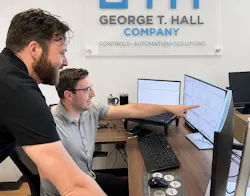
“We’re seeing a shift in young talent. Just a few years ago, junior engineers would arrive with mechanical and electrical skills based on internships in which they applied instruments, physical systems and other hardware,” says Dylan Lane, digital manufacturing systems manager at George T. Hall, a system integrator in Anaheim, Calif., and a certified member of the Control System Integrators Association (CSIA). “Lately, their initial skills have towards knowing more about software, virtual devices and other digital systems.
“Consequently, we’re also seeing a growing gap in engineering talent, including fewer with the ability to handle physical devices and less understanding of physical processes. They’re aware of software, but they don’t know how physical processes actually work. They may have seen many simulations, virtual renderings and other pictures, but they often don’t have much hands-on experience. The market is saturated with kids, who played a lot of computer games and may know about computer science, but now they want to use those skills in other areas or industries, and that’s the source of the current gap.”
Mike Howard, EVP at GTH, adds that, “Many candidates have been excited about software, but they haven’t touched a process. They’re initially less interested in motors, machines and other process applications because they still think manufacturing is dark and dirty.”
Handing down hands-on
To close this gap between software’s virtual world and the hardware’s physical world, Howard and Lane report that GTH exposes young engineers to in-person field services to give them some much-needed, hands-on, troubleshooting experience. For example, Lane recently mentored a two-year coworker in his mid-20s on what it takes to succeed on the plant-floor, including teaching him to apply Schneider Electric’s EcoStruxure Automation Expert (EAE) software for PLCs and HMI/SCADA systems, which is hardware agnostic and can run on any industrial PC (IPC) with a Windows or Linux operating system.
“He was unwilling to be mentored at first, and thought it would be boring. However, this was because he didn’t understand what process operations actually need and how they’re impacted by their controls, so he got more intrigued and interested as we went along,” explains Lane. “System integrators see controls as a narrative, which begins with evaluating the process application as it is, and then examining it more closely to find performance gaps and other incorrect or inefficient situations that need to be modified. We need to know as much as we can about the existing process because it will determine what troubleshooting or other controls are required.”
Know-how boosts AI
Lane reports his young protégé eventually developed a successful EAE project after they whiteboarded a complete flowchart diagram for a client’s water/wastewater project. This included a full, functional translation, new programming and graphics implementation, and even some AI-based functions for simple scripting.
Get your subscription to Control's tri-weekly newsletter.
“More engineers are leaning on AI tools, which will give them the right answer 95% of the time. However, to use it properly, they still need to know their process well enough to develop good prompts, or otherwise be aware of what’s wrong with it during the remaining 5% of the time, such as when they’re not directly monitoring it,” explains Lane. “AI can point out smaller performance gaps well enough for them to be understood. However, AI scripts typically struggle with higher-level process pieces, and can miss situations at the edge of their understanding, such as pump and upstream valve specifications that a water/wastewater plant must follow.”
For instance, AI can provide the script needed to program a pump, but it might neglect including instructions about what to do when a valve closes, and creates a potentially dangerous deadhead situation for that pump. In these cases, pumps typically need mechanisms that can reliably shut them off under certain conditions, but there’s no guarantee that AI tools know about them.
“Field personnel and system integrators can look at P&ID diagrams, and know what’s needed to shut a pump off when it’s valve closes,” says Howard. “Veteran engineers will know what’s missing, while rookies and AI tools may not detect performance gaps, may misunderstand what they’re seeing, or may flag items that aren’t part of the applicable process control narrative. What they need is a bridge to connect related low-level and high-level functions, and that’s where real experience comes in.”
Persistence builds bridges
Lane reports his protégé subsequently grew into his role, and is now taking more ownership of understanding processes, consulting with veterans, helping GTH develop a culture of passing on expertise, and using AI as a tool, rather than expecting it to substitute for genuine expertise.
“Where rookies used to ask veterans, many now try to use AI. However, most don’t have enough independent knowledge to form questions that will generate useful answers, so they still need to consult an expert source,” adds Lane. “Likewise, many companies and especially startups want to ‘revolutionize process automation with software.’ However, their next questions are, ‘So, how do we connect, train and maintain cybersecurity?,’ and those are the whole job for a system integrator.”
Unfortunately, even though veteran know-how is extremely valuable, it can be equally difficult to extract from experienced individuals, who are often prickly and sometimes disillusioned and suspicious. This means rookies and other interested individuals must practice the even rarer skills of drive, persistence and the ability to self-start to find answers.
“The heart of good process control, just like engineering in general, is a willingness to pull things apart, and put them back together again. However, digitalization is requiring us to reframe what it means to be a process control engineer,” adds Lane. “For example, I used to student teach physics and math at the University of Nevada Reno, which was part of students’ regular, technical and mechanical education. However, when I later worked at a system integrator in Chicago, it accelerated its educational process. One day each year, its staff did no project work, and instead had 24 hours to quickly solve a problem, and come up with a possible solution and controls that could be shipped immediately. These solutions might include applying a vision system to a pool table to estimate different shots, or using robotics to mix, serve and keep track of drinks. This frames what students or employees are learning, so even if it’s complex, it’s still interesting and more likely to foster their curiosity.
“The struggle is that a lot of introductory education and entry-level jobs aren’t intriguing, so there’s also big gap between low-level tasks such as learning how small pumps work, and high-level tasks such as how they impact the overall business. Many engineers find themselves on one side or the other, and closing that gap requires showing participants how little processes can help solve larger problems. Even though the high-level side wants to pump in new data, I think this gap is growing because fewer people are drawn to little challenges that can be pulled apart and solved because no one shows them how it contributes to the overall picture.”
This is the ninth installment of Control's August workforce cover story. Read the other installments here.
About the Author
 Jim Montague
 Leaders Logo
Leaders relevant to this article: