Back to school to fill skills gaps and engage communities
Key Highlights
- The U.S. manufacturing workforce faces a significant skills gap as Baby Boomers retire, risking loss of decades of expertise.
- MxD offers the Virtual Training Center with thousands of courses focused on emerging manufacturing skills like data analytics and cybersecurity.
- Partnerships with organizations like SACA enable faster certification and skill acquisition without the need for four-year degrees.
The brain drain facing U.S. manufacturing isn't a distant risk—it’s a countdown. By 2030, the last of the Baby Boomer generation will have reached retirement age, taking with them decades of institutional knowledge, technical skill and shop-floor expertise. For manufacturers already struggling to fill skilled roles, this timeline turns a looming gap into an urgent one. It's a challenge that’s central to Chicago-based MxD’s mission of helping manufacturers close their skills gaps before they widen further.
“Industrial and manufacturing workforces are already squeezed, but now it’s happening even more, and many employers can’t find enough people to build into their pipelines,” says Angela Accurso, workforce program director at MxD. “Because they’re desperate for talent, many manufacturers are thinking even further outside the box.”
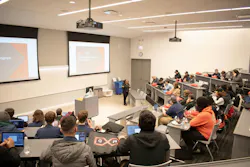
Accurso reports that process control and automation engineers are usually required to have at least a bachelor’s or associate’s degree, so many community colleges have been developing applicable associate and certificate programs. Likewise, as accelerating technical advances also shift job descriptions, MxD concentrates on developing newer skills, too. As a federally designated Manufacturing USA institute supported by the U.S. Dept. of War (DoW), MxD also works to modernize, secure and strengthen U.S. manufacturing by advancing technology adoption on the factory floor, supporting cybersecurity readiness among manufacturers, and building a talent pipeline for the future (Figure 1).
MxD’s marquee workforce initiative is the MxD Virtual Training Center (VTC), which includes thousands of on-demand virtual courses to build skills. It has 40,000 enrolled users across 38 states. VTC has five role-based curriculums focused on emerging sectors of manufacturing, including data annotation, data analytics, augmented and virtual reality (AR/VR), cybersecurity analyst and cybersecurity supply chain.
Get out in the community
With a network of more than 365 members from industry, academia and government, MxD works closely with its stakeholders to understand their gaps and needs. In some cases, this means combating the misconception that manufacturing jobs are grimy assembly lines and dead-end shift work. In fact, Accurso reports that manufacturing jobs are quite different now.
Get your subscription to Control's tri-weekly newsletter.
“Many industrial and manufacturing jobs haven’t been viewed as viable career options. However, they can provide family-sustaining wages, especially with today’s technologies, which are often easier for younger staffers to use because they’re technical natives,” explains Accurso. “There are also multiple talent pools that haven’t been tapped, such as women, veterans, English as a second language (ESL) candidates, and people with disabilities — if they can get some help from vision systems or other assistive devices.
“Consequently, we often recommend that small manufacturers be more community-minded, go to career events at their local community colleges and high schools, show what their organization does, remind people that products don’t just appear, demonstrate how they’re made, and inform students and their families that their companies can provide viable careers.”
To give employees and employers additional skill-building tools, MxD also provides its workforce readiness guides, which detail the competencies needed for getting hired in manufacturing. Users and organizations can copy, paste and alter them as needed for their own uses. “The guides identify 700 roles that are critical to manufacturing based on 50 deeper studies about factory automation, process controls, and other topics,” adds Accurso. “They’re basically job descriptions on steroids, and career pathways for manufacturers that aren’t able to do their own research on issues like workforce development, succession planning and others.”
MxD also works with the Smart Automation Certification Alliance to certify its VTC courses, which is especially important as technologies, engineering roles and MxD’s programs shift toward courses and competencies that can be gained more quickly. “Professionals don’t always need four-year degrees to acquire the engineering principles and skills they need,” says Accurso. “SACA and upper organizations have virtual platforms and training centers with thousands of courses on control, artificial intelligence (AI), soft skills and others, which are usually free and accessible to anyone.”
This is the twelvth installment of Control's August workforce cover story. Read the other installments here.
About the Author
 Jim Montague
 Leaders Logo
Leaders relevant to this article: