ABB to provide DCS for Japan’s first commercial-scale liquefied hydrogen terminal
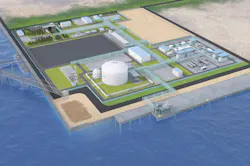
ABB reported Aug. 25 that it’s been picked by Kawasaki Heavy Industries Ltd. to deploy its Ability System 800xA distributed control system (DCS) at the Kawasaki LH2 terminal in Ogishima, about 30 km south of Tokyo. The terminal is reported to be the world’s first facility designed to handle and scale liquefied hydrogen supplied from pilot projects to the commercial level. Its new control system will help operators manage complex hydrogen terminal operations safely, reliably and efficiently via one integrated platform.
Scheduled to finished its demonstration phase by 2030, the terminal will play a central role in Japan’s plan to build an international, liquefied-hydrogen supply chain. Supported by Japan Suiso Energy Ltd. as project operator and the New Energy and Industrial Technology Development Organization’s (NEDO) Green Innovation Fund, this liquefied-hydrogen, supply-chain, commercialization-demonstration project will include a 50,000 m3 liquefied hydrogen storage tank, and facilities for cargo handling, liquefaction, hydrogen gas supply and truck dispatching.
Once up and running, the facility is designed to receive, store and distribute imported liquefied hydrogen safely and at scale. System 800xA will help achieve this by integrating process control, safety and operational data in one common environment, enabling faster decisions and greater operational visibility across the terminal.
ABB’s project scope includes System 800xA integrated with a SIL 3 safety instrumented system (SIS), which will provide a unified platform for process control, safety and plantwide operational visibility. The solution includes redundant AC 800M controllers and server infrastructure to support operations, data management and system availability, helping ensure reliable and continuous operation. This integrated and redundant architecture will reduce operational complexity, supports faster and more informed decision-making and improves availability across the terminal’s critical processes, from liquefaction and storage to loading, unloading and dispatch. This solution also ensures stable and reliable performance in the event of equipment unavailability.
“Japan’s hydrogen ambitions depend on infrastructure that can operate safely, reliably and efficiently at commercial scale,” said Tetsuo Miura, VP of ABB’s Energy Industries division in Japan. “By bringing automation control, safety and operational insight together, we’re proud to support the operations at Kawasaki LH2 terminal as Japan takes an important step toward building a future-ready hydrogen supply chain.”
