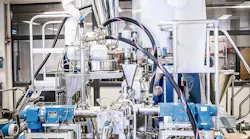
Comau installs battery cell formation and testing system at National Institute of Chemistry in Slovenia
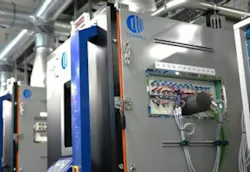
Comau reported Sept. 24 that it’s implemented an industrialized, laboratory-scale, battery cell-formation and testing system at the National Institute of Chemistry (NIC) in Ljubljana, Slovenia. It’s designed to support material validation, product development and lifecycle testing. This customized, turnkey system brings industrial processes and standards into NIC’s laboratory, while maintaining the flexibility required for R&D. NIC is open to academic and industrial users, and is positioned to support battery research and cell testing needs across Europe.
NIC’s new formation and testing system can manage pouch, cylindrical and prismatic battery cells on a common platform, seamlessly accommodate different cell sizes, chemistries and technologies, and let users work with a range of cells for laboratory and industrial applications. To perform all these tasks, Comau’s solution combines dedicated thermostatic chambers for cell formation and testing, which cover a -20 °C to 60 °C range, and provide room-temperature, walk-in rooms for cell testing. This equipment maintains industrial-level safety, flexibility and reliability in a laboratory-scale environment, and support its three primary formats, while remaining compact, accessible and easy to operate. Comau adds the key intent of these capabilities is bridging the gap between academic research and commercial battery development.
In the thermostatic chambers, standardized cell-tray positioning, industrial cabling and automated, remote-cell connections minimize manual intervention. This protects operators from electrical risks, while using easily customizable, 3D-printed fittings that let the equipment quickly and cost-effectively adapt to different cell formats. The system also meets stringent safety and security requirements, such as European Council for Automotive R&D (EUCAR) compliance, and maintains a fire-suppression system. In the room temperature-controlled environment, flexible fixtures are optimized for long-term, lifecycle testing, allowing researchers to manage the cells via one channel-independent control.
Overall, Comau’s technologies give NIC the flexibility to work with different cell sizes, formats and testing requirements in the same industrialized, laboratory environment. They also let NIC to support commercial users develop and validate new battery technologies, while retaining the flexibility required for research.
“Battery innovation increasingly depends on moving promising technologies out of the laboratory, and evaluating them with processes and conditions that reflect industrial reality,” says Aldo D’Ambrosio, battery and fuel cells segment leader at Comau. “By supporting different cell formats and testing requirements on the same platform, we’re helping NIC create an important link between research and the next stages of battery development.”