Rockwell Automation adds NVIDIA GPU-powered computers for industrial AI at the edge
Rockwell Automation is expanding its industrial edge-computing portfolio with two GPU-enabled industrial computers designed to support demanding artificial intelligence (AI) and machine learning workloads closer to manufacturing operations.
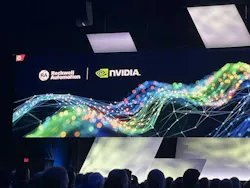
Announced Nov. 17 at Automation Fair in Boston, the new computers use NVIDIA accelerated computing to provide additional processing capacity for applications that benefit from GPU performance. The offering includes the 6300B-SB1 EdgeAI 4000, equipped with an NVIDIA RTX PRO 4000 Blackwell GPU, and the 6300B-SB1 EdgeAI 2000, featuring an NVIDIA RTX 2000E Ada Generation GPU.
The systems are designed to support compute-intensive applications at the supervisory level, including advanced machine vision, model predictive control (MPC), predictive maintenance and small language models (SLMs) that can provide operators with real-time advisory support.
Rockwell said the new hardware complements, rather than replaces, its existing industrial AI capabilities across control, human-machine interface (HMI) and visualization systems. Many of those capabilities do not require discrete GPU computing.
The additional processing capacity also gives manufacturers more flexibility in determining where industrial AI applications run. By keeping compute-intensive workloads on premises, facilities can process operational data locally, including in environments with limited cloud connectivity or requirements to keep data within the plant.
The computers can integrate with Rockwell's FactoryTalk Optix HMI and industrial visualization software. This combination can deliver low-latency, context-aware information to operators and maintenance personnel, including application-specific guidance generated by small language models.
"The opportunity for industrial AI is much bigger than adding intelligence to individual applications," said Matheus Bulho, senior vice president of Software & Control at Rockwell Automation. He said placing intelligence closer to equipment and operational context can give operators practical, real-time guidance while keeping people involved in critical decisions.
Rockwell's broader industrial AI strategy spans control, visualization, software and computing infrastructure, allowing manufacturers to select architectures according to application requirements, operating environments and performance needs.