Key Highlights
- Although renewable energy use has increased over the last 50 years, it remains far less than what’s needed.
- The prominent issue isn’t whether to transition to zero-carbon fuels, but when because delays risk worsening consequences.
- Hydrogen produced from solar-powered water electrolysis is expected to become the primary clean-energy source.

Life on Earth was stable as long as the vegetation was able to convert enough solar energy into the forms that humans and animals needed for survival. This was the "Natural Energy Age."
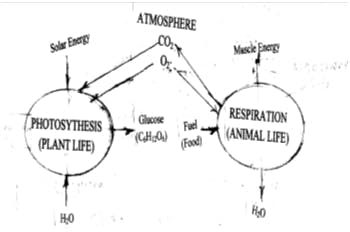
Figure 1 illustrates this balanced and stable energy cycle, which changed when our energy use started to exceed what vegetation could provide. Consequently, this added energy requirement had to be supplemented. The source of that extra energy was found when we started to burn underground, fossil-fuel reserves.
The "Fossil Age" started in 1712 when Thomas Newcomen started burning coal in his steam engines in England. In the 19th century, Nikola Tesla discovered AC engines and Thomas Edison invented lightbulbs.
Burning our coal reserves put extra greenhouse gases into the atmosphere, increasing its CO2 concentration from 280 ppm to nearly 500 ppm. This caused average, global surface temperatures to rise from about 13.9 °C to about 15.2 °C.
During this age, the scientific world became concerned about the harmful climate effects of greenhouse gases (GHG), but fossil fuel industry lobbyists temporarily succeeded in questioning some of their findings. Today, we’re witnessing the debate between climate change deniers and those who accept it. It seems to me the majority view of climate change accepters is increasing because the cost of carbon-free or "green" fuels (solar, wind) is declining.
Also, the term "green" shouldn’t be used interchangeably with "renewable" or "net zero.” Electric devices that run on power made by fossil-burning fuels aren’t carbon-free. The bottom line isn’t whether burning non-carbon fuels must stop or not, or if the conversion to zero carbon fuels—such as solar hydrogen—must occur or not, but only when and what will be the consequences if it‘s delayed? It seems to me that a temporary stoppage of our progress toward a sustainable and clean future will only be a blip on our line of progress, and we can quickly overcome it.
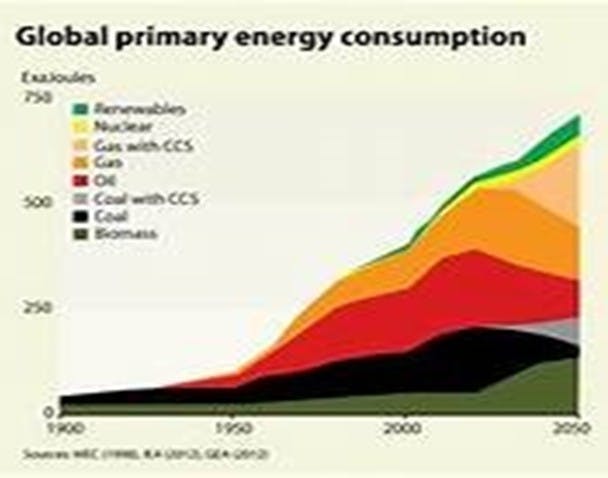
On the other hand, the green region in Figure 2 shows that, during the last half century, we increased the renewable share of our total energy consumption (natural gas, biomass, fuel cells and CCS, etc), but it remains insufficient because what’s needed is an effort comparable to only what the Marshall Plan delivered to help rebuild Europe after World War II.
I expect the present "Fossil Age" will be followed by the "Hydrogen Energy Age,” in which hydrogen will be made by free solar energy in electrolyzers using water as the source of hydrogen fuel. This will stop global warming by making production and distribution processes carbon-free (or eliminate it altogether), and will operate as a gigantic, artificial forest.
Get your subscription to Control's tri-weekly newsletter.
Water electrolyzers and China
As the green area in Figure 2 shows, today’s use of hydrogen is small but increasing. Last year, total, global hydrogen consumption reached almost 100 million tons (MT), and this year it’s expected to surpass that by another 10%. However, this amount of green hydrogen production is still a minute portion of the total. Consumption of green hydrogen (Figure 3) is expected to increase to about 95 million tons in the coming decade as it's use in long-distance energy transportation and energy storage increases.

Electrolyzer deployment is facing significant overcapacity. Still, China's capacity exceeds Europe's demand by four to eight times. Globally installed capacity for water electrolysis reached 2 gigawatts (GW) in 2024, and more than 1 GW of that capacity has been added in the past few months. China now accounts for 65% of globally installed capacity, and is home to nearly 60% of global electrolyzer manufacturing capacity.
Figure 4 shows a simplified, water-based hydrogen energy system. Close to the end of this century, we’ll probably be out of fossil fuels, so the "Hydrogen Age" must be operating by then. By that time, global warming must be zero, and all energy must come from burning solar-derived hydrogen made from water without any fuel cost and without any carbon dioxide emissions.
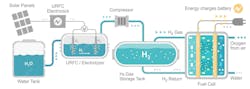
The advantages of using hydrogen fuel isn’t just its continuous availability, high-energy density, low-weight, short refilling time, and ease of transportation or storage, but also the ease with which existing equipment (grids, distributing pipe networks, turbines) can be reused during the conversion process.
The lower costs of unitized regenerative fuel cells (URFC) that can operate as both an electrolyzer and fuel cell can also play an important role in converting our infrastructures for a carbon-free energy future, decreasing the cost of implementing hydrogen technologies across applications from off-grid to distributed energy systems.
About the Author
 Béla Lipták
Béla Lipták
Columnist and Control Consultant
Béla Lipták is an automation and safety consultant and editor of the Instrument and Automation Engineers’ Handbook (IAEH).
 Leaders Logo
Leaders relevant to this article: