Key Highlights
- Automation and data analytics improve efficiency, reduce waste and support ESG goals by providing real-time insights into manufacturing processes.
- Adopting renewable energy sources like photovoltaics and biomass can significantly lower the carbon footprint of production facilities.
- Innovations such as servo-controlled flow valves and aseptic filling technologies help optimize product quality while conserving resources.

Similar to dealing with resource constraints like environmental rules and tariffs, pursuing sustainability can contribute to better outcomes and products, according to Jeremy Anderson, president of Process and Data Automation (PDA), a system integrator in Erie, Pa., and a certified member of the Control System Integrators Association. He explains environmental, social and governance (ESG) goals can shift participants’ focus from mundane tasks, and even encourage them to integrate quality-of-life goals for their staff and clients. This can be accomplished via better use of automation that reaches into devices, achieves better reporting, identifies efficiencies sooner, and reduces waste.
“We define sustainability as holistically spanning the entire value chain, including building equipment, adding to processes, and continuing through to end-stage customization and value creation,” says Anderson. “We continue beyond that to work on sustainability that includes ESG because its three legs feed off each other. We’re also a wholly owned subsidiary of Krones Group, which is based in Germany and the European Union (EU), where focus on sustainability is more well-defined.”
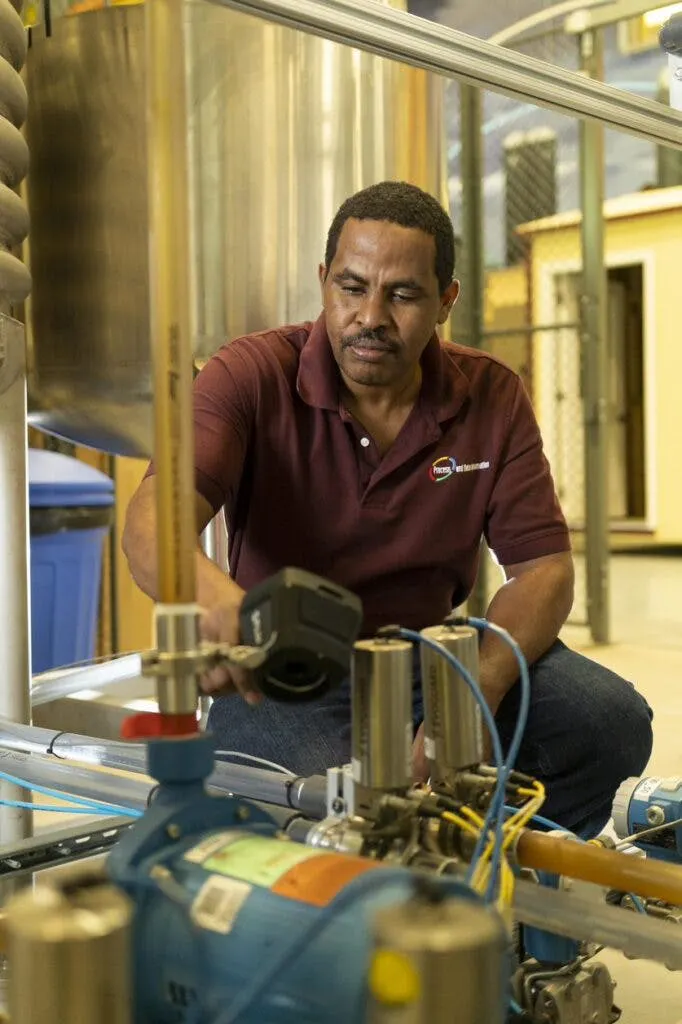
“For instance, North American shoppers want variability in their consumer packaged goods (CPG), and this means manufacturers must seamlessly change over their processes, and identify other efficiencies,” explains Anderson. “More specifically, soda pop and other carbonated beverages are seeking more consumable CO2, so producers need more adaptable CO2 technologies to achieve required specifications, while also avoiding over-carbonating their products. They’re working on aseptic filling technologies, which will let them get closer to ambient temperature filling that doesn’t require an additional drying step to prevent condensation. The traditional method is heating beverages, filling containers, and drying their exteriors in a tunnel, so their labels will have a dry surface to adhere to. However, this costs more, uses more energy, and requires 20 more feet of conveyor space.”
Another innovation for improving efficiency and sustainability is using servo-controlled flow valves, which PDA and Krones have been working with for several years. “Users running carousel equipment can still fill 40,000 to 60,000 containers per hour, but until recently, they could only run fast or slow, and had to rely on pneumatics and costly compressors,” says Anderson. “Servo-controlled valves allow an infinite number of speeds and other properties, which can be tailored to specific recipes and products. Filling orifices can be similarly adjusted to suit particular flow properties and media characteristics. This can help avoid over-foaming and over-carbonation, ensure better product quality, and save 10% on CO2 consumed.”
Integrating alternate energies
The second major way of achieving sustainability is adopting new ideas and technologies, including those that rely on renewable energy sources, as well as planning production around variable demand periods and costs. Anderson reports a recent, greenfield project by Krones in Germany combines multiple, alternative energy sources to power a brewing process, including using wood chips for heat and photovoltaics.
“We’re taking pieces of what we learn in Germany, and applying them to North America. However, we need to plan for optimal demand rates in both locations, and identify suitable energy sources based on those strategies,” says Anderson. “Our clients can use whichever strategies are suitable, but they’re more incentivized when resources are limited, or when consumers and government organizations like the EU encourage them.”
Get your subscription to Control's tri-weekly newsletter.
Anderson adds consumers are likewise pushing manufacturers and their system integrators and suppliers to provide more sustainable packaging, such as replacing plastic, six-pack rings with fiberboard tops, and recyclable PET (RPET) plastic containers. This may help manufacturers save by eliminating some traditional equipment, but they’ll likely face new dilemmas, such as convincing consumers to accept cloudier bottles that use more recyclables, so they may only be able to bottle dark liquids that won’t appear as cloudy.
“Manufacturers will likely have to optimize percentages of RPET flakes they’re using, and employ more data analytics to help them resolve injection-molding issues. They’ll have to decide whether to use RPET at 22% or 18% based on possible impacts on perceived quality, and determine whether to integrate some new plastic stocks,” adds Anderson. “We’re seeing more manufacturers trying to get closer to recovering different plastic streams, especially in California and the EU.”
Steps to sustainability
Because sustainability show up in so many technical disciplines, each user or organization must adopt a workable combination that suits their needs. Anderson recommends that manufacturers first look closely at the entire lifecycle of their equipment and products. They should then ask where they can source, design, build, operate and maintain their equipment and products more sustainably.
“A filling operation may find that it can save 50% on its expenses by implementing a better dryer. However, it would be even better if they can identify an upstream efficiency that could eliminate the need for the dryer entirely,” explains Anderson. “Looking at overall lifecycles is important because it can uncover these overall ‘why’ questions—and point to better answers—rather than just settling for incremental efficiencies. However, big questions and answers can only happen by leveraging a lot of data. The good news is many machines and processes have mountains of unused information that can help build these big pictures.”
Once all available data is gathered, however, the work doesn’t stop there. Anderson reports that, once participants can see all their variables, they must tear them apart to learn where they can make better decisions. This usually means using available data to test assumptions for possible improvements, such as monitoring dewpoints, temperatures and other variables, and investigating whether local environmental factors got pulled through to impact the facility’s process monitoring.
“Layering environmental information on top of existing data can help show that otherwise random low yields or other events may be due, for example, to outside wind plugging filters more quickly. However, situations like these aren’t visible until enough data points from enough places are gathered together,” adds Anderson. “Many multinational clients want to look for these kinds of efficiencies, so system migrators need to follow suit.
“Examining process, equipment, and product lifecycles creates these initial ‘why’ questions, and gathering raw information in big data feeds the business case that lets users pursue sustainability wins. Our clients often use cloud-computing services like AWS to analyze their data, and are starting to use AI-based tools like Claude to integrate and interpret the results. This is enabling sustainability to become a performance metric for some manufacturers, where they previously just looked at rate, yield, and their top and bottom lines. Likewise, consumers and shareholders are also demanding more sustainable products and packaging, and judging companies based on their ability to deliver them. So, sustainability is also a metric for them, and it’s not temporary.”
This is part one of Control's July 2026 sustainability feature. Read the other installments here.
About the Author
 Jim Montague
 Leaders Logo
Leaders relevant to this article: