Industry shifts from automation to reasoning
Key Highlights
- AI reasoning systems overcome the "expert bottleneck" in process plant decision-making.
- Instrumentation engineering talent shortages make AI reasoning operationally urgent.
- Cross-functional reasoning unlocks failure modes that no single engineering discipline can see.
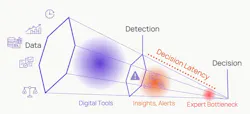
For half a century, industrial technology has moved on a single trajectory: do more, faster, with less human effort. Distributed control systems (DCS) automated our loops, historians captured our data, and predictive analytics flagged our anomalies. Each wave delivered real value, yet each one stopped at the same wall—the moment a machine had to think rather than detect or take a rule-based action—and a human had to step in. Now, that wall is coming down. The shift from automation to reasoning is the largest change to process operations since the DCS—and it is happening at exactly the moment that industry is running out of the people it has always relied on to do the thinking.
The arc of industrial technology
There have been a few very distinct technology waves that have impacted process operations. Each advancement layered new capability on top of the last:
- Wave 1—Automation (1970s–1990s): PLC and DCS codified deterministic logic. If X, then Y. The objective was to remove the human hand from repetitive control action.
- Wave 2—Digitalization (2000s): Historians, condition monitoring and alarm management captured and surfaced data at scale. The objective shifted from action to visibility.
- Wave 3—Predictive analytics (2010s): Machine learning models flagged when something was statistically off. The objective was to anticipate failure, but the machine still could not explain why or what to do.
- Wave 4—Reasoning (now): AI systems that connect signals and skillsets across domains, form hypotheses, weigh evidence and recommend action. The objective is no longer to scale human action, but to scale human judgment.
Automation versus reasoning—a continuum caveat
Automation and reasoning are often discussed together, and while describing them as points on a continuum works in analogy, they should be delineated by the differences in objectives and capability.
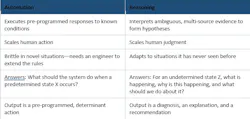
Put simply, automation made plants faster. Reasoning makes plants smarter.
The expertise cliff
The technology industry evolves to meet the needs of the markets it serves. So why now for reasoning technology? It’s because the human side of the equation is collapsing faster than most operators care to admit. Senior engineers who learned a plant by walking it for 30 years are retiring faster than the industry can replace them, and the pipeline behind them has thinned to a fraction of what it was a decade ago. Some of the contributing factors:
- Petroleum engineering enrollment in the U.S. has collapsed. Undergraduate enrollment peaked at roughly 11,000 students in 2014 and has fallen by more than 75% since, with several major universities now graduating only single-digit cohorts.
- Instrumentation and control engineering has nearly disappeared as a standalone discipline. In most North American universities, it has been folded into broader electrical or mechatronics programs that rarely produce graduates who understand a working plant.
- Manufacturing is short on people. Deloitte and the Manufacturing Institute estimate up to 2.1 million unfilled U.S. manufacturing jobs by 2030, and the process industries are hit hardest because the work is rural, shift-based, and increasingly invisible to the next generation.
- The people who do the thinking are leaving. In many North American plants, the average age of operators and reliability engineers is now over 50. Within 10 years, the people who know why a particular column behaves differently the way it does will be gone.
There is no realistic plan to replace tacit plant expertise the way it was originally built. The expertise must be captured and operationalized in a way that doesn’t rely on the experiences of the individual. The answer to how we tackle this is reasoning.
Why reasoning is a big deal
A modern plant generates orders of magnitude more data than its engineers can inspect. Automation handles the routine. Predictive models handle the obviously abnormal, detecting alerts, anomalies and insights. But it's that next step in the decision-making process—between an anomaly being identified and it being investigated, diagnosed, and the optimal action prescribed—where most incidents, downtime and lost yield live. The completion of that step gets bottlenecked by the reliance on human expertise that can’t scale. It creates decision latency that costs real margin. This bottleneck is what reasoning unlocks.
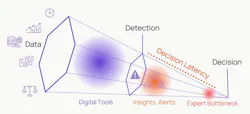
The way reasoning overcomes the expert bottleneck in critical plant decision-making starts with being evidence-based, not rules-based. Reasoning systems assemble the evidence, propose root causes and rank hypotheses. These ranked hypotheses are explainable. Engineers see the chain of logic and the data sources analyzed so that they trust the system instead of fighting alert fatigue. Institutional knowledge compounds when every incident becomes a teachable case, and expertise is captured rather than lost when senior engineers retire. When one engineer with a reasoning system covers what previously required a team, it fundamentally changes the economics of the control room. It does so, not by replacing people, but by elevating what they spend their day on.
Why reasoning has been hard to achieve
If reasoning is valuable, why don't we have it already? Because reasoning over a process plant is not one problem—it is multiple problems that have historically lived in different worlds, and solving any one of them independently is not enough.
- The full picture means taking in multiple data sources. Plants speak in many languages at once: sensor time-series, alarm logs, P&IDs, work orders, operator notes, vendor manuals, lab samples, inspection photos. These data sources aren’t compatible. They weren’t designed to be analyzed together. Reasoning helps fuse it into a single coherent view of the asset that is interpretable by anyone—no coding skills or spreadsheet gymnastics required.
- A true root cause of diagnosis requires multiple skillsets. Real root cause analysis braids together process engineering, control theory, instrumentation, mechanical reliability, metallurgy and safety. No single model, and no single human, covers all the domains. Reasoning systems must encode pieces of each and know when to apply them.
- Pools of data and models require the right orchestration. Even with the right skills and the right data, the hardest part is knowing which model to apply, to which signal, at which moment, and how. A vibration analysis is useless when the real story is a controller saturating; a controller analysis is useless when the real story is a clogged restriction orifice. The orchestration is what separates a generic data platform from an industrial-grade decision support system.
This is why earlier waves stopped at automation, monitoring dashboards, and anomaly detection. Each of those waves solved one of the problems above while ignoring the others. Reasoning is the first architecture capable of handling all three at once. That’s what makes it a genuine technology inflection point rather than another analytics layer.
Hidden opportunity living at the intersections
Plants are organized by function—reliability, process, instrumentation, safety, controls, maintenance—and so is their data. Each team operates excellently within the boundary of their lanes and almost blind across lanes. However, failures rarely respect functional lanes. A bearing failure can trace back to a process upset that triggered control loop oscillation that masked an instrumentation drift that finally fatigued the asset. This one root cause propagated symptoms across six teams, and no single person saw the whole chain.
By looking across all functions at once, reasoning surfaces causal links no single discipline would catch on its own:
- Reliability × process: a slow process deviation is silently degrading a critical asset months before vibration trends would show it.
- Instrumentation × controls: a control loop is compensating for a sensor drift, hiding the real problem and consuming excess energy doing it.
- Safety × maintenance: a deferred maintenance item is quietly walking a unit closer to a dependency on safety systems.
These are the losses that never show up cleanly on any one dashboard because they don't belong to any one function. Reasoning makes the previously invisible visible, and the visible avoidable.
Reasoning will accelerate the leaders and laggards divide
Every prior wave of process technology produced a gap between leaders and laggards that took a decade to close. Plants that adopted DCS early ran cleaner and safer for the next 20 years. Reasoning AI will be no different—except the curve is steeper, because AI technology learns and adapts at a pace unlike any technology revolution we’ve experienced in history. Each month a reasoning system runs, it gets better and widens the divide between those who break the expert bottleneck and those who fight the losing battle against a shrinking human expert pool. Starting late means starting from zero against operators with a year or two of compounding advantage and a workforce that is shrinking under both your feet.
The question is no longer whether reasoning AI will redefine process operations. It will. The question is where each plant falls on the adoption curve—whether defining the next decade of industrial operation, or playing catch-up to it, with a shrinking pool of experts and a growing mound of insights to interpret.
About the Author
 Jagadish Gattu
Jagadish Gattu
UptimeAI
Jagadish (Jag) Gattu is the Founder and CEO of UptimeAI, an industrial AI company working with AI reasoning agents that scale operational expertise and enable expert-level decision-making across energy and heavy industry.
 Leaders Logo
Leaders relevant to this article: