AI gets in on IIoT’s projection act
Key Highlights
- TwinThread connects to various industrial data sources, organizing data into digital twins for comprehensive process monitoring.
- The platform provides easy-to-use, code-free tools that enable rapid deployment and actionable insights for operators and engineers.
- It predicts quality issues and downtime, allowing proactive adjustments and continuous process optimization.

Inexorably, once IIoT branches out to IT-level, enterprise and other networking realms, especially these days, it must encounter irresistible AI promises of efficiency and riches.
For instance, TwinThread is a cloud-based, AI platform that reports it can connect to any type of industrial data source, such as historians, Aveva PI System, DCSs and others. It organizes that data into digital-twin hierarchies, and funnels it through AI and ML models that solve common industrial use cases, such as preventing downtime and increasing throughput.
“We built an easy-to-use wizard for these solutions that can connect in minutes, doesn’t require users to write code or be data scientists, and can rapidly identify improvement areas in their data,” says Andrew Waycott, cofounder and president of TwinThread. “Our digital-twin structure lays the groundwork for how our pre-built solutions ingest, organize, and leverage sensor and process data to mirror what’s happening in real time. They also use that data to power predictions based on changing conditions, and recommend how to keep conditions within an ideal range.”
Waycott reports this speculative aspect of the model can predict end-of-line product quality and potential downtime issues. It’s similar to advanced process control (APC), but it’s different because APC typically examines short intervals to adjust loops for short-term operations, so it’s less aware of larger trends. TwinThread can also execute closed-loop optimization. It considers the downstream consequences of process conditions, and uses historical data from past seasons or years to inform more impactful operator interactions on the plant floor.
“Regular data gathering and simulations need lags and inertia to settle out for 15-30 minutes. We’re trying to influence operations at that level, and find and maintain optimal running conditions,” explains Waycott. “TwinThread helps steer whole processes, so they can continuously run optimally, and push recommendations, so users don’t have to guess what’s happening.”
Pet food projections
For example, Colgate-Palmolive recently updated TwinThread’s software that it implemented previously with an AI-based agent to further improve production of its Hill’s Science Diet pet food (Figure 1). The company originally implemented TwinThread in 2018-19 before the COVID-19 pandemic, and integrated its operators’ domain expertise into its platform, so less experienced personnel could benefit. This was helpful because average tenure before COVID-19 was 10 years or more, but after the pandemic, it was significantly less due to retirements.
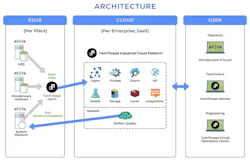
“We connected to Colgate-Palmolive’s production systems at about six plants worldwide, which use PLCs and other devices to grind and mix raw materials, extrude, dry, coat, cool and package their dog food in about 50 minutes,” explains Waycott. “Previously, the company would take hourly samples and try to close its feedback loops. However, with the entire production cycle taking only 50 minutes, it wasn’t fast enough to detect a bad batch until it was too late. Plus, it could take two hours to get production back to an optimal level. Now, with TwinThread checking and predicting quality every 15 minutes, it can advise Colgate-Palmolive on what setpoint changes to make during the process to achieve perfect protein, fat, density and moisture levels.”
Get your subscription to Control's tri-weekly newsletter.
Beyond enabling quality improvements while processes are running, closer-to-real-time data gathering and analysis by its cloud-based platform also lets TwinThread’s agent run in cyber-secure, demilitarized (DMZ) areas between operations and cloud layers. This lets it talk to Wonderware historians, SQL servers and PLCs via OPC UA networking. Because this agent communicates constantly with production sources, it gets the latest information, and relays it to TwinThread’s cloud-based platform, where its AI models generate predictive insights and recommendations. It can make direct changes in control settings, but in many cases, operators decide whether to accept or deny these recommendations. The system may subsequently add an auto-accept function for some recommendations after sufficient testing is completed.
Maintaining guardrails and limits
Despite accelerating its analytics and insights, Colgate-Palmolive also kept the guardrails on its legacy SCADA and DCS, which serve as the final acceptance before actuating control changes. It also retained its process sampling and lab testing for regulatory compliance, integrated existing historian functions and prior data to enable context, and improved recommendations from TwinThread and its AI agent with help from personnel’s past experiences and records.
“Getting a real-time data stream means more information for predictive, AI-based, product-quality efforts, which can be adjusted as soon as suboptimal conditions are detected,” says Waycott. “These predictive capabilities consist of searching existing recipe books and flow conditions that can be adjusted, and using this deep understanding to push recommended prescription changes back to the operators. Our objective is to grab all the historian data we can, and use golden-batch results and similar documentation to help every production line run more efficiently. Many users collect masses of data, but they don’t know what to do with it. They think they’re data-poor when they’re actually data-rich.”
Likewise, Colgate-Palmolive’s pet food plants increased their process capability index (CPK) by using TwinThread’s platform and agent. CPK measures how well a process stays within specified, upper and lower limits relative to its standard deviation or natural variation. This also translates to significant yield increases and net savings.
Waycott adds it’s a mistake to think of IIoT infrastructure as a project that needs to be finished, or that users have to spend a lot of money to get their data ready. “I suggest starting and testing what can be done with the information that users already have, rather than waiting for perfect data before trying to realize some value from it. It’s only valuable if it’s informing and driving an actual process,” says Waycott. “Most processes are already running with sensors and controls, and what users need is greater visibility into what they’re doing to drive out variability. This means identifying anomalies, providing continuous feedback about operations, and developing a full process centerline for all products.”
This is part one of Control's June 2026 IIoT cover story. Read the other installments here.
About the Author
 Jim Montague
 Leaders Logo
Leaders relevant to this article: