Honeywell charts automation, AI-driven future at 50th anniversary HUG
For half a century, the annual gathering of the Honeywell User Group has served as a proving ground where engineers, operators and technology partners shaped the evolution of industrial automation. This year’s edition, held in Phoenix the week of June 8, not only celebrates a half-century of HUG gatherings, but also looks to the future of industrial automation.
"On behalf of Honeywell, thank you for your partnership," said Jim Masso, president and CEO of Honeywell Process Automation, addressing longtime customers and collaborators during the conference’s opening keynote session. "The future of automation is in this room."
Masso traced an arc from 1975, when the company introduced the TDC 2000—the groundbreaking distributed control system that drew knowing applause from longtime partners in the audience—to today's Experion Cognition system, which Honeywell describes as its most advanced DCS platform ever.
An exclusive focus on automation
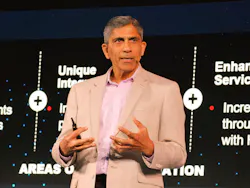
However, the event’s significance extends beyond product development. Honeywell Chairman and CEO Vimal Kapur (pictured) said the event represents a critical feedback mechanism as the company navigates one of the most consequential transformations in its history.
Kapur took the stage to explain why Honeywell embarked on its strategic transformation into three focused, independent, publicly traded companies shortly after he assumed the CEO role three years ago.
"We had a major decision to make," Kapur said. "What will our next 50 to 100 years look like? Can Honeywell continue to run as a company which serves multiple sectors, or should we become a more focused automation company?"
The answer, he added, crystallized at the end of 2022 when AI became conversational and publicly visible at scale. For Kapur, that inflection point made it impossible to ignore the road ahead for industrial automation.
"It was very clear to us that automation will get redefined in the next five to 10 years based on the capability which these learning systems are offering," he said. "It is more likely that we can benefit from that as a focused company versus remaining a complex, diversified one. So that really started our journey."
Honeywell successfully separated its chemicals business, Solstice Advanced Materials, in October 2025. Its Aerospace division—headquartered in Phoenix and one of the company's largest business units—is set to separate on June 29th as a standalone entity called Honeywell Aerospace. What remains will become Honeywell Technologies, a pure-play automation company serving three markets—process industries, buildings and discrete manufacturing.
Speaking to Honeywell Technologies’ focus on automation, “You can expect us to invest more here, pay more attention and work more deeply in this domain," said Kapur.
AI demands a focused approach
The separation was not just a financial or organizational decision. It was, Kapur said, a necessary precondition for competing seriously in the AI era of automation. A sprawling conglomerate, he suggested, would struggle to move with the speed and depth of domain knowledge that the next decade of industrial AI demands.
That depth of domain knowledge is central to how Honeywell differentiates itself. Masso pointed to the company's integration of process technology expertise directly into its control systems and automation software—for example, through targeted, complementary acquisitions such as Sundyne and Compressor Controls Corp.
Kapur said that unlike many technology providers, Honeywell engages with customers from the earliest stages of asset planning through decades of operational life. "Any asset you build will typically survive 30, 40, maybe even 50 years," he noted. “Our solutions have to continue to grow for the next decades to support that asset."
Underpinning this lifecycle approach is Honeywell Forge, the company’s hardware agnostic, open-architecture platform that serves as the ‘intelligence-layer’ across its customers’ operations. It connects the assets you already own, unifies and unlocks the data they’ve been generating for years, and puts that intelligence to work. Kapur was direct about why a proprietary platform was necessary rather than simply relying on public cloud providers. "Public clouds are not designed for industrial environments," he said. "They are not trained for it. They don't have appreciation of the limitations we have on the data, protecting the data, and the proper readiness of the data."
From automation to autonomy
The broader vision of the company focuses on autonomous operations—often cited in the industry as a next step in the journey from AI-assisted augmentation to systems capable of running complex industrial facilities with increasing levels of autonomy. Kapur stressed that while these systems will automate tasks and provide greater operational intelligence, human oversight, expertise and decision-making will remain essential, particularly in refineries, chemical plants and other safety and mission critical environments.
"We are progressing towards this journey from automation to augmentation and in the future, towards autonomy—but it cannot happen without your support," he urged the partners in the audience.
The partnerships between Honeywell and the operators, engineers and companies in the room will be vital to connecting 50 years of the Honeywell User Group to whatever comes next. Both executives made it clear that this year’s conference was not merely ceremonial, as Honeywell intends to use future iterations to help co-create the future of industrial automation.
About the Author
 Len Vermillion