From predictive maintenance to autonomous ops: The future of reliability
Produced with support from Honeywell Technologies
This show takeover was sponsored by our 2026 Honeywell Users Group coverage partner, Honeywell Technologies. See more coverage on our 2026 Honeywell Users Group page.
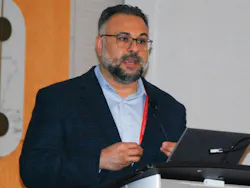
For decades, industrial reliability programs have evolved from run-to-failure approaches to preventive maintenance and, more recently, predictive analytics. According to Omar Sayeed, digital reliability leader at Honeywell, the next stage of that evolution will be defined by AI, agent-based workflows and increasing levels of automation.
Speaking at the 2026 Honeywell User Group conference in Phoenix, Sayeed outlined how manufacturers can progress toward autonomous asset optimization by strengthening data foundations, deploying predictive technologies and redesigning maintenance workflows. "It's very clear. To drive more autonomy in asset optimization, we're going to have to leverage more technology and leverage it differently," Sayeed said.
Asset reliability has become a strategic focus area for Honeywell, Sayeed said, with recent acquisitions in the last few years of turbo machinery equipment manufacturer Sundyne and Compressor Controls Corporation, which provides machinery train optimization services for oil and gas. "We're really excited about this journey," he said. “We are well known in process and automation and control, and assets are really the next most logical place for us to look, so it’s a very high priority within our business.”
The acquisitions build upon Honeywell's existing asset performance management (APM) platform and expand its expertise in equipment and reliability services, but the long-term goal is to extend beyond asset monitoring.
"This presentation is really to talk about where we're headed,” Sayeed said, namely how AI is impacting the way customers are taking care of their assets.
Understanding the asset management maturity model
Central to Honeywell's approach is an asset management maturity model that describes how organizations evolve in their reliability practices. Sayeed explained that the model is driven by increasing levels of data quality and automation.
Increasing data sophistication can involve deploying Industrial Internet of Things (IIoT) technologies, self-calibrating smart sensors, and intelligent analyzers capable of self-diagnosis, progressively shifting decision-making and actions away from manual intervention.
Historically, many facilities operated using a run-to-failure philosophy. More advanced organizations have moved toward preventive maintenance strategies based on calendar intervals or operating hours. Critical assets then become candidates for condition monitoring systems capable of identifying emerging issues.
Over the past several years, Sayeed said, predictive technologies have pushed industry maintenance further. “Predictive tools can give you warnings earlier than what you might get from a condition monitoring system and help you move from a reactive to more proactive maintenance strategy," he added.
And lastly, the next stages of asset management maturity involve autonomy.
Defining autonomous asset optimization and its barriers to adoption
Sayeed described autonomous asset optimization as the integration of multiple technologies designed to reduce human intervention while still improving asset performance. "Autonomous asset optimization involves using real-time asset data, physics-based models, machine learning models, AI, AI agents, and automation workflows to optimize the performance and lifecycle of industrial assets and minimize human intervention," he said.
Achieving asset autonomy requires several foundational elements. "It requires really robust data collection. It requires good analysis and prediction. Aid in decision-making requires some ability to take an action, ideally autonomously, or make recommendations to the human in the loop," Sayeed said. The important infrastructure and components needed include sensors, the automation and control network, and analytics platforms.
Some examples of industrial autonomy, Sayeed said, might be self-calibrating sensors, self-calibrating analyzers, or automatic load sharing between compressors to improve fuel efficiency and energy.
Despite the potential benefits, Sayeed identified several obstacles standing in the way of some organizations advancing toward autonomous operation. "The first is the resources that it takes to sustain these kinds of programs," he said. "Developing a model and deploying it is hard. Sustaining that model over time takes resources and expertise," Sayeed said.
Disconnected maintenance workflows present another challenge. "You can have many benefits from a predictive maintenance system or condition monitoring system to do proactive warning, but if we haven't connected the insight that's coming out of that application to the action that needs to happen in the field, then we lose that particular benefit," he explained. Without optimizing the ongoing maintenance plan, maintenance effort and costs will remain the same.
The final barrier involves operational trade-offs between equipment maintenance and production. "Being able to quickly weigh those trade-offs between reliability and performance is something that we think is a very, very important characteristic for autonomous operation," Sayeed said.
The six autonomous workflows
Honeywell has identified six workflows that underpin effective autonomous asset optimization. The first is asset surveillance, focused on triaging increasing volumes of alerts generated by predictive systems. "When you try to move to be more proactive, you naturally get a lot more alerts," Sayeed said. Those alerts need investigation and prioritization.
The second workflow is root cause analysis. "In an autonomous workflow, we would allow the agent to actually perform a 5-Why or a fishbone and present the evidence to a human being, rather than a human being have to go and fetch all of the information," he said.
The third workflow involves actionable insights through prescriptive recommendations. "Having prescriptive models that can isolate a particular failure once it's identified and provide recommended actions" helps organizations respond more effectively, Sayeed said.
The fourth workflow focuses on optimizing maintenance strategy by incorporating dynamic risk information into reliability planning. "If we want to actually reduce our maintenance costs in the long run, what would be helpful would be to update our maintenance strategies with insight that's coming from dynamic risk. So, evaluating risk that’s coming based on our sensing and our analytic models," he said.
The fifth area involves improving asset operation by evaluating the production and reliability trade-offs. “Being able to make the trade-offs between the reliability of the asset and the process requirement, and evaluate that quickly to make decisions, is really important as far as extending the asset operation,” Sayeed said.
The sixth supports field workers by ensuring technicians have the information they need at the point of execution, “making sure that the workers have the right instructions at the right time when they need to go and carry out maintenance," Sayeed said.
Building the foundation for autonomy
For organizations beginning this journey, Sayeed stressed that success starts with fundamentals. "The first step is to have a foundation in place," he said. That foundation includes identifying critical assets, strengthening data infrastructure, and deploying predictive models against the different asset classes. "Establish a robust data foundation," he added.
Organizations must also establish standardized work processes and adapt their operating models to support increasingly remote reliability functions while remaining centralized across the enterprise. “It's really important to consistently gather this information in a centralized manner,” Sayeed said.
The progression then moves from predicting failures toward prescribing actions, “basically transitioning from ‘when it's going to break’ to ‘what should I do about it’," Sayeed said.
Risk-based prioritization remains key in determining the response window to issues and orchestration between departments. Eventually, AI agents, Sayeed said, may coordinate activities across surveillance work groups, subject matter experts or maintenance personnel.
"The last one is the North Star: implementing autonomous action," Sayeed said, describing a future in which systems can make reliability-informed control decisions with minimal human involvement.
For process manufacturers struggling with labor shortages, increasing asset complexity, and growing reliability expectations, the path to autonomous operations begins not with replacing people, but with equipping them through better data, stronger maintenance workflows, and AI-enabled decision support.