Packaged equipment pitfalls: What instrument engineers must demand before the 2 a.m. breakdown
Key Highlights
- Instruments on packaged equipment must be documented as fully as instruments anywhere else on the site. Doing this takes the support of everyone on the project team.
- Reliable signals must be sent to plant automaton system.
- PID control and interlocks must be done in the plant automaton system.
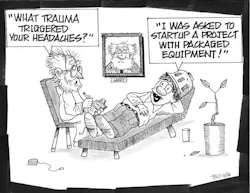
Greg: Both Lucinda and I have experienced many challenges with packaged equipment. Often key people from the project team and plant are not involved in the design of the packaged equipment. The supplier may be clueless as to the impact of the packaged equipment instrumentation and be more focused on reducing cost for a win in the bidding process. To help provide us with critical warnings, we are fortunate to have Lucinda Weaver provide us with key extensive knowledge she has learned in the process industry. Lucinda has worked on capital projects for over 45 years. She started as a programmer doing batch control on the Fisher DC2 and in the last 10 years of her career she has been a project technical lead supporting instruments, controls and everything else with a wire attached to it. Projects have been mostly pharmaceutical all over the US, Maritime Canada and some in Ireland. Retirement came at the end of 2025. Lucinda is a proud Oregon State Chemical Engineer.
What exactly is packaged equipment?
Lucinda: I always shutter in horror with the words packaged equipment because it is so poorly defined. My best way to describe this goes back to the old cartoon most of us saw at one point or another. A geeky old professor is standing at the chalkboard, the left side covered with lines, arrows and equations going to a box that says, “then a miracle occurs” and out of the right side of the box comes an arrow that says product. Sadly, I have seen P&IDs that don’t look much better, a few process lines come and go to a box that says vendor provides X.
So, my first warning is if your organization controls the process in that box, build it yourself. I’ve been on many projects that used off-site built skid process that was supposed to save us time and money. It did neither. On the other hand, some things that others own the technology on, I don’t want to put together from scratch. Having built and automated more than one boiler system from the pieces, I will tell you I love packaged boilers. The same goes for many finished goods and clean room pieces—parts washers, lyophilizers, autoclaves and the list can go on.
Me not wanting to build these from scratch, however, does not get me off the hook from getting all the information that the instrument mechanic needs for that 2 a.m. breakdown that will happen.
Greg: So, where do you start?
Lucinda: With the functional specification that goes out for quotation. Make it clear that you need all instrument specifications, the instrument index for all instruments and all instrument drawings electronically. If this is truly packaged equipment you won’t get to specify much on the instruments up front. If your vendor is nice, they might put the data into a project copy of your database, but if it is truly a standard package equipment, you won’t get that. At least you will have specs you can put into your system hopefully without retyping everything. I like using Excel as the media, because while it is not necessarily an easy load into my database, I can break it down to make most of the load go quickly with little re-entry of data.
After the specification has been quoted, make sure when the contract is put together by purchasing that you check to make sure your requests are included. Silly things like instrument issues are often deleted by buyers and project managers because they add to much to the price of the equipment. Try having even an intern take manual sheets, or worse climb all over the equipment to create instrument sheets and put that into the database entirely by hand for less money. College is expensive and we are not one of the professions that students expect the word intern to mean you don’t get paid.
Greg: The equipment is built, what comes next?
Lucinda: There is normally a factory acceptance test (FAT) in the contract before the equipment ships. That is a very detailed product check that reviews everything from weld maps to dimensions for connections and yes, the instruments and controls. Double check every instrument with the specification provided and make FAT deviation notes where there is any deviation. Spec sheets and the index should be updated by the supplier before the equipment ships.
Get your subscription to Control's tri-weekly newsletter.
Greg: Where does all this end?
Lucinda: It ends when you have received the final specs and index electronically and take the time to merge those fields into the instrument index and specifications. Some sites don’t merge these in but put these into the file marked vendor and give them a file number. At a minimum if you do that, the file numbers should be marked for each instrument in your master instrument database so looking up a tag there will eventually get you to correct place to find the data, but that does take time when the equipment is down. I have worked on sites where there were as many as 15,000 drawings for a single building (and that site had only had eight buildings) in the vendor files, with specs and databases adding to the chaos. I don’t want to be the mechanic that has to dig through that at 2 a.m.
Worth noting is that project managers who don’t want to pay the cost of getting this data put into the system usually don’t want to pay the cost to get vendor documents properly organized and titled so they are searchable among those 15,000 or so drawings. No instrument mechanic ever remembers the name of the PM who made these decisions, but they sure remember the name of the instrument engineer who allowed it to happen.
Greg: I have personally experienced pressure and temperature gauges and switches used. You need transmitters to send direct signals for intelligent use and monitoring in plant automation systems. I have also seen control valves used meant for labs with fragile stems and no positioners. Ideally, the packaged equipment should use the same instrumentation used in the plant and that impulse lines be avoided. Since straight runs are often not sufficient for flow measurements, magnetic flow meters and Coriolis flow meters would be the best choice even if it meant an increased cost. It is critical that the signals be employed by plant control systems and safety instrumented systems. You do not want controllers or interlocks on the packaged equipment. You also need an instrument index and instrument specifications along with installation details to review. Hopefully, you are involved in the decision-making process regarding what packaged equipment supplier to use. You should also be able to do factory acceptance testing well before equipment is needed in the plant so there is time to fix inadequacies.
For more guidance on how to avoid packaged equipment problems see the March 2020 Control Talk Column “8 rules to avoid skidding accidents”.
Top 10 things you don’t want to hear from a packaged equipment supplier
10. I challenge you to find cheaper packaged equipment.
9. We saved a lot of time, money and energy by using pressure gauges instead of pressure transmitters.
8. We avoided the impulse not to use impulse lines.
7. On-off control is so much simpler and easier to understand.
6. What is PID control?
5. We don’t need instrumentation specifications.
4. We are using the same instruments we have done for last 50 years.
3. Our control valves have been extensively used in research labs.
2. What is a positioner?
1. To make the package more compact, we reduced the straight runs for pitot tube flow sensors.
About the Author
 Greg McMillan
Columnist
Greg McMillan retired as a senior fellow at Solutia Inc., now a subsidiary of Eastman Chemical, in 2002. He was an adjunct professor in Washington University Saint Louis’ Chemical Engineering Department 2002-04, and retired as a principal senior software developer at Emerson Automation Solutions in 2024.


 Leaders Logo
Leaders relevant to this article: