Key Highlights
- Micro-credentials, typically 40-hour modules, combine theory and hands-on testing, and can count toward degrees, offering standardized skills development across regions and organizations.
- New digital skills, such as IIoT, data protocols and API integration, are essential for modern plant-floor personnel.
- Employers are encouraged to establish formal career pathways and partner with educational institutions to attract talent and facilitate continuous workforce development.
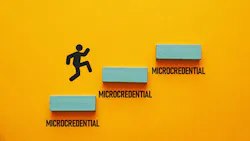
Because digitalized technologies are advancing even faster than experienced employees are retiring, many companies can’t wait for their remaining employees to earn additional degrees to gain the skills they need.
“The brain-drain and related workforce trends are a challenge—manufacturing is losing tremendous amounts of experience and needs to bring in new people quicker than ever,” says Conrad Leiva, VP for ecosystem and workforce development at the Collaborative Ecosystems for Smart Manufacturing Innovation Institute (CESMII). “They need education tracks, added skills and career-growth pathways to higher-paying jobs, so we’re expanding our micro-credentialing support, which is adapting and growing to meet changing needs. Industry is recognizing that we need national standards for micro-credentials, so participants and organizations can avoid zip-code certifications that only apply to limited areas.”
These micro-credentials are based training modules that average 40 hours of content and are provided through many training organizations and colleges in conjunction with the Smart Automation Certification Alliance (SACA). They include theory, instruction and hands-on competency testing, which can be earned and accumulated to achieve competency for different career pathways. They can provide flexibility, with training that starts with career and technical education (CTE), continues to apprenticeships, and can even fulfill up to half of the requirements for some two- to four-year degree programs.
“Micro-credentialing modules are offered by community colleges, trade schools, and/or in cooperation with employers as part of more formalized pathways, when they need to upscale new hires or existing staff,” explains Leiva. “For example, a manufacturing association in Ohio partners with local employers on what skills they need their technicians to develop. The goal is to have around 80% of training be generalized and have 20% that’s custom to the employer. We’re not there yet, but that’s the goal.”
Adding IT-type capabilities
Where it used to be enough for plant-floor personnel to configure, monitor and manage their PLCs, HMI/SCADA systems and DCSs, they now need to also work with Industrial Internet of Things (IIOT) sensors, edge devices, and cloud software.
“Technologists and engineers need to know how to integrate the IT side using data protocols like OPC UA and MQTT and bring data to shared data platforms like a unified namespace (UNS),” adds Leiva. “We need to turn technicians into technologists, and automation engineers into OT-IT integration specialists, who can leverage data to develop apps, using IIoT, low-code and agentic AI platforms. For example, platforms like Inductive Automation’s Ignition and Rockwell Automation’s FactoryTalk Optics are combining HMI, SCADA, IIoT and low-code capabilities.
“It seems like most applications are becoming role-based apps that can support the jobs that each user needs. These apps are moving beyond the enterprise and warehouse, and onto plant-floor work cells, adding predictive and AI functions that are allowing users to work along with digital-twin capabilities, too. This enables automation engineers to take on more information-based roles that used to be mostly on the IT side and give them expanded responsibilities that add more value to the company.”
Get your subscription to Control's tri-weekly newsletter.
Career investment attracts talent
Just as they seek to continuously improve process operations, Leiva reports that engineering candidates must also adopt a self-improvement mindset, visualize their careers as a continuous learning journey, and seek employers that embrace their workforce by investing in them, making training available and providing them flexibility and encouragement.
“Employers should establish formal career pathways as a tool to attract new talent, provide more options and flexibility for their employees, and develop closer partnerships with regional colleges and other workforce organizations,” says Leiva. “CESMII can help employers set up career pathways, which detail the skills they’re seeking for different roles. This shows candidates starting in one job the skills they can acquire for other jobs. We work with regional educators and show them how to align with career pathways, competency frameworks, ecosystem resources, and the national micro-credentialing network.”
Newer, digital skills are also needed beyond those required of engineers and technologists. Leiva adds they’re also needed for entry-level positions and many positions at all levels. Fortunately, he adds, there’s on-the-job assistance and guidance technologies that can help workers perform many tasks.
“These are exciting times for manufacturing careers. Workers can be assisted by smart platforms, apps and interfaces, which provide real-time data and guidance to help users make better decisions,” explains Leiva. “Newer skills for engineers and technologists include object-oriented programming, knowledge graphs, AI agents and open, standardized, plug-and-play, application program interface (API) functions. For instance, one of CESMII’s latest initiatives is its Industrial Information Interoperability Exchange, which is an open API that enables standardized connections, uses information models to publish equipment data, and allows apps to find and easily connect with that data.”
Models streamline plant-floor data flows
As digital twins, digital threads and open APIs continue bringing virtual and physical systems together, Leiva reports this merger will give automation engineers a clearer path to using real-time, plant-floor data, with some functions occurring at the edge, while others occur on cloud computing-service services.
“Digital threads connect product lifecycles from design to production and maintenance,” adds Leiva. “This lets data flow more easily, without so many traditional, manual translation and read-and-rewrite processes. This streamlining is needed for engineering designs and specifications, geometric dimensioning and tolerancing data, 3D CAD, CAM, CNC programs and inspection sheets, as well as many reconciliations that make sure products meet design intent, and comply with service-life maintenance requirements. None of these tasks are seamless, but a digital thread can make their data flow more automatically. It can also get users closer to the cradle-to-grave documentation users want for their equipment and operations by using automation to merge digital and physical information. This also means new knowledge and roles for engineers who can successfully bring them together.”
This is the eleventh installment of Control's August workforce cover story. Read the other installments here.
About the Author
 Jim Montague
 Leaders Logo
Leaders relevant to this article: