Easier information extraction and coordination
Key Highlights
- Operators can now easily extract, overlay and analyze data, enabling quicker identification of process issues and more effective responses.
- The system supports KPI-based alerts and imbalance detection.
- Most analytics are maintained on-premises to ensure in-depth data analysis, with cloud tools primarily used for visualization and dashboards.
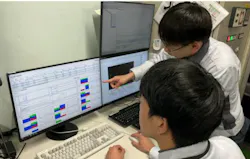
Maintaining accuracy and quality isn’t easy in any process industry, but it can be even more crucial and challenging in ink manufacturing. For instance, DIC Corp. in Tokyo is one of the world’s largest manufacturers of printing inks, organic pigments and polyphenylene sulfide (PPS) compounds, and its Sakai plant in Osaka prefecture is devoted to data analysis to ensure product stability. Its acrylic resin process employs 11 reactors that run more than 200 recipes with production times ranging from 12 to 48 hours per batch, including new, high-performance products that are often more labor-intensive despite sometimes limited staff.
The reactors and other equipment at the Sakai plants are managed by Yokogawa’s Centum VP distributed control system (DCS), but production conditions vary constantly due to changes in materials, machinery, manpower and methods (4M). DIC personnel monitor, gather and evaluate reaction and batch data, but assessments are typically difficult, and vary due to each operator’s assessment criteria. Following each reaction, Sakai’s personnel review its data to confirm conditions. Previously, they had to manipulate more than a dozen tags in an Excel file to arrange data in chronological order, overlay multiple graphs, extract historical trends, identify problems, and assign responses.
To alleviate these time-consuming issues, DIC worked with Yokogawa in 2022-23 to co-develop develop a data utilization platform (DUP) to make it easier to gather information needed to evaluate quality issues. They began by following up on Yokogawa’s Digital Plant Operation Intelligence (DPI) quality stabilization program implemented earlier, and sought to jointly develop software to streamline analysis preparations (Figure 1). They planned to achieve this goal by integrating SAP product and quality data with information from Centum VP, storing it in Yokogawa’s Exaquantum plant information management system, and possibly use Yokogawa’s Exapilot operation efficiency improvement software as a user interface. Exaquantum was demonstrated and tested, and adopted as the DUP at the Sakai facility (Figure 2).
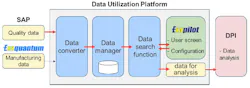
DIC reports that users can easily extract desired data from DUP by making selections in the interface, exporting them from the platform, and registering them with the DPI quality stabilization system and Yokogawa’s Process Data Analytics (PDA). Following analysis, operations can be managed using its Actionable Decision Support System (ADSS) that detects imbalances among multiple process data points, expresses them as KPIs, and alerts operators.
Get your subscription to Control's tri-weekly newsletter.
In fact, compiling information and overlaying graphs used to take DIC staffers an hour or longer, but now requires as little as 30 minutes. DUP is also easy to customize and configure onsite. Sakai’s operators add that DUP dramatically reduced preparation time for analyses, which enables them to focus on analyses themselves. For instance, they can now spend more time reviewing data, examine what’s happening in a production process, exchange idea with each other to pinpoint problems, and take on newer, higher-level, value-added tasks.
“We trace the evolution of data analytics functions to enable evaluations that link the 4Ms of manufacturing with productivity, quality, cost, delivery and safety (PQCDS), and especially focus on quality,” says Yasunori Okazaki, product and service planning leader for plant asset management at Yokogawa. “By establishing new infrastructures for data collection and storage, it’s becoming possible to gather 4M-related information more completely, and conduct more sophisticated analyses that reflect manufacturing conditions with greater accuracy.”
While some manufacturing-related analytics are beginning to move to the cloud, Okazaki reports that most are staying in on-premises systems at production sites. Consequently, analytics running in cloud environments are used mostly for data visualization such as dashboards, while on-premise solutions remain the dominant choice for in-depth data analysis. Okazaki adds that DPI and the follow-up program with Exaquantum that Yokogawa deployed with DIC at the Sakai facility is an example of a more comprehensive solution that goes beyond implementing data analytics software.
“This larger solution includes hypothesis-testing workshops designed to maximize the software's utility among frontline manufacturing staff and relevant departments. It also enables end-to-end delivery of data infrastructures and decision-support systems, such as defining requirements, formulating specifications, and implementing solutions,” explains Okazaki. “In addition, I believe the rise of generative AI will simplify the data analytics for users. However, determining how to combine it with 4Ms data, and interpreting the results, will still require human intentions and judgment. The fact that manufacturing know-how influences the quality of data analysis results won’t change.”
This is part three of Control's October 2026 data analytics feature. Read all installments here.
About the Author
 Jim Montague
 Leaders Logo
Leaders relevant to this article: