Ethernet gateway shrinks relay wiring
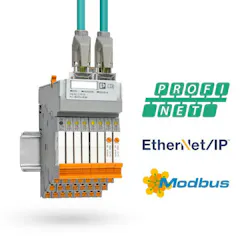
The PLC-Interface Ethernet Gateway from Phoenix Contact combines relays and communication in one modular system. The gateway plugs into a bank of relays and can then be connected to a PLC with a single Ethernet cable, enabling faster and cleaner integration, while saving space and reducing wiring.
The remote relay system supports simple applications with up to 56 I/O channels, including digital and analog inputs and outputs. The individual channels can be configured specifically to the application's needs for a high level of flexibility. The PLC-Interface Ethernet Gateway supports a range of protocols, approvals, and certifications, including EtherNet/IP, Profinet Class C, and Modbus/TCP, along with S2 redundancy to ensure reliable performance across industrial networks. The gateway is compatible with common controller software for intuitive network integration.
Firmware updates ensure the continuous extension of functions and optimum performance. Because the gateway is part of the PLC-Interface relay family, it is easy to integrate into existing systems. The ecosystem features a wide range of functions, from simple coupling relays to relay modules with integrated circuit breakers. The system's flexibility and compatibility support a future-proof automation strategy for simple applications.
The PLC-Interface Ethernet Gateway seamlessly complements the Axioline family. It is cost-effective for low-cost, small applications that only require a small number of I/O points and specialize for high-voltage and relay needs.
It is suitable for applications that demand 120 V inputs and a higher density of relay outputs, providing flexibility and reliability. It combines a bus coupler, I/O cards (analog and digital) and coupling relays into one compact unit, saving space. I/O can be configured on a channel-by-channel basis, including voltage potentials, at a lower per-channel cost than traditional I/O solutions.