Endress+Hauser expands instrumentation possibilities through technical innovation
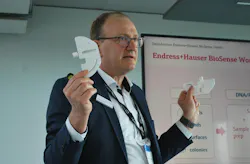
While Endress+Hauser continues to help solve an increasingly broad range of instrumentation applications, it's also investing heavily to develop technologies that address entirely new classes of sustainability, productivity and even medical challenges.
"It has been 70 years now since our founder, Georg Endress, filed his first patent," noted Peter Selders, CEO, Endress+Hauser, at the company's 2026 Global Forum, held the week of April 14 in Basel, Switzerland. "And we continue to drive innovation forward," he said, pointing to the €280 million (7% of revenue) invested in research and development in 2025. Similarly, the people working on new products are not included among the more than 1,300 employees who are solely engaged in research and development at our company, he said.
Indeed, more than 9,400 active patents and patent applications protect the company's intellectual property. "Our innovative spirit has gone into the 41 new products we have launched in the past year, which provide significant benefits to our customers," Selders said.
No calibration necessary
One such innovation on display at the Endress+Hauser Global Forum is the iTHERM TrustSense TM371/TM372, a temperature sensor that can self-calibrate without the need to shut down production and remove the sensor to a laboratory for calibration against a reference device. Instead, the iTHERM TrustSense makes use of the Curie effect, the shift in a metal's magnetic properties at a specific temperature.
The first such instrument required a temperature of 118 degrees Celsius for calibration verification; a relatively high temperature reached during steam sterilization of equipment used in food and beverage and life sciences applications. "Our new thermometer self-calibrates at 39 degrees Celsius," said Seders. "It works during low-temperature cleaning and applies to a much wider range of applications."
Advancing sustainable transformation
Another important aspect of Endress+Hauser's technical innovations is a fundamental rethinking of the company's current instrumentation portfolio to ensure that they advance overall sustainability, particularly in terms of Scope 3 emissions--while also delivering greater direct value to customers.
Hans Joachim Frölich is Endress+Hauser's director, technology & portfolio, and is leading the company's wide-ranging EcoDesign efforts. Consistent with their goal to be a Sustainability 2.0 "Resonator," whose instruments deliver both sustainability advances and customer value, the company "aims to achieve emission reductions while staying competitive and growing," Frölich said.
Indeed, more and more customers are asking Endress+Hauser for EcoVadis and Carbon Disclosure Project (CDP) ratings; Product Carbon Footprint information, and Science Based Targets Initiative (SBTi) commitments, Frölich said. "Reaching our SBTi near-term target requires 50% lower carbon dioxide emissions per unit on average by 2034, relative to 2024--yet few customers are willing to pay a premium."
Digital connectivity as enabler
A key technical innovation that is tied up in the improved customer value that instrumentation can provide is digital connectivity and the advanced solutions it enables.
"Digital connectivity is one piece on the way to sustainable transformation," explained Rolf Bickhofer, managing director, Endress+Hauser Digital Solutions. “Those who modernize their industrial infrastructure, automate and digitalize will also decarbonize, operate efficiently, and stay resilient.”
Digital twins are necessary and digital connectivity is the enabler to succeed on both environmental and operational fronts, Bickhofer said. "That means fewer resources consumed, lower emissions and greater circularity as well as higher reliability and productivity, less downtime and more transparency."
Better data means better decisions, and at Endress+Hauser products like Field Xpert and FieldCare already are help customers access and interpret device data across their installed base, while Heartbeat Technology provides built-in diagnostics and verification that give operators the confidence to decide--securely, transparently and without interrupting operations, Bickhofer said.
From fieldbus to networks
The medium of choice for today's process instrumentation and control systems is also at a tipping point, moving away from relatively slow analog/digital hybrids and high-effort fieldbus set-ups toward open, high speed, Ethernet based architectures. Endress+Hauser is among those instrumentation suppliers leading the charge to adopt Ethernet-APL, a relatively new standard that brings a unified Ethernet network all the way to field devices. Especially in the process industries, Ethernet-APL is a breakthrough that has been gathering critical mass among suppliers.
Broadly speaking, Ethernet-APL provides:
- Seamless, high-speed communication from field instruments into IT and cloud systems.
- Higher data availability and bandwidth, enabling advanced monitoring and diagnostics, energy management and predictive capabilities.
- Better data, yielding better decisions, leading to reduced energy use, waste, downtime and emissions.
- Power and signal on the same wires, which can reduce cabling costs and engineering time.
Endress+Hauser's longstanding commitment to open standards and multi-vendor collaboration helped shape the Ethernet-APL standard from the beginning, including leadership on the APL task force.
Representing the end-user perspective on Ethernet-APL's advantages, Gerd Niedermeyer, electrical & instrumentation engineering manager, BASF, shared the company's experience as an early proponent and implementer of the technology. "It provides minimal complexity and maximum cost-effectiveness," he said. "Ethernet-APL also offers the potential to standardize the architecture of non-safety and safety, with the use of the same field devices."
The unified architecture from field to cloud also lays the groundwork necessary for coming developments in AI. "Agentic AI will introduce new dimensions and options," added Laurent Mulley, chief sales officer, Endress+Hauser. "Process automation will evolve from being efficiency-driven to being intelligence-driven," he said. "Value creation is the common vision, provided through expertise and process know-how."
Instrumentation frontiers
While Endress+Hauser's acquisition last year of SICK's gas analysis business helped broaden the company's analytical capabilities, the company has also invested in a range of incubators, start-ups and institutional partnerships to advance entirely new analytical capabilities--many of which are anchored at the company's Freiburg Innovation Center, or FRIZ, in Freiburg, Germany.
The three-story building near the campus of University of Freiburg houses development labs for the company's Digital Solutions division, including labs focused on Industrial IoT, Sensor Automation Lab, and Optics Hub. Also located here are Endress+Hauser BioSense, iST Jobst, PatServe, and labs focused on gas, chemicals and biological analysis.
The Sensor Automation Lab provides research and development support across the Endress+Hauser organization, developing the company's knowledge base in cooperation with universities and research institutes. The Industrial IoT group focuses on developing the company's Netilion platform, adding health and analytics measures across the instrumentation lifecycle. The Lab's intentional focus is well beyond traditional instrumentation, for example, transferring sensor technologies from traditional stainless steel pharmaceutical processes into the new, single-use biotech world.
The Optics Hub is focused on pre-development and research in optical measurement technologies, such as Raman spectroscopy and tunable diode laser absorption spectroscopy (TDLAS).
From industrial processes to biological ones
The sensor technologies being developed and supported at FRIZ also cross the divide from purely industrial to biological and even medical applications. On the industrial side of the spectrum for Endress+Hauser BioSense are analytical devices that can quantify biological activity, for example in fermentation processes.
And while the analysis is not quite real time, "you have results within an hour," explained Dr. Nicholas Krohn, managing director. "You can readily monitor your water systems and mitigate any risks."
Other BioSense instruments rely on enzymes immobilized on the surface of an electrode and can provide live, real-time information about metabolic shifts, said Andreas Wiltin, head of sensor development. "It's a sensor the size of a sugar cube and promises to make cell therapy more efficient and affordable."
Endress+Hauser BioSense also codevelops instrumentation with other parties, working together to identify requirements, assess market potential and technical feasibility, and conduct rapid prototyping, iterative development and field trials with on-site training. "Example applications for co-development include quality control and hygiene monitoring in food and beverage, detection of harmful organisms in water/wastewater systems, and in life sciences, sterilization monitoring and testing of raw material for DNA traces," said Krohn.
Last but certainly not least in the line-up of FRIZ innovators is iST Jobst, a spin-off from the University of Freiburg and leading developer and manufacturer of biosensors since 2002, and part of the iST and Endress+Hauser groups since 2017. The company focuses on the design, development and fabrication of microsensor platforms used for intensive care monitoring, next-gen organ transport, plus cell and gene therapies for cancer.
"Biomedical applications benefit tremendously from online monitoring of metabolites," explained Dr. Andreas Weltin, group leader, Department of Microsystems Engineering, University of Freiburg. "Electrochemical biosensors provide a unique solution, featuring multiparametric analysis, excellent long-term stability," he added. "Microsensor technology is serving those in need: improving outcomes, cutting costs, saving lives."
About the Author
 Keith Larson
Keith Larson
Group Publisher
Keith Larson is group publisher responsible for Endeavor Business Media's Industrial Processing group, including Automation World, Chemical Processing, Control, Control Design, Food Processing, Pharma Manufacturing, Plastics Machinery & Manufacturing, Processing and The Journal.