Tapping the potential of greywater
Produced with support from Yokogawa
This show takeover was sponsored by our YNOW2026 coverage partner, Yokogawa. See more coverage on our YNOW2026 page.
We’ve got to get smarter about our use of water.
That sentiment is central to the most common current discussions in the industrial space, particularly with the rise of data centers, which are famously thirsty.
A key tool in a more sustainable approach to H2O is optimizing efforts with greywater…in particular, how we can wisely reuse wastewater from homes (think sink, bath and laundry water). Traditionally, we’ve reused this water for non-potable purposes like irrigation and toilet flushing. But emerging tools are expanding our access to and potential uses for greywater, and emerging practices are making those tactics viable.
And there’s good news!
“We have an abundant greywater supply,” explained Dr. Sidan Lu, Postdoctoral Associate at Rice University, where she has a long history of developing advanced membrane-electrochemical systems for wastewater treatment and resource recovery.
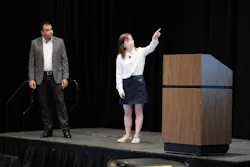
Lu and co-presenter Dr. Amro Hassanein, Bioenergy and Biosolids Technology Strategist at Yokogawa Corporation of America, explained on Day Two of YNOW2026 how Rice University and Yokogawa are developing an autonomous modular treatment system to improve decentralized greywater reuse, exploring the integration of advanced treatment technologies, automated controls, and real-time monitoring to support sustainable water management.
Greywater is a promising water source, Hassanein explained, as it is a more reliable supply; since it comes from laundry systems, showers, dishwashers and other sources, you don’t have to wait for Mother Nature to deliver it.
Various tactics for greywater processing were spotlighted during Hassanein and Lu’s session, including a foam-fractionator approach (one of the most energy-efficient physical-chemical methods for treating water) and electrochemical chlorination (for more advanced disinfection).
The presenters detailed their greywater reuse system-design principles including:
- A small, modular scale (in comparison to traditional centralized water systems where one large hub serves a wide community)
- Minimal chemicals required to prep greywater for use
- Minimum energy consumption
- A design for resilience and environmental fluctuations
- Meets the ISO 30500 standard
They anchored their presentation to that greywater program currently underway at Rice University. Program stakeholders are studying treatment mechanisms and greywater matrices, conducting failure-mode experiments and water-quality interpretations. Yokogawa industrial-grade sensing tools are in use, while program participants rely on Yokogawa measurement disciplines and the corporation’s reliability perspective to guide decisions.
The goal of the project is to design and validate an AI-ready, autonomous greywater-reuse platform that can operate safely under variable campus conditions with reduced operator intervention.
And once the approach is proven, it can graduate; go off campus and expand to regions around the globe that are not properly served by traditional, centralized water-distribution networks. “We can move from theoretical practices to real-world effectiveness,” beamed Hassanein, who spotlighted specific smart technologies that are empowering their efforts. “What is unique about Yokogawa sensors is that they can be bolted, and these connections enable us to understand full systems.”
Hassanein added that once you fully understand the data within a system (or ecosystem, since we’re talking about natural resources), you can develop machine-learning models that can drive smarter decisions. In short, reliable autonomy.
The presenting pair detailed three layers of autonomy in use with their program:
- Real-time state awareness—the system continuously monitors tank levels, flow, pH, conductivity, turbidity, dissolved oxygen, temperature, pressure, chlorine residuals and equipment state.
- Dynamic control actions—sensor inputs determine whether to enable upstream transfer, run foam-fractionation bypass electrodialysis, hold water or trigger recirculation.
- Fail-safe protection—if a critical sensor fails, a tank reaches a high level, a filter plugs, electrodialysis faults, chlorine exceeds limits, or final water quality is not acceptable, the system enters a safe state.
Having water-distribution networks that can be decentralized to work where there is the greatest need, and can work in an autonomous fashion without any human intervention, is critical, the presenters believe.
The most important aspect of this approach, said Lu, is the infrastructure resilience that results from this approach. Decentralized distribution does not replace the traditional, centralized approach, but rather complements it by adding robust reliability and an ability to withstand fluctuations with weather and system performance. As marginalized communities around the globe have been underserved by the centralized approach, stressed Lu, this new strategy is not just a water equalizer—it has an equity component, too.
Water scarcity isn’t a problem limited to just Africa or the Middle East. Here in the United States, we suffer water-main breaks every two minutes, according to Hassanein, resulting in people struggling to get by without clean water until those breaks are fixed. We can now with a decentralized approach reduce pressure—quite literally—on centralized H₂O-distribution systems, enabling both methods to optimally deliver water.
And during times of water-main breaks or emergency crisis or extreme weather, that—figuratively—reduces pressure on the people who desperately need their water.